Hello! Welcome to the fourth lesson in our "Mathematical Foundations: Linear Algebra" module.
In our last lesson, we mastered Gaussian elimination, a powerful algorithm for solving systems of linear equations. You learned to transform a system into an augmented matrix and use row operations to find a unique solution, or to determine if the system had no solution or infinitely many solutions.
We ended with a preview: a single number, the determinant, can tell us in advance if a matrix has a unique solution. Today, we'll dive deep into that concept. This lesson addresses the learning outcome: Compute the determinant and inverse of a square matrix. We'll discover how these two concepts are deeply connected and provide a new way to think about solving linear systems.
1. The Determinant of a Matrix
The determinant is a special scalar value that can be calculated from any square matrix. It encodes a surprising amount of information about the matrix. Its most immediate use, for us, is that it tells us whether a matrix is "invertible" — a concept we'll explore shortly. The notation for the determinant of a matrix is either or .
Determinant of a 2x2 Matrix
For a 2x2 matrix, the calculation is straightforward.
If we have a matrix , its determinant is given by the formula:
It's the product of the main diagonal elements minus the product of the off-diagonal elements.
Let's read a short text that formally defines the determinant and its properties.
6.4 - The Determinant of a Square Matrix
This resource from Richland College, 'The Determinant of a Square Matrix,' clearly defines the determinant, its notation, and the formula for a 2x2 matrix.
Read from the beginning down to the end of the section 'Properties of Determinants'. Focus on the notation, the 2x2 formula, and the crucial last property: an inverse exists only if the determinant is not zero.
Test your understanding!
Calculate the determinant of the matrix .
Show answer
Using the formula :
.
Determinant of a 3x3 Matrix: Cofactor Expansion
Calculating the determinant for larger matrices, like 3x3, requires a more general method called expansion by cofactors. This process breaks down the 3x3 determinant into several 2x2 determinants. It involves two key concepts:
- Minor: For any element in the matrix, its minor is the determinant of the 2x2 sub-matrix that remains after deleting the element's row and column.
- Cofactor: A cofactor is just a minor with a specific sign (+ or -) attached, based on its position in the matrix. The signs follow a "checkerboard" pattern:
To find the determinant, you pick any single row or column. Then, you multiply each element in that row/column by its cofactor and sum the results.
The same resource we just used explains this process step-by-step.
6.4 - The Determinant of a Square Matrix
Let's continue with the Richland College article. It provides a clear, detailed guide to calculating a 3x3 determinant using minors and cofactors.
Read the sections 'Expansion using Minors and Cofactors' and 'Expanding to Find the Determinant'. Follow the example closely to see how the determinant is calculated by expanding along the first row.
2. The Inverse of a Matrix
Now that we understand the determinant, let's move on to the inverse. The inverse of a square matrix , denoted , is a matrix that, when multiplied by , yields the identity matrix .
This is analogous to how, for a number , its reciprocal gives . The identity matrix is the matrix equivalent of the number 1.
A crucial fact is that a matrix only has an inverse if its determinant is non-zero. A matrix with a zero determinant is called a singular matrix and has no inverse.
The following video provides an excellent introduction to the concept of an inverse, how to find it for a 2x2 matrix, and why it's useful.
Inverse Matrices and Their Properties
This video from Professor Dave Explains will give you a solid conceptual grounding on matrix inverses.
Watch from the beginning until 07:01. Pay attention to: The definition of an inverse and its relationship to the identity matrix (00:00 - 01:35). The simple formula for the inverse of a 2x2 matrix (01:35 - 04:56). How the inverse can be used to solve a system of equations Ax=b (04:56 - 07:01).
This image provides a great visual summary of the 2x2 inverse process.
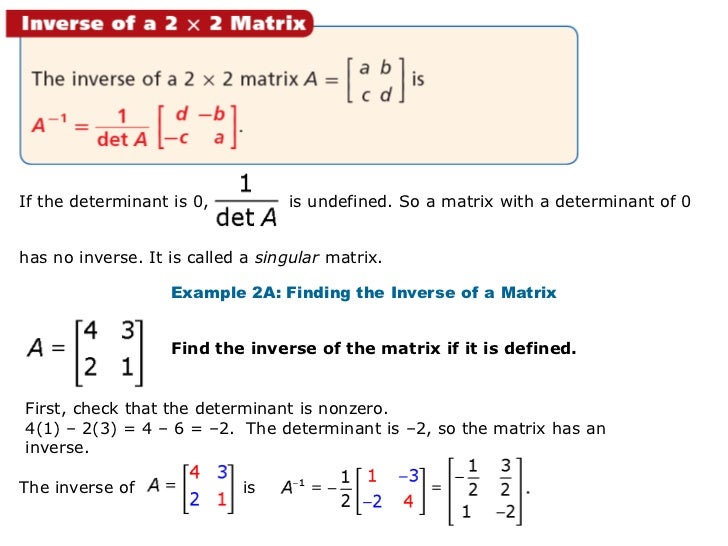
3. Finding the Inverse of a 3x3 Matrix: The Adjoint Method
As the video hinted, finding the inverse of a 3x3 matrix is more laborious. The standard manual method is the adjoint method, which builds directly on the concepts of minors and cofactors we used for the determinant.
Here is the four-step process:
- Matrix of Minors: For the original matrix , create a new matrix where each element is the corresponding minor.
- Matrix of Cofactors (): Apply the checkerboard sign pattern to the matrix of minors.
- Adjoint Matrix (): Find the transpose of the matrix of cofactors (). Transposing means swapping the rows and columns.
- Inverse (): The inverse is found using the final formula:
This formula makes it clear why the determinant cannot be zero—it would lead to division by zero!
The following resource provides a very clear and detailed walkthrough of this entire process with excellent examples.
Lesson Explainer: Inverse of a Matrix: The Adjoint Method
This explainer from Nagwa provides a thorough, step-by-step guide to finding a 3x3 inverse using the adjoint method. It defines each component and then puts them all together.
This is a detailed resource. Follow these sections in order: Start by reading 'Definition: Minors and Cofactors' and 'Definition: Cofactor Matrix' to refresh those concepts. Next, read 'Definition: Adjoint Matrices'. This is the new step: transposing the cofactor matrix. Then, read 'Formula: Inverse of a Matrix'. This is the final formula that brings everything together. Finally, study 'Example 4' from start to finish. It is a complete, worked-out problem that shows every step: calculating the determinant, finding all the minors and cofactors, forming the adjoint, and finally computing the inverse. This will solidify your understanding of the whole process.
Test your understanding!
You are given the matrix .
- Is this matrix singular or non-singular?
- Find its inverse, .
- Verify your answer by calculating . Does it equal the identity matrix?
Show answer
-
First, calculate the determinant: . Since the determinant is not zero, the matrix is non-singular.
-
Use the formula for the 2x2 inverse:
-
Verify the result:
The calculation is correct!
Conclusion
In this lesson, we demystified two of the most important concepts in matrix algebra: the determinant and the inverse. You now have a powerful set of tools to analyze square matrices.
Key Takeaways:
- The determinant is a scalar value calculated from a square matrix.
- The determinant of a 2x2 matrix is .
- The determinant of a 3x3 (or larger) matrix is found using cofactor expansion.
- A matrix has an inverse only if its determinant is non-zero. Such a matrix is called non-singular.
- The inverse of a 3x3 matrix is found using the adjoint method, with the formula .
- The inverse provides an alternative way to solve a system of linear equations: if , then .
In our next lesson, we will explore the rank of a matrix. You'll see how rank, like the determinant, gives us deep insight into the properties of a matrix and the nature of the solutions to a linear system, tying together what we've learned in the last two lessons.