Hello! Welcome to the third lesson in our module on Core Data Structures.
In the last lesson, we built a singly linked list from scratch. We saw how its node-based structure provided flexibility for dynamic resizing and offered insertion and deletion at the beginning of the list, a significant advantage over arrays in certain scenarios.
Today, we'll build upon that foundation to explore another fundamental data structure: the stack. The learning outcome for this lesson is to implement a stack and use it to solve a parenthesis-matching problem. We'll cover:
- The concept of a stack and its "Last-In, First-Out" (LIFO) behavior.
- The core stack operations:
push,pop,peek, andisEmpty. - How to implement a stack in Python using a list.
- How to apply a stack to solve the classic computer science problem of checking for balanced parentheses in an expression.
Let's get started!
1. What is a Stack?
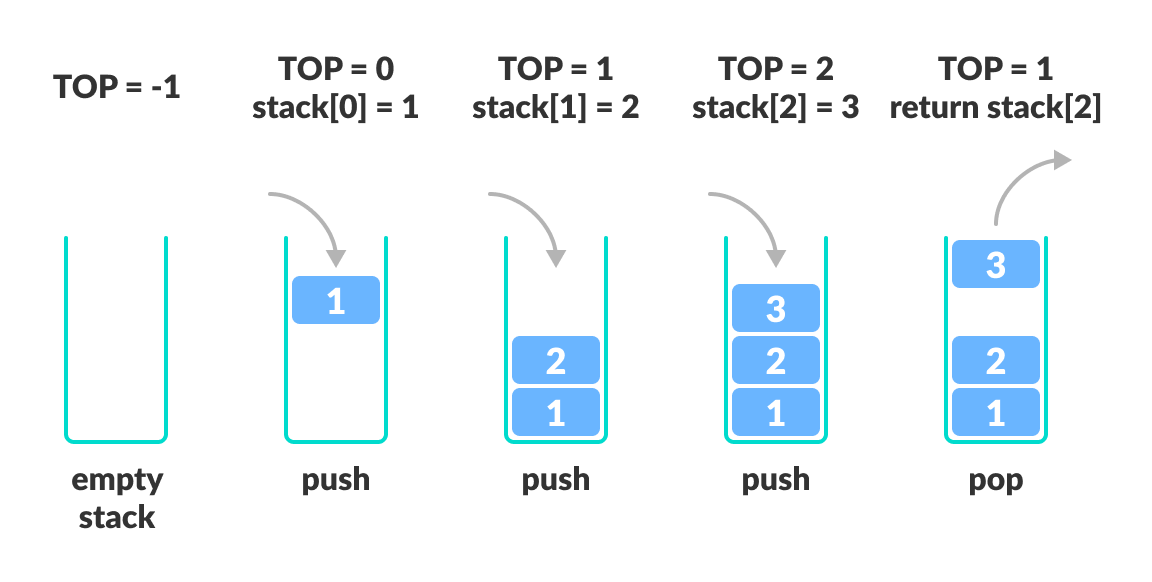
A stack is a linear data structure that is conceptually similar to a stack of plates or a pile of books. You can only add a new item to the top, and you can only remove an item from the top. This simple but powerful rule is known as LIFO: Last-In, First-Out. The last element you add is the first one you can take off.
Stack in Data Structures: Implementations in Java, Python, ...
To get a formal definition and some real-world analogies for the stack data structure, please read the introductory part of this article from ScholarHat.
Read the section titled 'What is a Stack in Data Structures?' and the 'Real-World Examples'. This will help you build a strong mental model of how a stack operates.
Core Stack Operations
There are four primary operations associated with a stack:
push(item): Adds an item to the top of the stack.pop(): Removes and returns the item from the top of thestack.peek()(ortop()): Returns the top item without removing it.isEmpty(): Checks if the stack is empty.
A crucial feature of a well-implemented stack is that all these operations have a time complexity of . They take a constant amount of time, regardless of how many items are in the stack.
2. Implementing a Stack in Python
You can implement a stack using various underlying data structures, including the linked list we built in the last lesson. However, the most straightforward way in Python is to use its built-in list. Python's list methods append() and pop() naturally provide the LIFO behavior we need.
Here is a simple class-based implementation of a stack using a Python list:
class Stack:
    def __init__(self):
        """Initializes an empty stack."""
        self.items = []

    def push(self, item):
        """Adds an item to the top of the stack. O(1)"""
        self.items.append(item)

    def pop(self):
        """Removes and returns the top item. Returns None if the stack is empty. O(1)"""
        if not self.isEmpty():
            return self.items.pop()
        return None

    def peek(self):
        """Returns the top item without removing it. Returns None if empty. O(1)"""
        if not self.isEmpty():
            return self.items[-1]
        return None

    def isEmpty(self):
        """Checks if the stack is empty. O(1)"""
        return len(self.items) == 0

    def size(self):
        """Returns the number of items in the stack."""
        return len(self.items)
Connection to Previous Lesson:
Notice how we could also build this using our SinglyLinkedList. The push operation would correspond to insert_at_beginning(), and pop would correspond to delete_from_beginning(). Since both of those linked list operations are , a linked list is also a very efficient way to implement a stack.
Test your understanding!
Imagine an empty stack. The following operations are performed in order:
push(10)push(20)peek()pop()push(30)pop()
What is the value of the top element of the stack after these operations are completed?
Show answer
Let's trace the state of the stack:
push(10)-> Stack:[10]push(20)-> Stack:[10, 20]peek()-> Returns20. Stack:[10, 20]pop()-> Returns20. Stack:[10]push(30)-> Stack:[10, 30]pop()-> Returns30. Stack:[10]
The value of the top element is 10.
3. Application: The Parenthesis Matching Problem
Now for the practical part. A classic use case for stacks is to check if an expression containing parentheses (), braces {}, and brackets [] is "balanced".
An expression is balanced if:
- Every opening symbol has a corresponding closing symbol.
- The pairs of symbols are of the same type (e.g.,
{is closed by}). - The nesting order is correct. For example,
([)]is not balanced because the(was opened before[, but]was closed before).
The key insight is that the most recently opened bracket must be the first one to be closed. This "last-in, first-out" requirement is a perfect fit for a stack.
Check for balanced parentheses using stack
This excellent video from mycodeschool explains the problem and intuitively develops the stack-based solution from the ground up.
Watch the video from the beginning up to 09:55. Focus on understanding: What 'balanced' means. Why simply counting bracket types is not enough. How the LIFO principle leads naturally to using a stack.
The Algorithm
As explained in the video, we can solve this with a simple algorithm:
- Initialize an empty stack.
- Iterate through each character of the expression string from left to right.
- If the character is an opening bracket (
(,{, or[), push it onto the stack. - If the character is a closing bracket (
),}, or]):
a. Check if the stack is empty. If it is, the expression is unbalanced because there's a closing bracket with no opener. ReturnFalse.
b. If the stack is not empty, pop the top element.
c. Compare the popped bracket with the current closing bracket. If they don't form a matching pair (e.g.,(and)), the expression is unbalanced. ReturnFalse. - After the loop finishes, check if the stack is empty. If it is, every opening bracket found a matching closer, so the expression is balanced. If the stack is not empty, there are unmatched opening brackets, so it's unbalanced.
Valid Parentheses in an Expression
This article from GeeksforGeeks provides a great set of illustrations that walk through this algorithm visually.
Read the section '[Approach 1] Using Stack' and carefully follow the 'Illustration' diagrams. They show exactly how the stack changes as the algorithm processes the string "[{()}]".
4. Implementing the Solution in Python
Now, let's translate this algorithm into a Python function using the stack principles we've learned.
Stack in Data Structures: Implementations in Java, Python, ...
The ScholarHat article we saw earlier provides a clean Python implementation for this problem. Let's study it.
Read the section '2. Check for Balanced Parentheses' and examine the Python code provided. Compare it to the algorithm steps we just outlined.
Here's a breakdown of the logic you saw in the article, with some added comments for clarity.
def is_balanced(expression):
    # Our stack will store the opening brackets
    stack = []

    # A mapping to easily check for matching pairs
    matching_bracket = {')': '(', ']': '[', '}': '{'}

    for char in expression:
        # If it's an opening bracket, push it onto the stack
        if char in "({[":
            stack.push(char)
        # If it's a closing bracket
        elif char in ")}]":
            # Case 1: Stack is empty, so no matching opener
            if not stack:
                return False

            # Pop the last opened bracket
            top_element = stack.pop()

            # Case 2: Popped bracket doesn't match the current closer
            if matching_bracket[char] != top_element:
                return False

    # Case 3: After loop, stack must be empty for expression to be balanced
    return not stack

# --- Let's test it ---
expr1 = "()[]{}"  # Balanced
expr2 = "([)]"    # Not Balanced
expr3 = "{{[[(())]]}}" # Balanced
expr4 = "((("      # Not Balanced

print(f"'{expr1}' is balanced: {is_balanced(expr1)}")
print(f"'{expr2}' is balanced: {is_balanced(expr2)}")
print(f"'{expr3}' is balanced: {is_balanced(expr3)}")
print(f"'{expr4}' is balanced: {is_balanced(expr4)}")
Notice that we've simply used a Python list (stack = []) as our stack. stack.append() is our push and stack.pop() is our pop. The line return not stack is a concise way of writing return len(stack) == 0.
Conclusion
In this lesson, you've added another essential data structure to your toolkit. The stack, with its simple LIFO principle, is incredibly versatile and forms the backbone of many algorithms related to parsing, backtracking, and managing execution flow (like function calls in a program).
Key Takeaways:
- A stack is a Last-In, First-Out (LIFO) data structure.
- The primary operations are
push,pop,peek, andisEmpty, all of which operate in time. - Stacks can be implemented using arrays/lists or linked lists.
- The parenthesis matching problem is a classic example that demonstrates the power of stacks for handling nested structures. The core logic is to push opening brackets and pop to verify closing ones.
Preview of the Next Lesson:
Having mastered the LIFO principle of stacks, we will next explore its counterpart: the queue. A queue operates on a First-In, First-Out (FIFO) principle, just like a checkout line at a store. We will implement a queue and see how it's used to model different kinds of real-world processes.