Introduction
In our last lesson, we delved into the complex and often contentious criticisms surrounding the management of Waqf properties in India. We analyzed the three main pillars of this critique: systemic mismanagement leading to vast underperformance, structural flaws in the Waqf Act of 1995 that enabled overreach, and a pattern of specific allegations of corruption and encroachment. These issues collectively built the political momentum for comprehensive reform.
This lesson logically follows by examining the proposed solution: the Waqf (Amendment) Bill, 2024. Our objective is to describe the key provisions of the bill, focusing on changes to board composition and property dispute adjudication. We will systematically unpack the proposed legislation, mapping each major reform to the specific problems we identified previously. This will provide a clear, structured understanding of how the government aims to overhaul the entire Waqf ecosystem.
The Reforms at a Glance
To begin, let's get a high-level overview of the proposed changes. The following infographic from The Times of India provides a concise summary of the key reforms introduced in the Waqf (Amendment) Bill, 2024. We will use this as our roadmap for the lesson, exploring each of these points in greater detail.
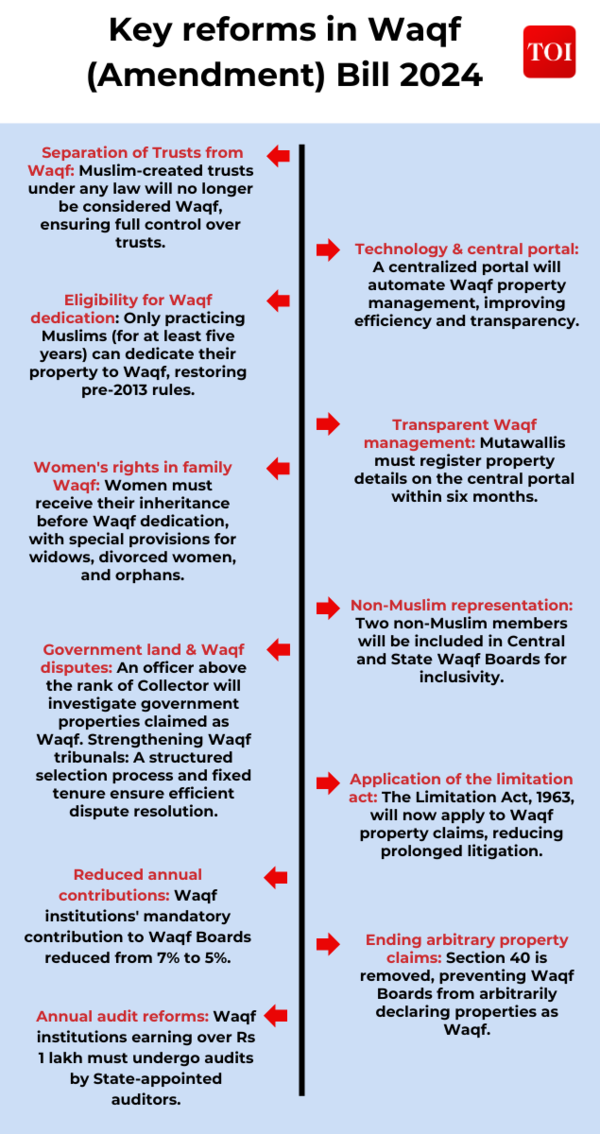
As you can see, the amendments are sweeping, touching upon nearly every aspect of Waqf administration that has been a subject of criticism. They can be broadly grouped into four categories:
- Reforming governance and composition.
- Curbing arbitrary property claims.
- Overhauling dispute resolution mechanisms.
- Enhancing transparency and accountability.
1. Reforming Governance and Composition
A central criticism of the existing system, which you'll recall from our last discussion, was that Waqf Boards were often seen as insular, opaque, and unaccountable. The Bill proposes significant changes to the composition of both the state-level Waqf Boards and the Central Waqf Council to address this.
The core change is the mandatory inclusion of non-Muslim members and a shift from an electoral to a nomination-based system for certain positions. The PRS India summary of the bill provides the most precise details on this.
The Waqf (Amendment) Bill, 2024 - PRS India
This document from PRS Legislative Research offers a neutral, factual breakdown of the bill's provisions.
Please read the two bullet points under the heading Key Features that describe the changes to the composition of the Central Waqf Council and Waqf Boards. Note the specific requirements for including non-Muslims, women, and representatives from different Muslim sects, as well as the shift from electing to nominating MPs, MLAs, and Bar Council members.
The rationale presented by the government for these changes is to bring Waqf administration in line with how other charitable trusts are overseen. The argument, as articulated by Home Minister Amit Shah, draws an analogy to the office of the Charities Commissioner, which oversees trusts of all religions without being restricted to a person of a specific faith. The StudyIQ video explains the core provision and the initial suggestions from the Joint Parliamentary Committee (JPC) to which the bill was referred.
WAQF Amendment Bill 2024: Why Is It So Controversial? | StudyIQ
This video from StudyIQ explains the controversies surrounding the bill's provisions.
Watch from 02:47 to 03:51. Pay attention to how the bill allows for non-Muslims to be appointed as CEOs and members of the board, and the JPC's recommendation that the appointed officer should have knowledge of Muslim law.
These changes are among the most controversial aspects of the bill, sparking a debate about institutional autonomy versus public accountability, which we will explore further in a later lesson.
2. Curbing Arbitrary Property Claims
Perhaps the most potent political criticism against the old Act was its potential for misuse in claiming property. The 2013 amendments, in particular, were seen as having granted Waqf Boards what critics called "sweeping powers." The 2024 Bill introduces several provisions to directly counter this.
A. Ending Arbitrary Declarations (Repeal of Section 40)
As we discussed, Section 40 of the 1995 Act empowered a Waqf Board to investigate and declare a property as Waqf. This provision is now proposed to be removed entirely, stripping the boards of their unilateral power to make such declarations.
B. Abolishing 'Waqf by User'
The concept of 'Waqf by user' allowed a property to be recognized as Waqf based on long-term use for religious or charitable purposes, even without a formal deed of dedication. Critics argued this created ambiguity and was used to claim properties retroactively. The new bill abolishes this concept, requiring a formal, registered deed for any property to be considered Waqf. The StudyIQ video provides a clear explanation of this change and its implications.
WAQF Amendment Bill 2024: Why Is It So Controversial? | StudyIQ
This video clearly explains the concept of 'Waqf by user' and the impact of its removal.
Watch the segment from 05:08 to 06:11. Note how the removal of this provision could affect properties like older mosques and graveyards that may lack formal documentation.
C. Application of the Limitation Act, 1963
In our previous lesson, we highlighted the exemption of Waqf claims from the Limitation Act as a major structural flaw. This allowed boards to claim properties after decades or even centuries, creating immense uncertainty for landowners. The new bill reverses this, making Waqf property claims subject to the same statutes of limitation as other civil property disputes. This is a crucial reform aimed at reducing prolonged and speculative litigation.
D. Stricter Rules for Dedication
The bill also tightens the rules for who can create a Waqf. It specifies that only a person who has been a "practicing Muslim for at least five years" and is the lawful owner can dedicate a property. Furthermore, the dedication must not disinherit legal heirs, specifically protecting the inheritance rights of women.
3. Overhauling Dispute Resolution
To address concerns about a biased and closed-loop legal process, the bill fundamentally restructures how disputes are adjudicated.
A. Empowering the Collector and Redefining Jurisdiction
For any dispute involving a property claimed by both the government and a Waqf board, the power to adjudicate is shifted from the Waqf Tribunal to the District Collector (or a more senior officer). This is a direct response to instances where boards laid claim to government lands and buildings. However, as the video below points out, this also raises concerns about a potential conflict of interest.
WAQF Amendment Bill 2024: Why Is It So Controversial? | StudyIQ
This segment explains the transfer of power to the District Collector and the associated concerns.
Please watch from 03:57 to 05:08. Focus on the argument that having a government officer decide on a dispute involving the government creates a conflict of interest.
B. Reforming Tribunals and Allowing High Court Appeals
The bill also changes the composition of the Waqf Tribunals and, crucially, revokes the finality of their decisions.
The Waqf (Amendment) Bill, 2024 - PRS India
This PRS summary details the changes to the tribunal system.
Please read the two final bullet points in the Key Features section, titled "Composition of Tribunals" and "Appeals against orders of Tribunals". Observe the removal of the 'expert in Muslim law' from the tribunal and the introduction of a direct appeal mechanism to the High Court.
This structural change opens the Waqf legal process to mainstream judicial oversight, addressing the long-standing criticism that the previous system operated outside the conventional checks and balances of the Indian judiciary.
4. Enhancing Transparency and Accountability
Finally, a set of provisions aims to tackle the systemic issues of mismanagement and corruption by forcing greater transparency.
- Technology & Central Portal: The bill mandates the creation of a centralized digital portal (building on the existing WAMSI - Waqf Asset Management System of India). All Waqf properties must be registered on this portal within a fixed timeframe (initially proposed as six months). Failure to register could result in forfeiting the right to legal recourse in case of a future dispute.
- Annual Audit Reforms: As noted in the infographic, Waqf institutions with significant earnings (over Rs 1 lakh) will be subject to mandatory audits by State-appointed auditors, bringing them under greater financial scrutiny.
- Reduced Mandatory Contributions: The mandatory contribution from Waqf institutions to their respective state boards is reduced from 7% to 5%, which is intended to leave more resources at the institutional level for charitable work.
- Separation of Trusts: The bill clarifies that Muslim-created trusts registered under other laws (like the Indian Trusts Act, 1882) will no longer be considered Waqf, ensuring they are governed solely by the laws under which they were established.
Conclusion
In this lesson, we have systematically deconstructed the Waqf (Amendment) Bill, 2024, examining its core provisions. We've seen how each proposed change is designed as a direct response to the long-standing criticisms of inefficiency, legal overreach, and corruption that plagued the previous system.
Key Takeaways:
- Governance Reform: The bill alters the composition of Waqf Boards and the Central Council by mandating the inclusion of non-Muslim members and women, and shifting from elected to nominated posts for certain categories.
- Curbing Arbitrary Claims: It seeks to end arbitrary property claims by repealing Section 40, abolishing the 'Waqf by user' doctrine, applying the Limitation Act of 1963 to all claims, and setting stricter criteria for property dedication.
- New Dispute Resolution: The bill shifts jurisdiction over government-Waqf property disputes to the District Collector, reforms the composition of Waqf Tribunals, and, most importantly, allows their decisions to be appealed in the High Court.
- Transparency and Accountability: It introduces mandatory digital registration of all Waqf properties on a central portal and enforces stricter, state-led financial audits.
Preview of the Next Lesson:
While these provisions are presented by the government as necessary reforms for efficiency and justice, they have ignited a fierce constitutional debate. Critics argue that several provisions, particularly the inclusion of non-Muslims in the administration of religious endowments, violate the fundamental rights of religious denominations. In our next lesson, we will analyze the constitutional arguments against the bill, primarily concerning Article 26 of the Constitution, which guarantees religious denominations the right to manage their own affairs.