Introduction
Welcome back! In our previous lesson, you mastered the fundamental skill of creating causal loop diagrams (CLDs) by translating real-world scenarios into structured systems maps. We saw how to identify variables, links, and the resulting reinforcing (R) and balancing (B) feedback loops.
Today, we move from building blocks to blueprints. We will use your CLD skills to diagnose common, problematic patterns of behaviour known as system archetypes. These archetypes are recurring structures that produce predictable, and often undesirable, outcomes.
Your learning outcome for this lesson is to diagnose the 'Fixes that Backfire' archetype in a scenario by mapping its feedback loops. This is the first archetype in your FLATS GEDS mnemonic, representing the 'F' for "Fixing that Backfires." By learning to spot this pattern, you can start to understand why some solutions not only fail to solve a problem but actually make it worse over time.
To begin, consider this classic Dilbert comic strip:

The manager's "fix" might just backfire. This is the exact dynamic we will explore today.
1. The Anatomy of a 'Fix that Backfires'
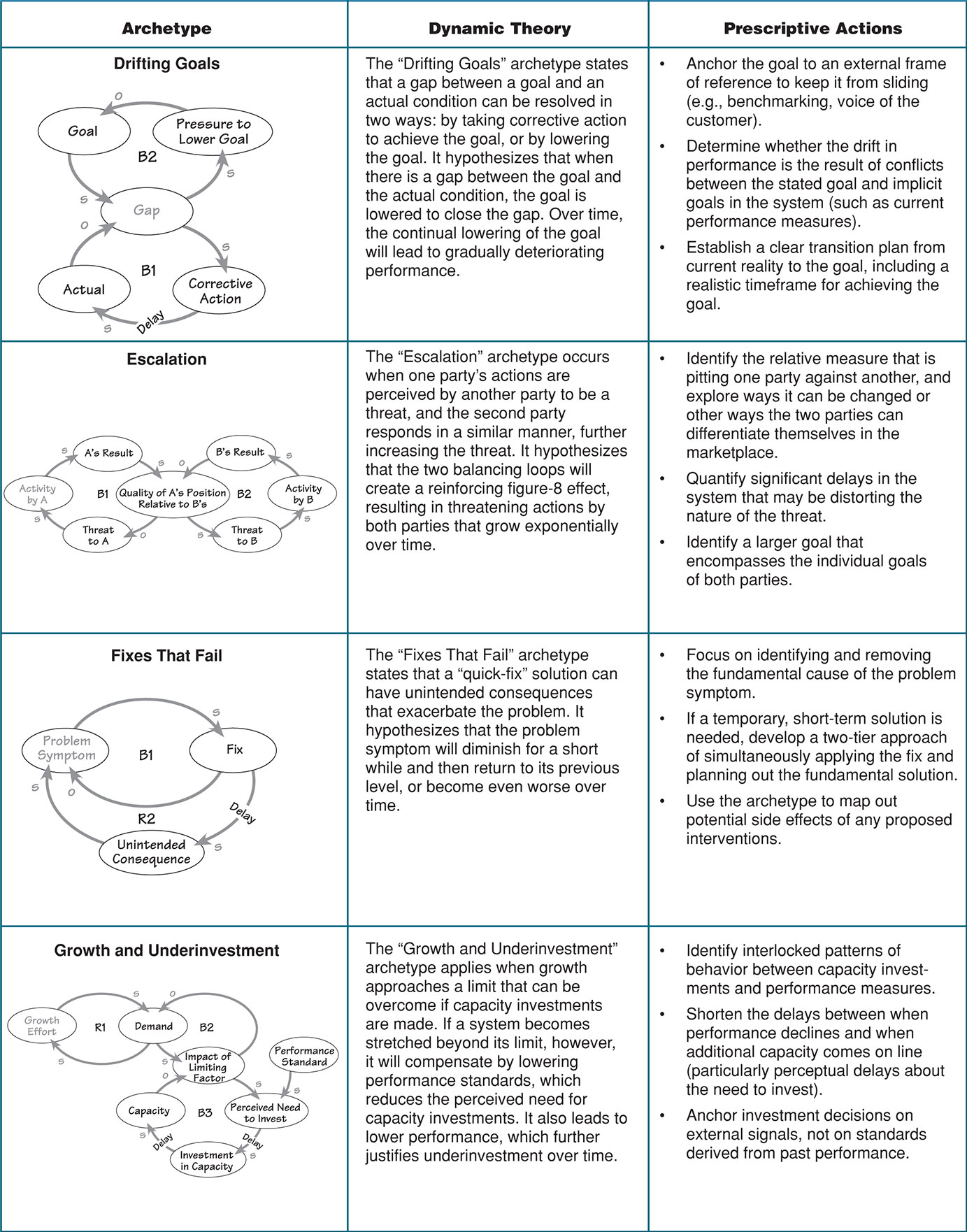
The 'Fixes that Backfire' archetype describes a situation where a seemingly effective short-term solution has long-term consequences that worsen the original problem. This happens because the "fix" addresses a symptom, not the root cause, and in doing so, creates unintended effects that reinforce the problem.
The structure always consists of two interconnected feedback loops:
- A Balancing Loop (B): The Quick Fix. This loop represents the immediate solution. A problem symptom appears, a fix is applied, and the symptom is temporarily relieved. This loop provides immediate positive feedback to the decision-maker.
- A Reinforcing Loop (R): The Backfire. This loop represents the delayed, unintended consequence. The quick fix, after some time, creates a new problem or worsens an existing one, which ultimately makes the original symptom even more severe.
Let's dive into a resource that explains this structure clearly.
The web page 'Systems Thinking Primer' from Odd-e provides a concise explanation and diagram of the 'Fixes that backfire' archetype.
Please read the section titled 'Fixes that backfire'. Focus on how the diagram connects a balancing loop (the intended fix) and a reinforcing loop (the unintended consequence). Pay close attention to the role of the 'delay' in making the backfire effect surprising.
As the reading highlights, the delay is a critical component. Because the negative consequence doesn't appear immediately, the decision-maker often fails to connect it to their "successful" fix. They see the symptom reappear and are likely to apply even more of the same quick fix, strengthening the vicious cycle.
The typical behaviour of this system over time looks like this: the problem symptom fluctuates as the fix is repeatedly applied, but the unintended consequence steadily grows, making the overall situation worse.
2. Diagnosing a Backfire in Lingerie Production
Let's apply this diagnostic lens to a scenario from your interest in lingerie design.
Scenario:
A lingerie company is under intense pressure to increase the production speed of its most popular cleavage-enhancing bra to meet high demand. To get bras out the door faster, management decides to eliminate a final, time-consuming quality control (QC) check that catches minor aesthetic flaws.
Let's map this using the 'Fixes that Backfire' structure.
Step 1: Identify the Problem Symptom and the Quick Fix (The Balancing Loop)
- Problem Symptom:
Pressure to Increase Production Speed - The Fix: As this pressure rises, the company implements the fix:
Skipping Final QC. This action directly increasesProduction Speed, which in turn reduces thePressure to Increase Production Speed.
This forms our balancing loop, B1, which provides immediate relief.
Diagram showing the balancing loop (B1) of the quick fix. Increased pressure leads to skipping QC, which increases speed and reduces the initial pressure.
Step 2: Identify the Unintended Consequence and Delay (The Reinforcing Loop)
- The Consequence:
Skipping Final QCmeans more bras with minor defects (e.g., uneven stitching, slight color variations) reach the customer. After a delay (the time it takes for products to be sold and used), this leads to a rise inCustomer Complaints and Returns. - The Backfire: The increase in
Customer Complaints and Returnsrequires staff to spend more time on customer service and processing returns. ThisRework and Admin Loadpulls resources away from production, ultimately reducing the company's overall efficiency and increasing thePressure to Increase Production Speedeven further.
This forms our reinforcing loop, R2, where the fix ultimately makes the problem worse.
The full 'Fixes that Backfire' diagram. The B1 loop shows the short-term solution, while the R2 loop shows how skipping QC leads to complaints and rework, which ultimately increases the pressure to speed up production, creating a vicious cycle.
By mapping the full system, we can clearly diagnose this as a 'Fixes that Backfire' archetype. The company is likely trapped in a cycle of cutting corners to save time, only to lose more time dealing with the consequences.
3. Diagnosing a Backfire in a Vee Relationship
Now, let's apply the same diagnostic process to a scenario in a Vee relationship.
Scenario:
In a Vee relationship (husband, wife, metamour), the wife feels insecure and disconnected when her husband spends time with his metamour. This creates noticeable tension in their marriage. To quickly alleviate this tension, the husband starts proactively offering to cancel or shorten his planned dates with the metamour.
Step 1: The Problem Symptom and The Quick Fix (The Balancing Loop)
- Problem Symptom:
Tension in Marriage - The Fix: When
Tension in Marriagerises, the husband applies the fix:Cancelling/Shortening Dates with Metamour. This gesture provides immediate reassurance to the wife, and theTension in Marriagetemporarily decreases.
This is the fast-acting balancing loop, B1. The husband gets immediate positive feedback: his action reduced the conflict.
Diagram showing the balancing loop (B1) of the quick fix. Increased tension leads the husband to cancel dates, which provides reassurance and temporarily reduces the tension.
Step 2: The Unintended Consequence and Delay (The Reinforcing Loop)
- The Consequence: The repeated
Cancelling/Shortening of Dates, after a delay, erodes trust and createsResentment in the Metamour. It signals that her time is not valued and that the agreements in place are unreliable. - The Backfire: The
Resentment in the Metamourleads to increased conflict between the husband and the metamour. This creates a new source of stress and instability in the overall relationship system. ThisOverall System Instabilityultimately feeds back into and increases the originalTension in Marriage, often making it more severe and frequent than before.
This creates the reinforcing loop, R2. The very act intended to reduce tension ends up amplifying it from a different direction.
The full 'Fixes that Backfire' diagram. The B1 loop is the husband's short-term fix. The R2 loop shows how this fix, over time, creates resentment and instability that feeds back to make the marital tension even worse.
Again, mapping the structure allows us to diagnose a 'Fixes that Backfire' dynamic. The husband is solving the immediate problem of his wife's feelings at the long-term expense of the stability of the entire relationship structure.
Conclusion
In this lesson, you have learned how to diagnose one of the most common system archetypes: 'Fixes that Backfire'. As a statistician and researcher, you can appreciate that this archetype provides a powerful hypothesis for explaining why a system's behaviour doesn't improve despite repeated interventions.
Key Takeaways:
- The 'Fixes that Backfire' archetype consists of a fast-acting balancing loop (the quick fix) and a delayed reinforcing loop (the unintended consequence).
- The delay is a crucial element, as it obscures the causal link between the "solution" and the eventual worsening of the problem.
- To diagnose this archetype, you must map both loops: first the story of the immediate fix, and then the story of the delayed, unintended backfire.
Next Lesson Preview:
Now that you can diagnose and map this archetype, the next logical question is: what do you do about it? In our next lesson, you will learn how to move from diagnosis to solution by using Root Cause Analysis to identify the fundamental problem that is driving the need for a quick fix in the first place.