Introduction
Welcome to the second module of our course. In Module 1, we focused on divergent thinking with the SCAMPER framework, learning how to generate a wide variety of new ideas by systematically transforming existing ones. You capped that module by synthesising those techniques into concrete design concepts for a cleavage-enhancing bra.
Now, we shift from generating ideas to analysing possibilities and understanding complex situations. This module is titled "Exploring Possibilities with Thought Experiments," and we'll use the mnemonic RCS PPB to navigate its six techniques.
Today, we begin with 'R': Retroduction. Our goal is to construct a retroductive thought experiment to infer the most plausible cause of a given social or technical problem. This is a foundational skill for any kind of diagnosis or problem-solving. As a social researcher, you are already familiar with forming hypotheses from observations; retroduction provides a formal name and structure for this type of inference, framing it as a specific kind of thought experiment.
1. Understanding Retroduction: An Inference to the Best Explanation
What do we do when we encounter a surprising fact or a puzzling outcome? We naturally start searching for an explanation. This process of working backward from an effect to its most likely cause is the essence of retroduction.
You might be familiar with the famous fictional detective Sherlock Holmes, who claimed his method was "deduction." However, the logical process he used was often something else entirely. Let's clarify the difference.
What Sherlock Holmes Got Wrong | Deduction, Induction, and Abduction
This video, 'What Sherlock Holmes Got Wrong' by Benjamin Keep, PhD, JD, offers a clear distinction between three types of reasoning: deduction, induction, and abduction. Pay close attention to the definition of abduction, as it is the foundation of retroduction.
Please watch from 04:23 to 06:16. The first part explains abduction using a simple example. The second part connects this back to Sherlock Holmes, clarifying that his method is really about finding the most plausible explanation, not a logically guaranteed conclusion.
As the video explains, abductive reasoning is the process of forming an "inference to the best explanation." When we observe wet ground, we infer it probably rained. This isn't a guaranteed truth (a sprinkler could have been on), but it's the most plausible explanation based on the evidence.
Retroduction is a term from philosophy and social science that formalises this process, especially when uncovering hidden causes. It means "to lead back." One academic paper describes it as "looking and thinking backwards, or ‘last things first’" to uncover connections.
A powerful way to think about this is the old proverb "For want of a nail":
For want of a nail, the shoe was lost.
For want of a shoe, the horse was lost.
For want of a horse, the rider was lost.
For want of a rider, the battle was lost.
For want of a battle, the kingdom was lost.
And all for the want of a horseshoe nail.
Retroduction is the detective work of starting with the "lost kingdom" (the observed outcome) and tracing the causal chain backward to discover the "missing nail" (the root cause).
2. The Four Steps of a Retroductive Thought Experiment
While the concept can feel intuitive, applying it systematically makes it a much more powerful tool. We can break the process down into four distinct steps.
What is Abductive Reasoning? | In-depth Guide & Examples - ATLAS.ti
The article 'What is Abductive Reasoning?' from ATLAS.ti provides a clear, structured approach to this form of inference. We will adopt its steps for our retroductive framework.
Please read the section titled 'Steps in the abductive reasoning process.' This will give you a clear, actionable framework for our exercises.
Based on that reading, here is our four-step framework for constructing a retroductive thought experiment:
- Observation: Start with a surprising, puzzling, or unexpected fact or outcome. This is your "lost kingdom."
- Hypothesis Formation: Generate one or more plausible causal stories or explanations that could lead to the observation. This is the core creative step—the "inference to the best explanation." Ask yourself: "What might be the 'missing nail' here?"
- Abductive Validation: Test your hypotheses. Compare them against each other and against other known facts. Which explanation is the simplest, most elegant, and requires the fewest new assumptions? This is where your statistical sense of probability and likelihood comes into play.
- Inference & Iteration: Select the most plausible hypothesis based on your validation. It's important to remember, as the ATLAS.ti article notes, that this conclusion is provisional—it's your best guess given the current data, and it can be refined as new information emerges.
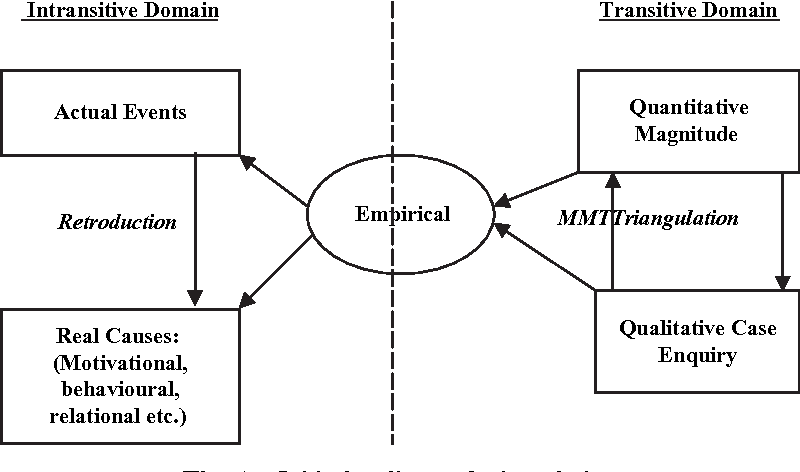
This process can be visually represented. For a statistician accustomed to modeling, the diagram below shows how retroduction acts as the inferential bridge between the empirical data we can observe and the real, underlying causes we want to understand.
3. Applying the Framework
Let's walk through an example in each of your domains of interest.
Example 1: A Technical Problem (Lingerie Design)
- 1. Observation: A new prototype for a cleavage-enhancing bra is being tested. Testers with smaller busts report that while it provides significant lift, the resulting shape looks unnatural and "shelf-like," rather than the desired "gentle swell."
- 2. Hypothesis Formation: What is the most plausible cause of this "shelf-like" effect?
- Hypothesis A: The padding is a uniform slab, pushing the entire breast up vertically without shaping it inward.
- Hypothesis B: The underwire is too wide and flat at the bottom, creating a broad, flat base instead of a rounded cup.
- Hypothesis C: The fabric of the cup is too rigid and doesn't conform to the body, creating an artificial shape.
- 3. Abductive Validation:
- We review the design. The fabric is a standard, flexible microfiber, so Hypothesis C is less likely.
- We compare A and B. A "shelf" effect is most directly created by upward force without inward compression. Uniform padding (Hypothesis A) is a textbook way to achieve this. A wide underwire (Hypothesis B) would contribute, but the primary shaping agent is the padding inside the cup. Therefore, Hypothesis A seems the most direct and simplest explanation.
- 4. Inference: The most plausible cause is the uniform, non-graduated padding. The next design iteration should experiment with crescent-shaped or angled padding to create both upward and inward push.
Example 2: Your Turn with a Social Problem (Vee Relationship)
Now, it's your turn to apply this structured thinking to a more complex social dynamic. As a social researcher, you are well-equipped to "excavate" the hidden mechanisms at play.
Scenario:
Imagine a vee relationship consisting of a husband, a wife, and the husband's partner (the 'metamour'). The relationship is established, and all parties have agreed to the structure. However, a puzzling pattern emerges: the wife experiences a noticeable spike in anxiety and emotional withdrawal for a day or two after the husband has a date with his metamour. When asked, the wife can't articulate a specific reason; she says she logically supports the relationship but feels an unshakeable sense of unease.
Your Task (15-20 minutes):
Using the four-step retroductive framework, construct a thought experiment to diagnose the potential cause of the wife's anxiety.
- Observation: State the puzzling phenomenon clearly.
- Hypothesis Formation: Propose at least two distinct and plausible hypotheses for the wife's anxiety. Go beyond simple "jealousy" and think about the underlying social or relational mechanisms.
- Hint: Consider what might be missing or what unspoken expectations might not be met. Think about rituals, communication, or emotional transitions.
- Abductive Validation: For each hypothesis, briefly explain why it is a plausible cause. Then, describe what additional (hypothetical) information you might look for to determine if it's the best explanation. For instance, if Hypothesis X is true, what else would you expect to see or not see?
- Inference: Based on your validation, conclude which hypothesis seems more plausible and why.
Conclusion
In this lesson, we began our exploration of thought experiments by focusing on retroduction. You learned to distinguish it from other forms of reasoning and saw how it serves as a powerful tool for inferring the most likely cause of a puzzling outcome.
Key Takeaways:
- Retroduction is Abduction: It is a structured process of making an "inference to the best explanation" by working backward from an effect to its cause.
- It's a Diagnostic Tool: Retroduction is fundamental to diagnosis, whether you are troubleshooting a technical flaw in a product or trying to understand a complex emotional reaction in a relationship.
- A Structured Process: By following the steps of Observation, Hypothesis Formation, Validation, and Inference, you can turn an intuitive guess into a rigorous thought experiment.
- Conclusions are Provisional: Retroductive inferences are not absolute truths but are the most plausible hypotheses given the available evidence, open to revision.
This skill of looking backward to understand "why" something happened is the first of our six thought experiment techniques.
In our next lesson, we will continue our journey by exploring Semifactual thinking. We will shift our gaze slightly to look at the very recent past and ask, "What if a small detail had been different?" This will allow us to analyse how minor actions can lead to major changes in outcomes.