Introduction
Welcome back. In our last lesson, we delved into counterfactual thought experiments, looking backward to analyze the consequences of a major past decision. You used the Counterfactual Potency framework to dissect a pivotal choice in your lingerie business, turning hindsight into a tool for strategic insight. This was the "C" in your RCS PPB framework, focusing on what would have happened.
Today, we shift our gaze from the past to the future. We will tackle the first "P" in your framework by exploring predictive thought experiments. Instead of asking "what if I had chosen differently?", we will ask, "If I choose this path now, what will most likely happen?"
Your learning outcome for this lesson is to design a predictive thought experiment to forecast the most likely outcomes of a proposed action.
This process is fundamentally about forecasting. Given your background as a statistician, this links directly to the principles of predictive analytics, where we use existing data and models to project future events.
1. Defining Predictive Thought Experiments
A predictive thought experiment is a structured mental simulation designed to forecast the most probable consequences of a specific action you are considering. It is a disciplined attempt to answer the question: "What is the single most likely future that will result from this choice?"
Let's place this in the context of the tools we've already covered:
- Retroduction: Looks at a surprising present outcome and works backward to find the most plausible past cause. ("Why did this happen?")
- Counterfactual: Looks at a past decision and explores an alternative, unrealized timeline. ("What would have happened if...?")
- Predictive (Today): Looks at a present decision and projects forward to the most likely future outcome. ("What will happen if...?")
The goal here is not to imagine all possibilities (we'll touch on that in a future lesson) but to make your best, most rational forecast. This requires moving beyond wishful thinking and confronting the likely chain of cause and effect.
2. The Forecaster's Hazard: Projection Bias
Accurate prediction is notoriously difficult, in part because our thinking is shaped by subtle cognitive biases. As a social researcher, you are likely familiar with these. One of the most significant obstacles to accurate prediction is projection bias.
Projection bias is the common error of assuming that our future selves will share the same perspectives, feelings, and preferences as our present selves. When we are in a particular state—be it hungry, angry, excited, or anxious—we tend to project that state onto our future, leading to flawed predictions about our own (and others') behavior.
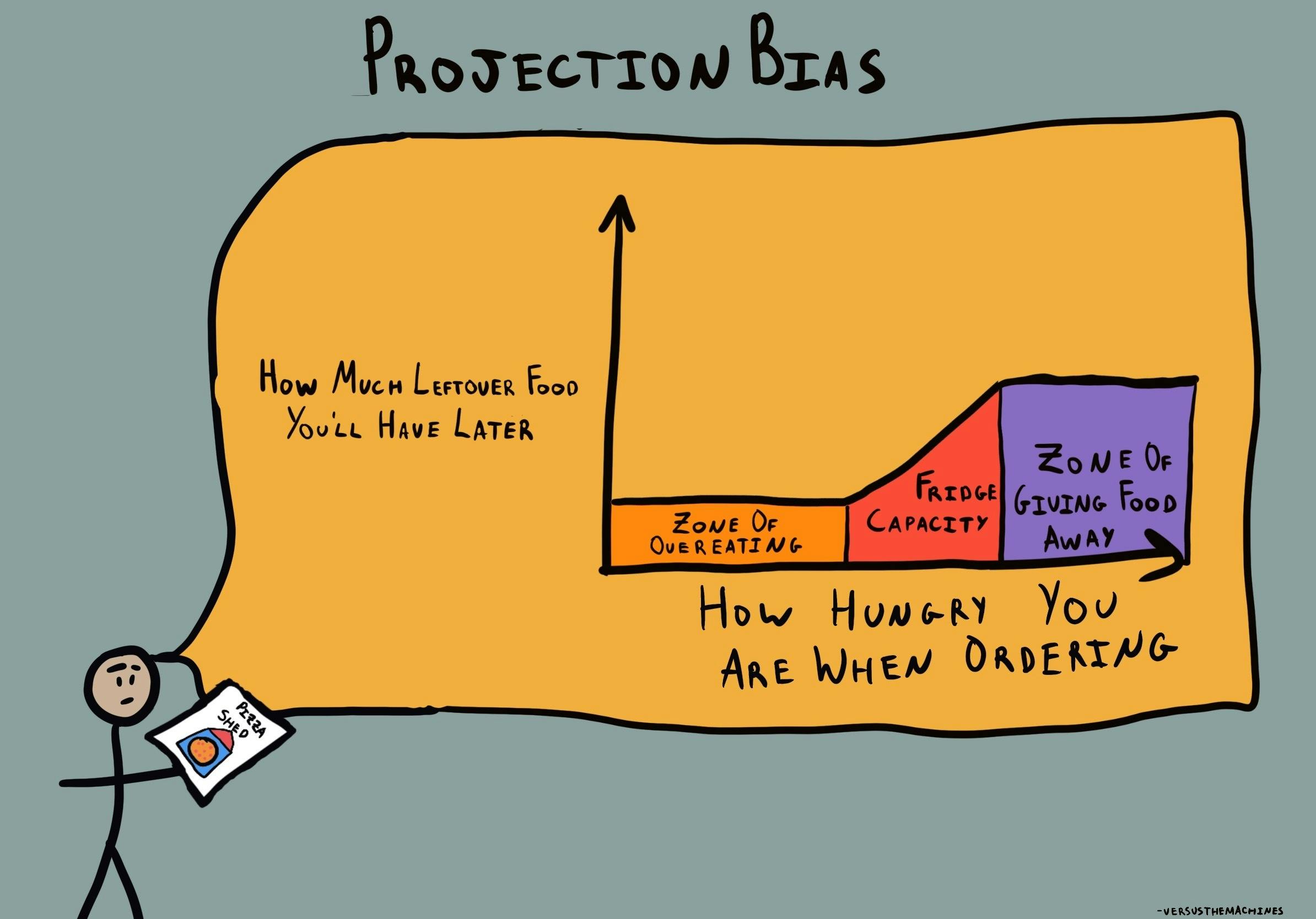
In your domains, this bias can manifest easily:
- Lingerie Design: In a moment of intense creative inspiration, you might design a visually stunning but highly complex and uncomfortable bra, underestimating how a future customer's priority will shift from aesthetic appreciation in the store to a desire for comfort during a long day.
- Relationships: In the heat of an argument fueled by insecurity, you might propose a rigid rule or agreement, believing it will bring future security. You are projecting your current need for control onto the future, without accurately forecasting how that rule will feel on a calm, ordinary day.
Recognizing this bias is the first step to overcoming it and making more objective predictions.
3. A Framework for Structured Prediction
To conduct a rigorous predictive thought experiment and mitigate biases, we can use a systematic, six-step process. This provides a clear structure, much like the Counterfactual Potency framework from our last lesson.
- Define the Proposed Action: State, with absolute clarity, the specific decision or action you are contemplating. (e.g., "I will launch a new bra line using only organic cotton.")
- Identify Key Drivers and Uncertainties: List the main internal and external factors that will influence the outcome. What are the knowns (e.g., material costs, your design skills) and the unknowns (e.g., customer reaction, competitor moves)?
- Gather Evidence and Project the Baseline: What relevant past experiences, data, or observations can you draw upon? This is where your research skills are crucial. Critically, what is the baseline? What will likely happen if you do nothing?
- Simulate the Causal Chain: Starting with the action, walk through the sequence of events it will likely set in motion. Use "if-then" logic: "If I take Action A, then Consequence B is the most likely immediate result. Because of B, Consequence C will probably follow."
- Conduct a Bias Check: Pause and explicitly ask yourself: Is my prediction being skewed by my current emotional or psychological state? Am I falling victim to projection bias? Am I engaging in wishful thinking (best-case scenario) or catastrophic thinking (worst-case scenario)? Adjust your simulation to be more neutral and objective.
- Formulate the Prediction: Conclude with a clear statement about the most likely outcome. It's also good practice to state your level of confidence in this prediction (e.g., "I am 80% confident that this will lead to...").
4. Your Turn: Analyzing a Relationship Decision
Our last exercise focused on your business, so this one will focus on relationship dynamics. Let's analyze a common scenario in a Vee relationship using the predictive framework.
Scenario:
You are in a Vee relationship, with your husband as the "hinge" partner connecting you and his other partner (your metamour). You and your metamour have a cordial but somewhat distant relationship. You feel a persistent sense of insecurity and a desire for the three of you to feel more like a cohesive unit. You believe that more structured time together is the solution.
- Proposed Action: You are considering proposing a new rule: a mandatory "Vee Night" every Wednesday, where the three of you must have dinner together and engage in a planned activity.
- Your Desired Outcome: You hope this forced interaction will build closeness, reduce your insecurity, and strengthen the bonds of the entire triad.
Your Task (20 minutes):
Use the six-step framework to design a predictive thought experiment for this proposed action. Go through each step methodically.
- Define the Proposed Action: (Stated above).
- Identify Key Drivers: What are the key personalities, motivations, and dynamics at play? (e.g., your feeling of insecurity, your husband's desire to keep both partners happy, your metamour's potential desire for autonomy in her relationship with your husband).
- Gather Evidence: What has happened in the past during planned vs. spontaneous group interactions? How have you and your metamour reacted to feelings of obligation or pressure before?
- Simulate the Causal Chain: If you propose this rule, what is the most likely sequence of events?
- How will your husband likely react when presented with the idea?
- How will your metamour likely react? Will she see it as a welcome invitation or a mandatory chore?
- What will the atmosphere of the first few "Vee Nights" likely be? Genuinely warm, or polite but strained?
- Over time, what is the most probable impact on your relationship with your metamour?
- Conduct a Bias Check: Is your belief that this rule will create closeness an example of projection bias? Are you projecting your current need for security and structure onto the situation, and assuming the others will share the positive feeling you hope to get from it? Are you forecasting your desired outcome rather than the most probable one?
- Formulate the Prediction: Based on your simulation, what is the single most likely long-term outcome of implementing this rule? Will it lead to greater harmony or greater resentment? State your prediction clearly.
Take your time to write down your analysis for each step. The goal is to produce a realistic forecast, even if it’s not the one you wish for.
Conclusion
Today you've learned how to construct a predictive thought experiment, a powerful method for looking into the future consequences of your decisions. By applying a structured framework and actively checking for cognitive traps like projection bias, you can move from wishful thinking to more realistic forecasting.
Key Takeaways:
- Prediction is Forward-Looking: Unlike counterfactuals, predictive thought experiments simulate the most probable future that follows from a present choice.
- Structure Enhances Rigor: A step-by-step process (Define, Identify, Gather, Simulate, Check, Formulate) turns a simple guess into a robust mental model.
- Beware of Projection Bias: Your current emotional state can significantly distort your predictions. Always question whether you're assuming your future self (and others) will feel the same way you do now.
- The Goal is Probability, Not Possibility: The aim is to forecast the most likely outcome, not to map out every possible scenario.
In our next lesson, we will explore prefactual thought experiments. While prediction asks "What will happen?", prefactual thinking assumes a future event has already occurred and asks "How did it happen?". It’s a subtle but crucial difference. Prefactual thinking isn't for forecasting, but for building mental plans and contingency strategies, making it the perfect complement to the predictive skills you've developed today.