Introduction
Hello! In our last lesson, we explored the 'Escalation' archetype, the 'E' in your FLATS GEDS mnemonic. We diagnosed its reinforcing feedback structure and, more importantly, learned a practical, three-step method to de-escalate conflict by validating emotions, exploring options, and allowing choice.
Today, we move to the 'D' in FLATS GEDS: Drifting Goals. This lesson addresses a subtle but powerful system limiter where standards slowly erode over time. Your learning outcome is to diagnose the 'Drifting Goals' archetype and formulate strategies to adhere to original standards.
This archetype describes the all-too-common situation where, under pressure, we close the gap between our goal and our actual performance by lowering the goal itself, rather than taking the harder path of improving our performance. It’s the classic story of standards slipping, often so gradually that no one notices until a crisis hits. We will use your lingerie design work as our case study to see how this dynamic can compromise quality over time.
1. Understanding the 'Drifting Goals' Archetype
What does it feel like when goals drift? It often starts with a sense of pressure and the temptation to "just be realistic" for now. The presenter in this video gives a brief, personal account of how this dynamic shows up in everyday life.
Systems Thinking Tools: Archetypes
To start, let's get a feel for the 'Drifting Goals' archetype from the 'Systems Thinking Tools: Archetypes' video by the System Dynamics Society. The speaker, Len, gives a very relatable overview of this pattern.
Please watch the segment from 00:23:13 to 00:26:38. Notice how he describes the human tendency to adjust a goal downwards when faced with difficulties, rather than taking corrective action.
This tendency to lower the bar is at the heart of the 'Drifting Goals' archetype. It’s a seductive, short-term solution that often leads to long-term decline. To diagnose and counter it, we first need to understand its underlying structure.
2. The Structure of a Slippery Slope
The 'Drifting Goals' archetype is defined by a structure of two competing balancing loops. Think of them as two different ways to solve the same problem: the tension created by a gap between what you want and what you have.
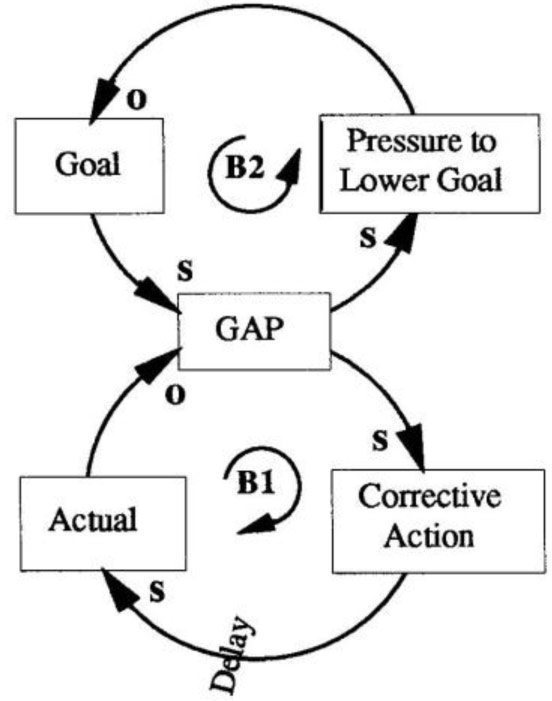
Let's break down the two loops:
-
Loop B1 (The Fundamental Solution): A gap between the
Goaland theActualperformance inspiresCorrective Actionto improve theActualstate. This is the productive, goal-oriented response. For example, if your bra design isn't meeting its quality goal, you invest in better materials or improve the manufacturing process. However, this loop often involves a delay; improvements take time and effort. -
Loop B2 (The Symptomatic Solution): The same
GAPalso createsPressure to Lower Goal. If the actual performance is consistently low, you might be tempted to revise the goal downwards to "be more realistic." This action immediately closes the gap, relieving the pressure. It's a faster, easier solution, but it undermines the original standard.
The system will tend to follow the path of least resistance. Because Loop B2 is often faster and less costly in the short term, the system defaults to lowering the goal, leading to a slow, downward spiral of performance.
3. Diagnosing 'Drifting Goals': The Tater Tots Case
To see how to diagnose this in a real-world scenario, we'll examine a classic business case involving Tater Tots. This example will serve as a direct analogue for the challenges you might face in lingerie design.
The article "Using 'Drifting Goals' to Keep Your Eye on the Vision" outlines a clear, seven-step process for diagnosing this archetype. Let's focus on the first few steps to see how the problem was identified.
Using "Drifting Goals" to Keep Your Eye on the Vision
This article from The Systems Thinker provides an excellent case study on how Ore-Ida faced a 'Drifting Goals' problem with their Tater Tots. It shows how a performance metric can degrade without anyone realizing the true cause.
Please read from the beginning of the article through step 4, 'Have the goals themselves been lowered over time?'. Pay close attention to how a goal of 'cost control' conflicted with the goal of 'quality', and how the quality standard was gradually linked to past (declining) performance, creating a slippery slope.
Application to Lingerie Design
Let's apply this diagnostic thinking to your interest in designing a cleavage-enhancing bra.
- Original Goal (The Vision): To create a bra that provides a "dramatic lift," defined by a specific measurement standard (e.g., +2 inches of lift on a standardized mannequin) and a customer satisfaction rating of 9/10 for "cleavage enhancement."
- Conflicting Goal: The company also has a goal to reduce the cost of goods sold by 5% each year.
- The Drift in Action:
- Pressure: To meet cost targets, the production manager approves a slightly lower-grade fabric and a faster, less precise stitching method for the cup seams. The changes are small, and the "dramatic lift" measurement drops slightly, from 2 inches to 1.8 inches.
- Goal Adjustment (Loop B2): At the next design review, the 1.8-inch lift is noted as the new performance baseline. The team, under pressure to meet launch deadlines, implicitly accepts this as the "new normal." The goal has drifted.
- Reinforcing Decline: The following year, more cost pressures lead to another small compromise. The lift drops to 1.6 inches. Over five years, the "dramatic lift" bra offers only "average lift," customer ratings slide, and sales decline. Management might blame changing consumer tastes, just as Ore-Ida did, without realizing they slowly eroded their own quality standard.
This is the 'Drifting Goals' archetype in action. The gap between the quality goal and actual performance was consistently closed by lowering the goal, not by taking corrective action (Loop B1) like finding innovative, low-cost materials that maintained performance.
4. Strategy 1: Anchor Your Goals Externally
How do you prevent this slippery slope? The first and most crucial strategy is to stop your goals from floating. You must anchor them to something solid and external to the system's internal pressures and past performance.
Using "Drifting Goals" to Keep Your Eye on the Vision
Let's return to the article 'Using "Drifting Goals" to Keep Your Eye on the Vision' to explore concrete strategies for intervention.
Please read steps 5, 6, and 7: 'Identify external frames of reference to anchor the goal,' 'Clarify the vision,' and 'Create a clear transition plan.' Focus on how external benchmarks and a clear vision provide the stability needed to resist the pressure to lower goals.
As the article suggests, anchoring your goals makes them less susceptible to internal pressures.
- Application in Lingerie Design:
- External Benchmarking: Instead of basing this year's quality on last year's, the goal is "Our bra must provide 15% more lift than the top-selling competitor's model." This goal is immune to your own performance drift.
- Voice of the Customer: The goal is "Achieve and maintain a 9/10 'cleavage enhancement' score from our customer panel." This anchors the goal to customer perception, not internal metrics.
- A Fixed "Platonic Ideal": Create a "gold standard" physical prototype of the bra, sealed and stored. The goal for every production run is "The final product must be indistinguishable in performance from the gold standard."
5. Strategy 2: Build a System That Protects the Goal
Anchoring a goal is a critical step, but it's not enough if your daily process allows for constant compromise. The pressure to lower goals often comes from fluctuations in motivation, energy, and resources. A powerful way to counteract this is to build a robust system that operates independently of these fluctuations.
The following video powerfully argues that you don't rise to the level of your goals; you fall to the level of your systems. This insight is the key to making your anchored goals resilient.
How To Set Systems Instead Of Goals (a system that will change your life) - Jim Rohn Motivation
This motivational video from Jim Rohn Everyday, 'How To Set Systems Instead Of Goals,' provides the psychological armor needed to protect your goals from drifting. It explains why a reliable system is more powerful than a lofty goal.
Please watch these three key segments that build on each other: (00:00:57 - 00:10:15): Focus on the core idea of building habits and systems that function even on 'bad days,' when motivation is low. (00:31:57 - 00:38:09): Understand how structure provides a safety net that holds you up when you 'crash,' preventing a bad day from derailing your standards. (00:51:42 - 00:57:48): Grasp the final point: depend on structure, not on unreliable energy or motivation.
A system translates your anchored goal into non-negotiable, daily actions. It is the practical implementation of "holding the vision."
- Application in Lingerie Design:
- The Goal: "Our bra provides 2 inches of lift."
- The System:
- "A performance test against the 'gold standard' prototype is mandatory for every new batch of fabric received. Any batch that fails is rejected, no exceptions." (This system works even when the purchasing manager is under pressure to accept a cheaper, subpar material).
- "The quality control team is empowered to halt the production line if the hourly spot-check measurements fall below 1.95 inches." (This system works even when the factory is behind schedule).
- "No changes to the design or materials can be approved without going through a full re-validation process, including a customer panel review." (This system prevents small, un-vetted changes from accumulating).
This system doesn't rely on the design team "feeling motivated" to fight for quality. It builds quality into the process, making it the default outcome.
Conclusion
In this lesson, we dissected the 'Drifting Goals' archetype, a system limiter that causes a slow erosion of standards by prioritizing the easy fix (lowering the goal) over the fundamental one (improving performance).
Key Takeaways:
- 'Drifting Goals' is a two-loop structure where a gap between a goal and reality is resolved by lowering the goal (a fast, symptomatic solution) instead of taking corrective action (a slower, fundamental solution).
- You can diagnose this archetype by looking for deteriorating performance metrics over time, often accompanied by conflicting goals (e.g., quality vs. cost) and a tendency to base new goals on past (and declining) performance.
- The primary strategy to prevent this is to anchor goals to external, objective references like competitor benchmarks or customer feedback, rather than internal history.
- A second powerful strategy is to translate your anchored goal into a robust system—a set of non-negotiable processes—that protects your standards from the daily pressures and fluctuations that cause them to drift.
Next Lesson Preview:
In our next lesson, we will tackle the final archetype in your FLATS GEDS mnemonic: 'S' for Success to the Successful. We will analyze the dynamic where one person, group, or project gets an initial advantage and is then repeatedly favored, starving others of resources and creating a system where the winners keep winning, often to the detriment of the system as a whole.