Introduction
Hello! In our last lesson, we diagnosed the 'Drifting Goals' archetype, where standards erode under pressure. We learned that the key to resilience is anchoring goals to external benchmarks and building robust systems to protect those standards.
Today, we address the final archetype in your FLATS GEDS mnemonic: 'S' for Success to the Successful. This lesson will equip you to meet the learning outcome: to diagnose the 'Success to the Successful' archetype and propose strategies for fair resource allocation.
This archetype describes a dynamic where an initial success gives one party an advantage, allowing them to attract more resources, which in turn fuels further success. This creates a powerful reinforcing loop that can starve other, equally deserving parties, leading to a "winner-takes-all" outcome. This isn't necessarily survival of the fittest, but often survival of the first or the luckiest.
Following our alternating pattern of case studies, we will apply this archetype to the domain of ethical non-monogamy, specifically analyzing how this dynamic can unintentionally destabilize a "Vee" relationship.
1. Diagnosing the 'Success to the Successful' Archetype
At its core, 'Success to the Successful' is a story of competition for a limited pool of resources, whether it's budget, talent, attention, or time. An early advantage, however small, can cascade into total dominance.
Let's begin with a quick overview of this dynamic.
Systems Thinking Tools: Archetypes
The 'Systems Thinking Tools: Archetypes' video from the System Dynamics Society provides a concise example of this archetype in the business world. This will give you a concrete feel for the pattern.
Please watch the segment from 00:26:38 to 00:27:58. The speaker uses the historical competition between Microsoft and WordPerfect to illustrate how an advantage in one area (operating systems) allowed one company to allocate more resources to another area (word processing) and ultimately dominate the market.
The story of Microsoft and WordPerfect shows how success in one domain can provide resources that create success in another, starving the competitor. This structure is common and can be visualized with a causal loop diagram.
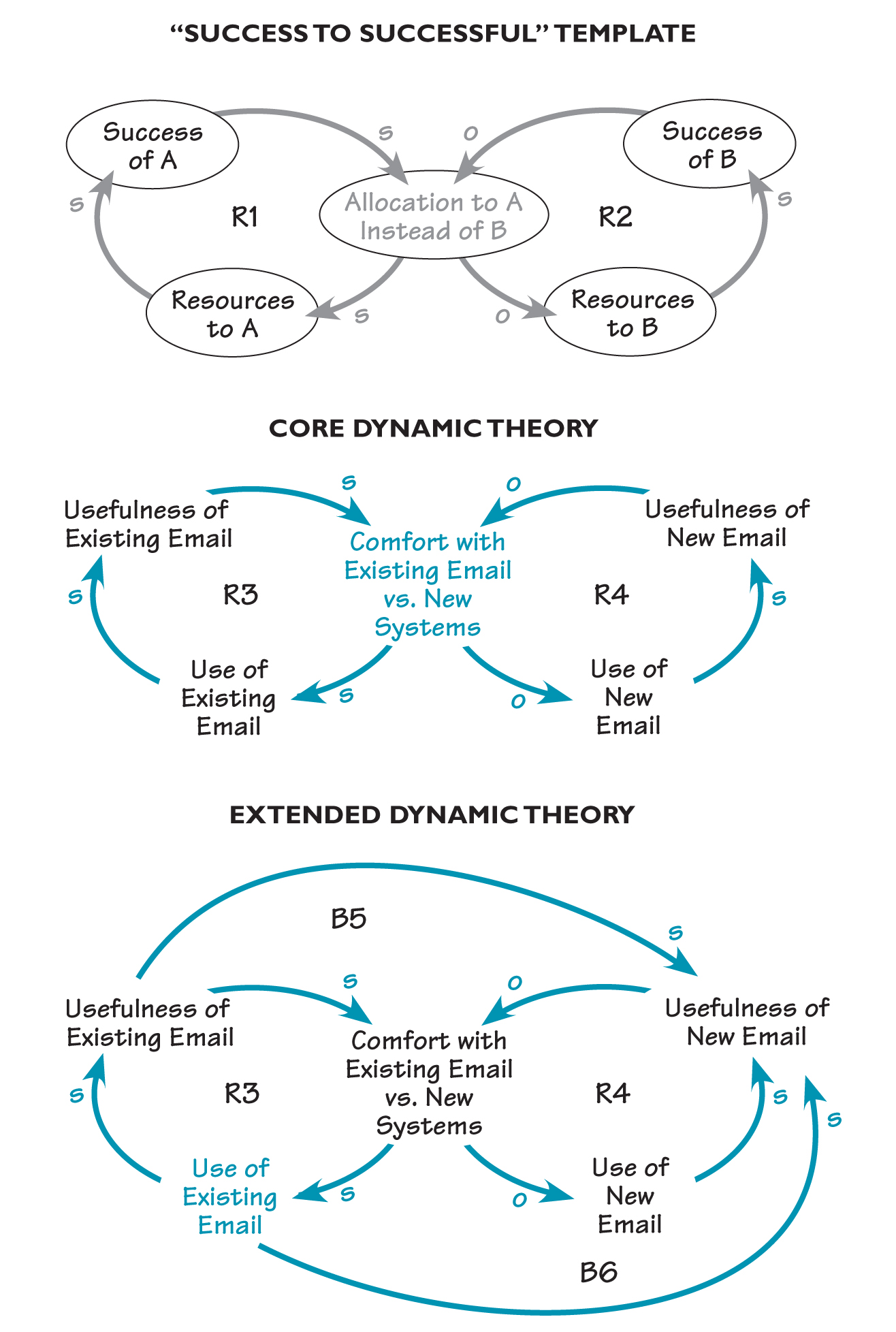
To better understand how to spot this in the wild, let's read a concise description of the archetype and its typical symptoms.
Success to the Successful – Systems Archetype 7
The article 'Success to the Successful – Systems Archetype 7' offers a clear definition and lists the common phrases and behaviors associated with this dynamic.
Please read the sections 'What's Happening?' and 'What the People Say'. Focus on how the system justifies allocating more resources to the winner and the kinds of complaints that arise from the 'losing' side.
As the article notes, people within this system often defend it as fair competition—the winner "deserves" the resources. Those on the losing side, however, perceive the system as fundamentally unfair, as their ability to perform is crippled by a lack of resources.
2. Application: The 'Success to the Successful' Dynamic in a Vee Relationship
Now, let's apply this diagnostic lens to the specific context of a "Vee" relationship.
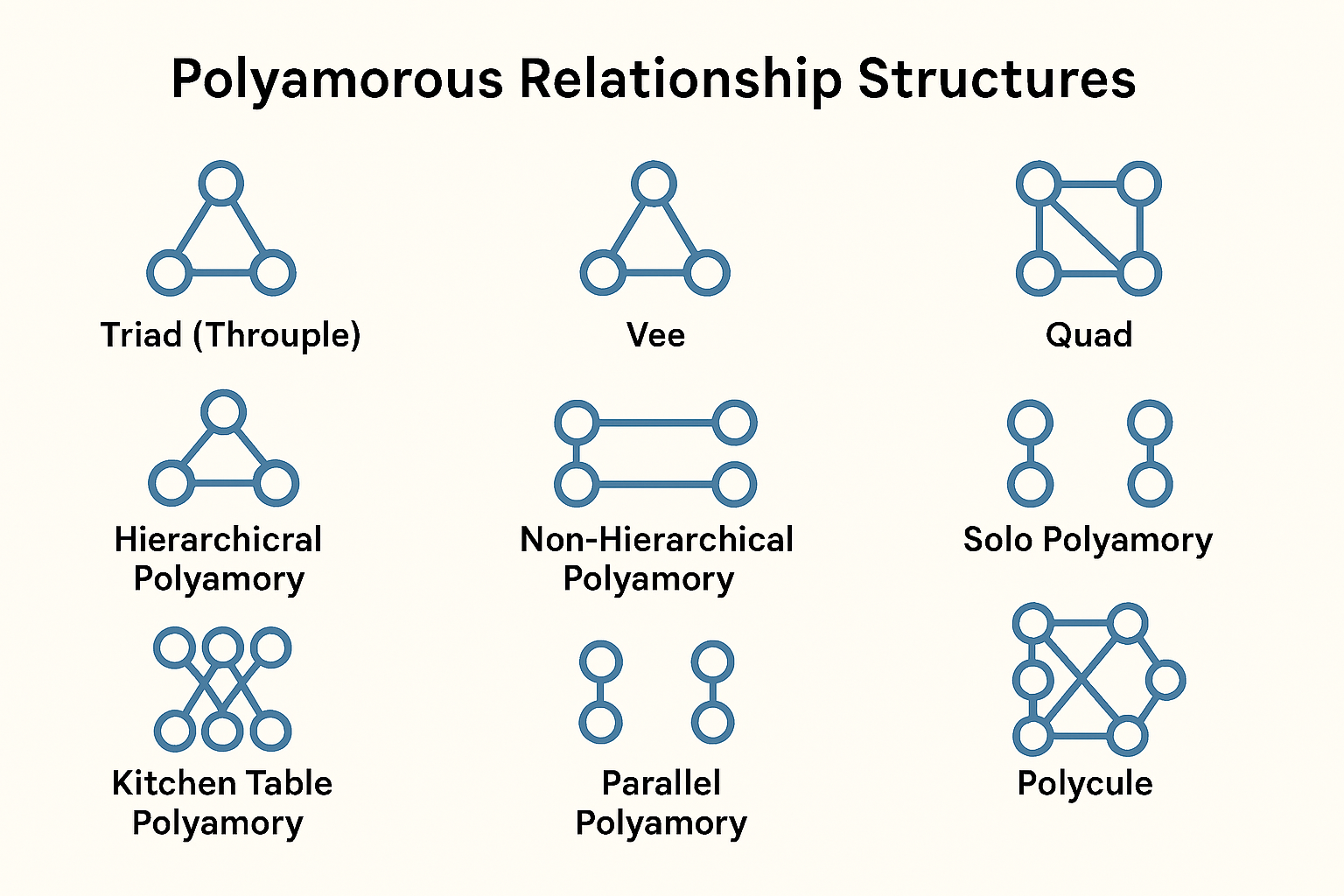
Scenario:
Imagine a Vee relationship with Alex (the hinge), Blair, and Casey. Alex has relationships with both Blair and Casey. The limited, shared resource is Alex's time, emotional energy, and attention.
- Initial Imbalance: Let's say, due to a chance event like a shared work project, Alex spends a bit more quality time with Blair over a few weeks.
- Reinforcing Loop R1 (Blair's Success):
- The extra time strengthens the bond between Alex and Blair. They feel more connected and have more shared experiences.
- This "success" makes Alex feel that the relationship with Blair is particularly rewarding.
- This feeling encourages Alex to allocate even more discretionary time and emotional energy to Blair.
- Reinforcing Loop R2 (Casey's Decline):
- As more of Alex's finite time and energy go to Blair, there is less available for Casey.
- Casey begins to feel neglected. The connection with Alex weakens due to a lack of shared time and attention.
- Alex may find their time with Casey less "successful" or more strained, creating a subtle, perhaps unconscious, justification for investing even less time there.
The Outcome:
Over time, the relationship with Blair flourishes while the relationship with Casey withers. This may not be due to any inherent incompatibility with Casey or superior compatibility with Blair. Instead, a small, random initial advantage created a "competency trap," similar to the one described in the article "Using 'Success to the Successful' to Avoid Competency Traps". Alex becomes "competent" at the relationship with Blair, making it easier and more rewarding to invest there, while becoming less practiced and competent at the relationship with Casey. The system itself has selected a winner.
3. Strategies for Fair Resource Allocation
The key to intervening in a 'Success to the Successful' dynamic is to break the reinforcing loop that links past success to future resource allocation. It requires moving from a competitive or performance-based allocation model to a more intentional, strategic one.
The article we read earlier proposes three direct and powerful strategies.
Success to the Successful – Systems Archetype 7
Let's return to 'Success to the Successful – Systems Archetype 7' to examine the proposed solutions.
Please read the 'What to Do?' section. Focus on the three strategies: watching the goal (questioning the metric), weakening the connection, and allocating for opportunity.
Let's translate these three strategies into concrete actions within our Vee relationship scenario.
Strategy 1: Question the Allocation Metric
- The Problem: The implicit metric Alex was using for allocating time was likely "Where do I feel the most connection and reward right now?" This metric is a lagging indicator of past investment and directly fuels the reinforcing loop.
- The Intervention: The goal must be elevated. Instead of two separate goals (Success of Alex-Blair, Success of Alex-Casey), establish one overarching goal: The long-term health and happiness of the entire Vee relationship system. This new, holistic goal forces a different kind of thinking. Success is no longer one relationship "winning," but the entire structure thriving.
Strategy 2: Decouple Allocation from Short-Term "Performance"
- The Problem: The feeling of "success" in Blair's relationship was automatically triggering more resource allocation.
- The Intervention: Intentionally break this link. Alex, perhaps in discussion with Blair and Casey, can decide to allocate resources based on the overarching goal, not on momentary feelings.
- Actionable Example: Implement a structured approach to time. This could mean having dedicated, non-negotiable weekly date nights with both Blair and Casey. This ensures that Casey's relationship receives a consistent "budget" of time and energy, regardless of whether it felt "successful" last week. This firewall prevents the starvation cycle from taking hold.
Strategy 3: Allocate for Opportunity, Not Just Past Performance
- The Problem: The "less successful" relationship with Casey was being starved, denying it the chance to ever recover or show its potential.
- The Intervention: Treat the relationships like a balanced portfolio. Just as a company invests in both its established cash cow and a promising (but currently unprofitable) R&D project, Alex should consciously invest in the relationship with Casey because of its potential.
- Actionable Example: Alex could work with Casey to identify and plan activities that are specifically designed to rebuild their connection. This is a deliberate investment of resources to nurture an "underperforming asset," recognizing that its current state is a result of the system's dynamics, not a permanent reflection of its value.
By applying these strategies, the participants shift from being passive victims of the system's structure to becoming active architects of their desired relationship dynamic. They ensure that both relationships have the necessary resources to thrive.
Conclusion
In this lesson, we completed our tour of the FLATS GEDS system limiters by dissecting the 'Success to the Successful' archetype.
Key Takeaways:
- Diagnosis: The 'Success to the Successful' archetype is a competitive dynamic driven by two reinforcing loops. An initial advantage allows one party to capture more of a limited resource, fueling further success and starving the other party.
- Application: In a Vee relationship, this can manifest when the hinge partner unconsciously allocates more time and energy to the relationship that feels momentarily "easier" or more "rewarding," creating a downward spiral for their other relationship.
- Strategies: To counter this, you must break the link between past success and future resources. This involves:
- Establishing a higher-level, shared goal for the whole system.
- Decoupling resource allocation from short-term performance, often through conscious structuring.
- Intentionally allocating resources to the "underdog" to give it a fair chance to succeed.
Next Lesson Preview:
This lesson concludes our module on System Limiters. We have built a powerful toolkit for diagnosing and intervening in complex systems, from your lingerie design work to relationship dynamics.
In our next module, we will pivot to the fascinating world of Decision Paradoxes, guided by your mnemonic HINT FAM BED WMP PPT. We will begin by exploring paradoxes of individual choice, starting with the Inventor's Paradox and the Ellsberg Paradox. These will challenge our assumptions about problem-solving and how we make decisions when faced with the unknown.