Introduction
Welcome to Module 4: Foundations of Systems Thinking. In the previous module, we focused on divergent thinking and the origins of new ideas, culminating in a practical exercise where you applied exaptation and the adjacent possible to propose a new bra design. You now have a solid toolkit for idea generation.
However, an idea's success depends on the environment—the system—in which it is implemented. This module shifts our focus from creating ideas to understanding the complex, interconnected worlds they inhabit. We'll be working towards your mnemonic FLATS GEDS, which outlines common systemic problems, but first, we need to build a solid foundation.
Today's lesson addresses the most fundamental question: What is a system? Your learning outcome is to define a system in terms of its elements, interconnections, and purpose. Mastering this definition is the essential first step before we can begin to map, analyse, and ultimately influence the systems around us, whether in business or in personal relationships.
1. The Anatomy of a System: Elements, Interconnections, and Purpose
At its core, a system is more than just a collection of things; it's an interconnected set of components that work together to achieve something. The field of systems thinking, pioneered by figures like Donella Meadows, provides a simple yet powerful framework for understanding any system.
To introduce this framework, let's watch a brief video that explains Meadows's three core components.
Thinking in Systems, Key Ideas (Ch. 1)
This video, based on Donella Meadows's seminal book 'Thinking in Systems,' breaks down her definition of a system into its three constituent parts.
Please watch the segment from 00:29 to 01:51. Focus on memorising the three key components: elements, interconnections, and purpose.
As the video explains, we can deconstruct any system into these three parts:
- Elements: These are the most visible parts of a system. They are the nouns—the tangible things, the people, the components you can count or list.
- Interconnections: These are the relationships that hold the elements together. They represent the flows of information, materials, or energy, as well as the rules, procedures, and logic that govern the system.
- Purpose or Function: This is the system's ultimate goal or outcome. For non-human systems (like a digestive system), we often call this a 'function'. For human-designed systems (like a company or a relationship structure), we call it a 'purpose'.
Visually, we can represent this structure as follows:

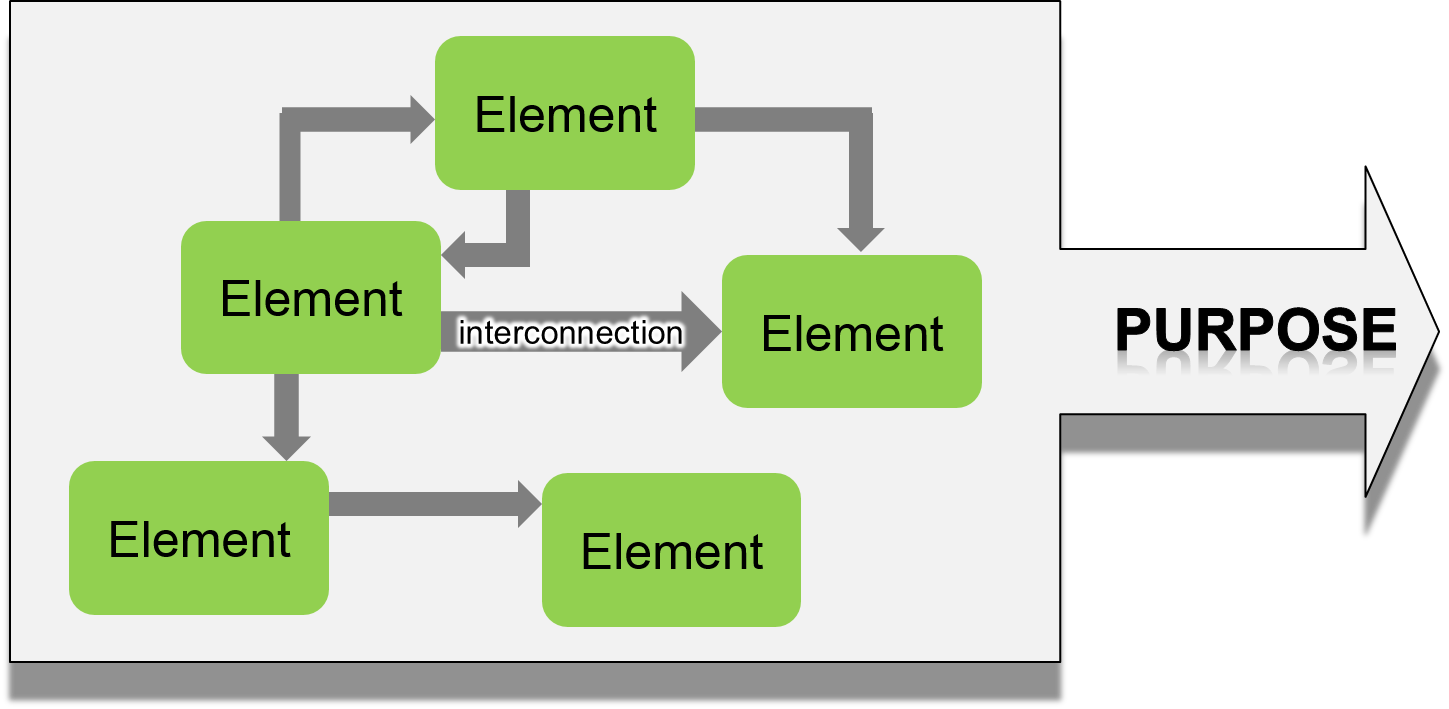
A critical insight from systems thinking is that a system's purpose is not what is stated, but what it actually does. Let's continue with the video to see how these components appear in different real-world systems.
Thinking in Systems, Key Ideas (Ch. 1)
Now, let's see how this three-part framework applies to various systems, from schools to healthcare.
Please watch from 01:51 to 05:49. Pay close attention to the table of examples. Importantly, notice the distinction the presenter makes between a system's stated purpose and its actual purpose.
2. Deconstructing Systems: Lingerie Production and Vee Relationships
To make this abstract framework concrete, let's apply it to your two areas of interest.
System 1: A Lingerie Production Line
Imagine the system responsible for producing one of your bra designs. We can break it down as follows:
| Component | Description |
|---|---|
| Purpose | To profitably produce and sell a specific bra design that meets customer needs for fit, comfort, and aesthetics (e.g., cleavage enhancement). |
| Elements | Designers, production managers, factory workers, raw materials (fabric, straps, clasps), machinery, marketing team, customers, budget. |
| Interconnections | Material Flows: Fabric moves from supplier to cutting table to sewing station. Information Flows: Design specs go to the factory; customer feedback goes to designers. Financial Flows: Revenue from customers pays for salaries and materials. Rules: Quality control standards, production deadlines, employment contracts. |
As you can see, the elements are the tangible parts, but the interconnections define how the system actually operates. The principle that "structure generates behavior", which we will explore throughout this module, means that the actions of the people (elements) are heavily influenced by these interconnections.
Interestingly, the presenter in the following video from MIT mentions having worked on lingerie brands like Playtex, highlighting that these same systemic principles apply across vastly different industries.
System Dynamics: Systems Thinking and Modeling for a Complex World
In this clip, the presenter from MIT's System Dynamics group explains why a background that includes both nuclear reactors and bras makes perfect sense from a systems thinking perspective.
Watch from 02:37 to 03:04. This serves as a good reminder that the underlying structure of systems is often similar, even if the elements are completely different.
System 2: The Vee Relationship
Now, let's apply the same analytical lens to a social system. Your experience as a social researcher and your interest in probability theory give you a strong foundation for seeing patterns and structures in human dynamics. The following article explicitly frames a Vee relationship as a "complex operational system," making it a perfect case study.
Vee Structure Polyamory Labor Management
This article provides a rigorous analysis of a Vee relationship, treating it as an operational system requiring explicit management. This aligns perfectly with our goal of defining a system by its core components.
Please read the 'concept' section, 'the hinge as the system bottleneck', and 'defining the vectors of relational labor'. As you read, identify the system's: Purpose: What is the operational goal of this system, according to the author? Elements: Who are the key actors in this system? Interconnections: What are the crucial flows and relationships that connect the actors?
Based on the article, we can deconstruct the Vee relationship system:
| Component | Description |
|---|---|
| Purpose | Stated: To foster love, connection, and intimacy among three individuals. Actual/Operational: To manage and allocate finite resources (time, emotional capacity, sexual energy) to maintain the stability of the relationship unit. |
| Elements | The Hinge partner, Metamour 1, and Metamour 2. |
| Interconnections | Communication Flows: Channeled and translated through the Hinge. Labor Flows: The flow of relational, emotional, and administrative labor, often disproportionately from the Hinge. Resource Flows: The allocation of the Hinge's time, attention, and energy. Rules/Logic: Attachment needs, sexual scripts, and explicit or implicit relationship agreements. |
This analysis demonstrates that even something as personal as a relationship can be understood as a system with a distinct structure and purpose.
3. The Hierarchy of Importance: Why Interconnections and Purpose Rule
A common trap is focusing too much on the elements of a system, because they are the easiest to see. However, the most profound changes to a system often come from altering its interconnections or its purpose.
This short article by Donella Meadows uses a powerful analogy to explain this hierarchy.
Donella Meadows on systems thinking: elements, interconnections, purposes
This text explains why changing a system's elements often has the least effect, while changing its interconnections or purpose can transform it entirely.
Please read the three main paragraphs of the article. Focus on the football team example and how it illustrates the relative power of changing elements, interconnections, and purpose.
To summarize the key insight:
- Changing elements (swapping players on a football team) might change performance, but it's still the same system—a football team.
- Changing interconnections (changing the rules from football to basketball) creates a completely different system, even with the same players.
- Changing the purpose (from winning to deliberately losing) fundamentally alters the system's behavior, even if the elements and interconnections remain the same.
In our Vee relationship example, the vee structure polyamory labor management article argues precisely this: the most common point of failure is not the people (elements), but the management of labor and resources (interconnections) and an unclear or unsustainable purpose. Shifting the purpose from a vague "let love guide us" to an explicit "we will rigorously manage our finite resources" fundamentally changes the system.
Conclusion
In this lesson, we established the foundational definition of a system. By breaking any system down into its core components, we can begin to understand how it functions and where the most powerful leverage points for change might be.
Key Takeaways:
- A system is an interconnected set of elements that is coherently organized to achieve a purpose.
- The three key components are Elements (the parts), Interconnections (the relationships and flows), and Purpose (the goal or function).
- A system's true purpose is what it does, not necessarily what it claims to do.
- In the hierarchy of a system, interconnections and purpose are often more influential in determining behavior than the individual elements.
You are now equipped with the basic lens of a systems thinker. In our next lesson, we will build upon this foundation by learning to map the structure of a system using stocks and flows. These are the fundamental building blocks for creating the causal loop diagrams we will use to diagnose the system archetypes in your FLATS GEDS mnemonic.