Welcome to the next lesson in our module on service integration. In the previous lesson, we explored how to improve the responsiveness of a single service by offloading slow I/O operations using FastAPI's BackgroundTasks. This is a powerful technique for optimizing performance within a service. Now, we'll shift our focus to managing how the outside world communicates with our entire system of microservices.
Today's lesson introduces a foundational pattern in microservices architecture: the API Gateway. We will explore its role as the front door to your application, focusing on its core responsibilities. Specifically, you will learn to explain the API Gateway pattern, including how it handles request routing, protocol translation, and authentication offloading. This knowledge is essential for designing a clean, secure, and manageable entry point into a distributed system.
1. The Problem with Direct Communication
In a monolithic architecture, clients (like a web browser or mobile app) typically communicate with a single, unified backend. The entry point is simple and clear. However, once we decompose a monolith into microservices, a new challenge emerges: how should clients interact with these numerous, independent services?
The most straightforward approach is direct client-to-microservice communication. Imagine an e-commerce application with separate services for Users, Products, and Orders.
A direct communication model where the client is responsible for calling multiple microservices.
This seemingly simple model introduces significant problems in a large-scale application. Let's explore them in detail by reading a section from Microsoft's guide on microservice architecture.
The API gateway pattern versus the direct client-to-microservice communication
This article provides a clear rationale for why direct client-to-service communication is problematic in complex systems, setting the stage for the API Gateway pattern.
Please read the sections titled "Direct client-to-microservice communication" and "Why consider API Gateways instead of direct client-to-microservice communication". As you read, focus on understanding the four key issues that arise: Too many round trips: How does fetching data for a single UI screen lead to "chatty" communication and increased latency? Coupling: Why does the client become fragile and difficult to maintain when it knows about the internal service structure? Security issues: What is the "attack surface," and how does exposing every microservice increase it? Protocol mismatch: Why can't a web browser directly communicate with services that use internal protocols like gRPC or AMQP?
As the article highlights, direct communication forces the client to be overly intelligent and tightly coupled to the backend architecture. Every time an internal service is refactored, renamed, or scaled, the client application might need to be updated. This creates a maintenance nightmare and slows down development.
2. The Solution: The API Gateway Pattern
To solve these problems, we introduce an intermediary layer: the API Gateway. The gateway acts as a single, unified entry point for all external requests. It's analogous to a reception desk in a large office building; instead of knowing the office number for every employee, you simply go to the reception, state your purpose, and they direct you accordingly.
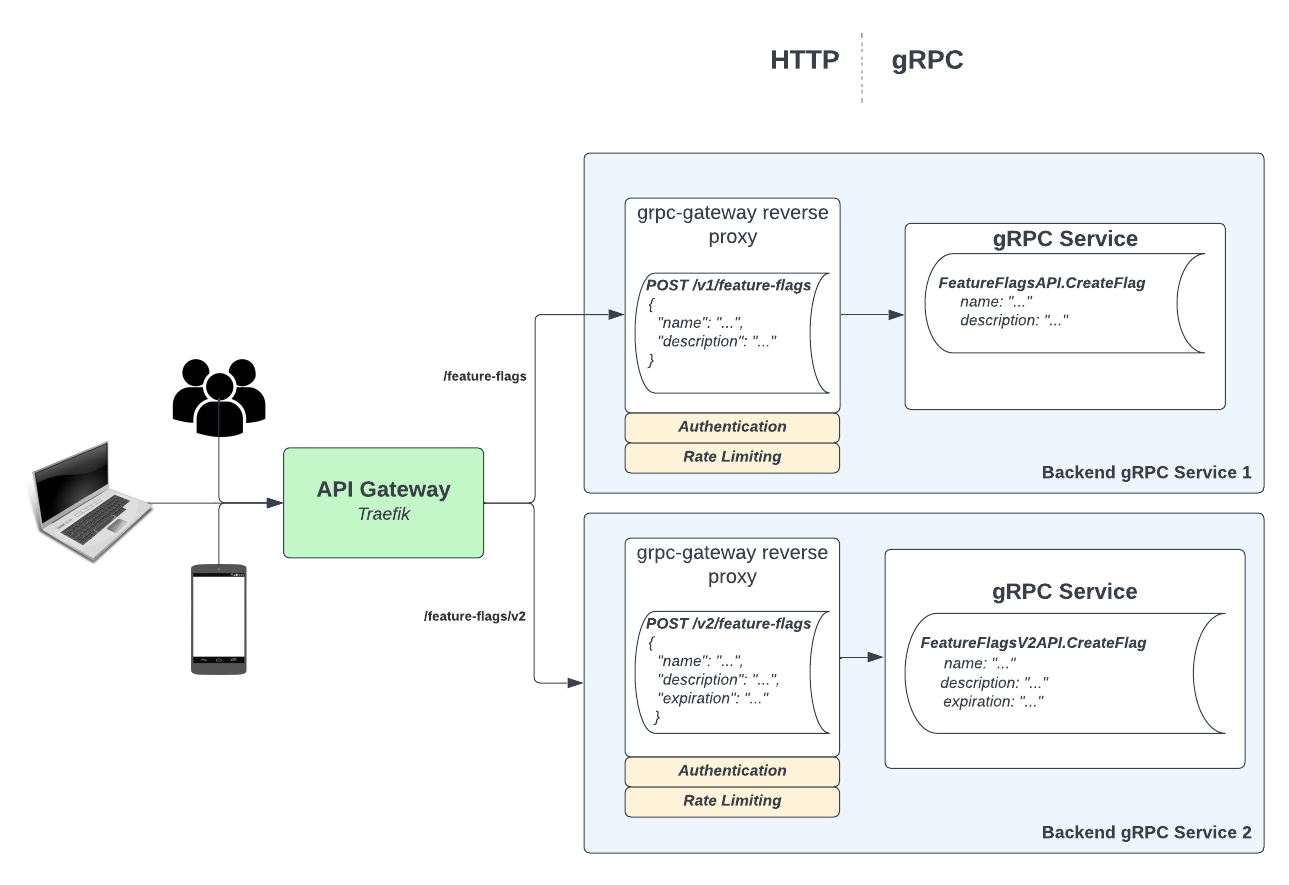
The API Gateway sits between the clients and the microservices, abstracting the complexity of the internal system. Clients send requests to the gateway, which then routes them to the appropriate downstream service(s).
This video provides a great high-level overview of the gateway's role and its primary functions.
The video "What is API Gateway?" from the ByteByteGo channel gives a concise visual explanation of the request flow through a gateway.
Watch the segment from the beginning until the end of step 8. Pay attention to the sequence of operations the gateway performs: validating the request, checking security policies, authenticating the user, and finally, routing and translating the request to the correct backend service.
As you saw, the gateway is much more than a simple router. It's a strategic control point for managing, securing, and observing all incoming traffic. Let's break down its three most critical functions.
3. Core Functions of an API Gateway
While an API Gateway can perform many tasks, its functionality can be grouped into a few core responsibilities that directly address the problems of direct communication.
a) Request Routing
The most fundamental job of the gateway is to act as a reverse proxy, directing incoming requests to the correct microservice based on the request path, headers, or other attributes. For example:
- A request to
GET /api/orders/123is routed to the Order Service. - A request to
POST /api/usersis routed to the User Service.
This routing decouples the client from the internal services. The client only needs to know the gateway's address. The internal services can be moved, scaled, or refactored without affecting the client, as long as the gateway's routing rules are updated accordingly. The API Gateway and gRPC Generation diagram above clearly shows how requests to /feature-flags and /feature-flags/v2 are routed to two different backend services.
b) Authentication Offloading
In a system with many microservices, you don't want to implement authentication and authorization logic in every single one. This is repetitive and makes security updates difficult.
The gateway provides a perfect place to centralize this logic. It can offload the responsibility of authenticating the user from the individual services.

The flow works as follows:
- The client authenticates with an identity provider (e.g., Auth0, Keycloak, or a custom identity service) and receives an access token (like a JWT).
- The client includes this token in the
Authorizationheader of every request to the API Gateway. - The API Gateway intercepts the request, validates the token, and ensures the user has the required permissions.
- If the token is valid, the gateway forwards the request to the appropriate microservice. It often adds headers containing the validated user ID or roles, so the downstream service can perform business logic without re-validating the token.
This simplifies the internal services significantly. They can trust that any request coming from the gateway has already been authenticated.
c) Protocol Translation
This function is especially relevant to our course. Our goal is to build high-performance internal services using gRPC. However, most external clients, particularly web browsers, cannot easily make gRPC calls. They speak HTTP/1.1 and expect JSON payloads.
The API Gateway can act as a protocol translator, bridging the gap between the external, client-friendly world of REST and the internal, high-performance world of gRPC.
gRPC API Gateway: Bridging the Gap Between REST and gRPC
This article from Zuplo explains exactly why we need a gateway to expose gRPC services to the outside world.
Read the sections "The gRPC Challenge: External Accessibility" and "gRPC Gateway: The Original Bridge". This will clarify why gRPC is great for internal communication but poses a challenge for external clients and how a gateway that translates protocols is the solution.
The gateway receives an incoming HTTP request (e.g., POST /users with a JSON body), translates it into a gRPC request (a Protobuf message), calls the internal gRPC service, and then translates the gRPC response (another Protobuf message) back into an HTTP response with a JSON body for the client. This gives you the best of both worlds: a standard, easy-to-use public API and a highly efficient internal network protocol.
4. Trade-offs and Best Practices
While the API Gateway pattern is powerful, it's not without its drawbacks. Introducing a gateway adds another component to your system that must be developed, deployed, and maintained.
Key considerations include:
- Single Point of Failure: If the gateway goes down, your entire application is unavailable. Therefore, the gateway must be highly available and resilient.
- Potential Performance Bottleneck: All traffic passes through the gateway. It must be horizontally scalable to handle the load.
- Development Bottleneck: If one team owns a single, monolithic gateway for the entire organization, they can become a bottleneck for other teams who need to expose new endpoints.
To avoid creating a new "monolithic gateway," a common best practice is to use the Backend for Frontend (BFF) pattern. Instead of one giant gateway, you create multiple, smaller gateways tailored to the needs of specific clients. For example, you might have one gateway for your mobile app that is optimized for low-bandwidth connections and another for your web app that provides a richer data set.
What is the API Gateway pattern?
Let's return to the Microsoft article to understand the BFF pattern and the potential drawbacks of using a gateway.
Read the section "What is the API Gateway pattern?", paying close attention to the part that discusses segregating gateways and introduces the "Backend for Frontend" (BFF) pattern. Also, read the final section, "Drawbacks of the API Gateway pattern," to get a balanced view.
Conclusion
In this lesson, you've learned about the critical role of the API Gateway in a microservices architecture. It acts as a shield and a controller, simplifying client interactions and centralizing cross-cutting concerns.
Key Takeaways:
- Direct client-to-microservice communication leads to tight coupling, chatty interfaces, and duplicated security logic.
- The API Gateway pattern solves these issues by providing a single, unified entry point to the system.
- Core functions of a gateway include:
- Request Routing: Decoupling clients from the internal service topology.
- Authentication Offloading: Centralizing security and simplifying internal services.
- Protocol Translation: Bridging the gap between external protocols like REST/HTTP and internal ones like gRPC.
- An API Gateway can also handle other concerns like rate limiting, caching, and logging.
- To avoid creating a new monolith, consider the Backend for Frontend (BFF) pattern, where you deploy smaller gateways for specific client applications.
Preview of the Next Lesson
Theory is essential, but practice is where understanding solidifies. In the next lesson, we will put these concepts into action by building a FastAPI service that acts as a REST-to-gRPC API Gateway. You will write the code to receive an HTTP request, translate it into a gRPC call to an internal microservice, and return the response. This will be our first step in truly connecting our async services together.