Welcome back! In our previous lessons, we've focused on building a system where services communicate directly and wait for a response. Your API Gateway, for instance, makes synchronous gRPC calls to downstream services and waits for their data before replying to the client. This request-response pattern is powerful and intuitive, but it's not the only way for services to talk to each other.
This lesson marks a crucial pivot in our course. We'll move beyond synchronous communication and explore its alternative: asynchronous messaging. You'll learn the fundamental trade-offs between these two patterns, which is one of the most important architectural decisions you'll make when designing a distributed system. We'll analyze when to use a direct RPC call versus when to send a "fire-and-forget" event to a message broker.
By the end of this lesson, you'll be able to analyze a business requirement and confidently choose the right communication style, balancing trade-offs like system coupling, performance, and resilience.
1. The Two Worlds of Communication: Synchronous vs. Asynchronous
At a high level, inter-service communication can be divided into two categories. Let's start by looking at the model you're already familiar with.
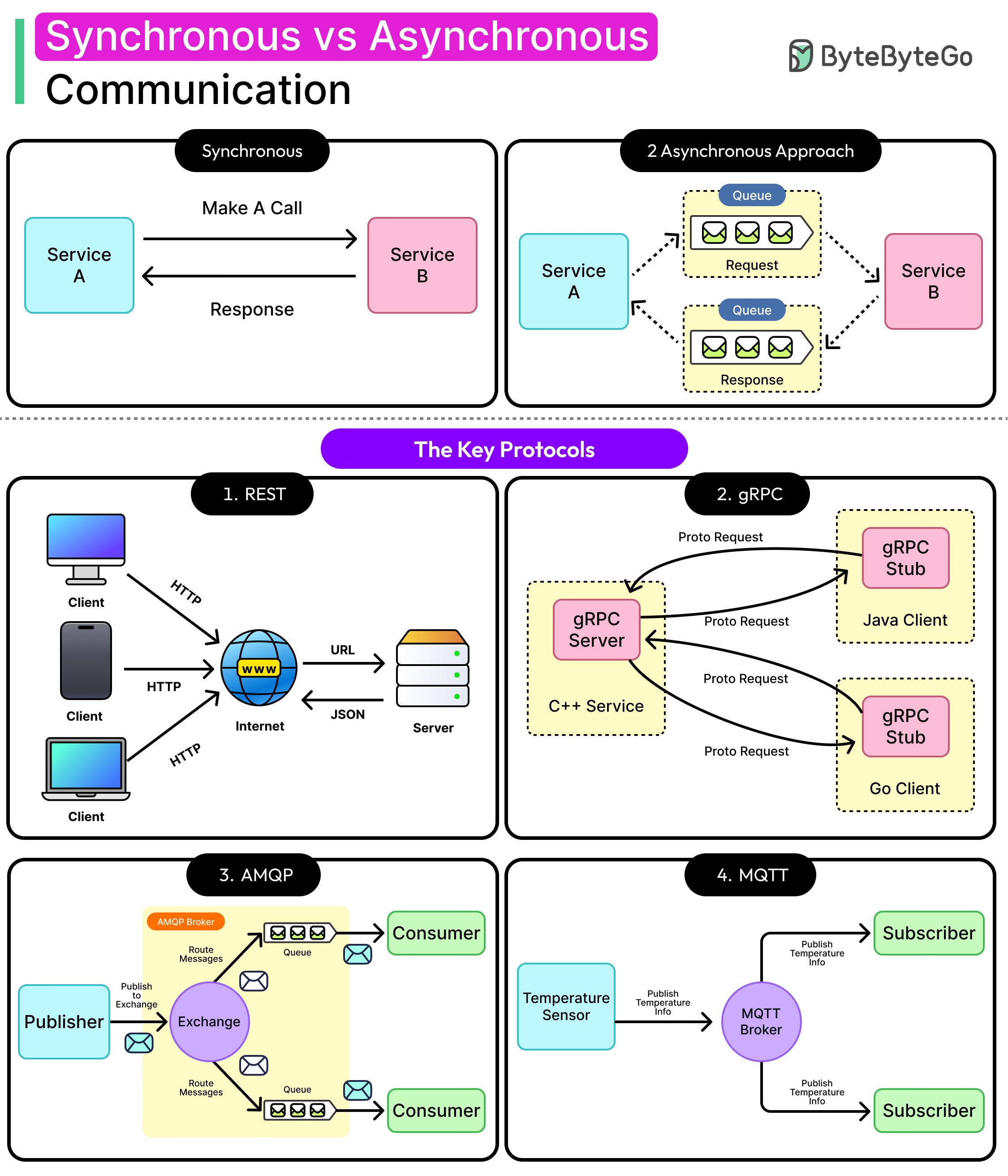
To get a detailed overview of both patterns, their mechanics, and their pros and cons, let's watch a video that breaks them down using a clear, real-world example.
Synchronous and Asynchronous Communication between Microservices
The video "Synchronous and Asynchronous Communication between Microservices" by Arpit Bhayani provides an excellent and thorough comparison.
Please watch the following sections carefully: Synchronous Communication Defined: Start with the explanation of synchronous communication. Notice how it's described as a blocking call and how it relates to technologies you know, like REST and gRPC. Pros and Cons of Synchronous: Watch the segment on the advantages (simplicity, real-time) and the disadvantages (blocking, tight coupling, cascading failures). When to Use Synchronous: Pay close attention to the use cases for synchronous communication. This is key for making practical design decisions.
Synchronous RPC: The Phone Call
As the video explains, synchronous communication, often implemented with Remote Procedure Calls (RPC) like REST or gRPC, is like a phone call.
- You dial the number (make a request).
- You wait for the other person to pick up and give you the information you need (wait for the response).
- You cannot do anything else while you are on that call (the process is blocked).
Key Characteristics:
- Tightly Coupled: The client (caller) and server (callee) must both be available at the same time. The client needs to know the server's location (address). This is called temporal coupling.
- Immediate Consistency: When you get a successful response, you know the operation has completed and the data is consistent at that moment.
- Simple Mental Model: It's straightforward to reason about the flow of execution.
However, as you saw, this leads to challenges like cascading failures. If Service C is slow or down, Service B (which calls C) becomes slow, which in turn makes Service A slow.
2. Asynchronous Messaging: The Text Message
Now, let's explore the alternative. Asynchronous communication is like sending a text message or an email.
- You write and send the message (publish an event).
- You put your phone away and continue with your day (the process is not blocked).
- The recipient will see the message and reply when they are available (the consumer processes the event eventually).
This pattern introduces a new component: a message broker (like RabbitMQ, Kafka, or Redis), which acts as a "mailbox" between services.
Let's continue with the video to see how this works in practice.
Synchronous and Asynchronous Communication between Microservices
Let's continue with the same video from Arpit Bhayani.
Now, focus on the asynchronous half of the discussion: Asynchronous Communication Defined: Watch the introduction to asynchronous communication. Note the central role of the message broker. Pros and Cons of Asynchronous: Watch the segments on its advantages (decoupling, scalability, resilience) and disadvantages (eventual consistency, complexity). When to Use Asynchronous: Finally, understand the ideal use cases, such as long-running tasks and fan-out scenarios.
Key Characteristics:
- Loosely Coupled: The producer (sender) and consumer (receiver) don't need to be available at the same time. The producer only needs to know the address of the message broker. This decoupling provides immense resilience and flexibility.
- Eventual Consistency: Since the consumer processes the event at a later time, the system's state is not immediately consistent across all services. There is a delay (latency) before the change is reflected everywhere.
- Higher Complexity: You now have an additional piece of infrastructure (the broker) to manage, and tracing a request flow across multiple asynchronous steps can be more difficult.
3. A Head-to-Head Comparison
Let's solidify these concepts by looking at a practical e-commerce scenario and a detailed breakdown of the trade-offs.
Event-Driven Architecture and Microservices
This article provides a great, high-level business case for asynchronous communication, framing it as Event-Driven Architecture (EDA).
Read the following sections to see a direct comparison: Start with "The Problem We All Know But Don’t Talk About" and "Enter the Game Changer: Event-Driven Architecture" for a clear analogy. Then, review the "A Real-World Example: E-commerce Done Right" section. This provides a perfect, concrete comparison of a synchronous vs. event-driven "Buy Now" flow. Finally, read "The Challenges (Because Nothing’s Perfect)" to get a balanced view of the complexities involved.
The e-commerce example in the article is a classic illustration. A synchronous "Buy Now" call would have to wait for the payment, inventory, and notification services sequentially, leading to high latency for the user. In an asynchronous flow, the order service can immediately confirm the order to the user and publish an OrderPlaced event. Other services then react to this event in parallel, and the user isn't forced to wait.
The following table provides a concise summary of the trade-offs, which is an invaluable reference for system design.

4. Making the Architectural Choice
So, how do you decide? The choice is never about one being universally "better." It's about matching the pattern to the specific business need. The article "Architectural Strategies for Data Sharing" provides a fantastic strategic comparison.
Architectural Strategies for Data Sharing in Distributed Python Systems
This article provides a deep, technical dive into different data sharing strategies, perfect for your background.
Focus on these key sections: "Strategy II: Synchronous API Communication (REST vs. gRPC)": Skim this to reinforce your understanding of the synchronous approach. The benchmark numbers comparing REST and gRPC are particularly insightful. "Strategy III: Asynchronous Messaging (RabbitMQ vs. Kafka)": Read this to understand the asynchronous alternative in more technical detail. "Conclusion and Strategic Comparison": This is the most important section. It provides a clear framework for deciding which pattern to use based on requirements for latency, consistency, and coupling.
Here is a summary of the decision-making framework:
| Use Synchronous Communication (RPC) when... | Use Asynchronous Communication (Messaging) when... |
|---|---|
| The caller needs an immediate response to continue its work. | The task can be performed in the background ("fire and forget"). |
| The operation is a query (read operation). | The operation is a command (write operation) that doesn't need an immediate result. |
| You need strong consistency. | Eventual consistency is acceptable. |
| The interaction is a short-running, real-time task (e.g., payment). | The task is long-running (e.g., generating a report, transcoding a video). |
| The services are part of a single, atomic transaction. | You need to notify multiple services about a single event (fan-out). |
| Simplicity is a primary concern. | Resilience and scalability under spiky loads are the primary concern. |
Example from our E-commerce System:
- Synchronous: When a user tries to log in, the API Gateway must call the User Service synchronously to validate credentials and get a token. The gateway cannot proceed without this response.
- Asynchronous: After a user places an order, the Order Service could publish an
OrderPlacedevent. A separate Notification Service would consume this event to send a confirmation email. The user doesn't need to wait for the email to be sent before seeing their order confirmation screen.
Conclusion
In this lesson, you've explored the fundamental architectural choice between synchronous RPC and asynchronous messaging. You learned that this is not an "either/or" decision; a well-designed distributed system uses both patterns strategically, leveraging the strengths of each.
Key Takeaways:
- Synchronous (RPC): Offers simplicity and immediate consistency but creates tight coupling and risks cascading failures. Best for real-time queries and commands that require an immediate response.
- Asynchronous (Messaging): Provides loose coupling, scalability, and resilience by using a message broker as an intermediary. It introduces complexity and eventual consistency. Best for background tasks, long-running jobs, and event notifications.
- The choice of communication style is a critical design trade-off that depends entirely on the business requirements of the interaction.
Preview of the Next Lesson
Now that you understand the "why" and "when," it's time for the "how." In the next lesson, we will get hands-on and implement our first asynchronous communication pattern. You will learn how to use Redis Pub/Sub to build a simple, lightweight publish-subscribe system for inter-service notifications, taking the first practical step into event-driven architecture.