Welcome to the third lesson in our course. Having set up a professional and secure Python environment in our previous sessions, we are now ready to shift our focus from the tooling to the technology itself. This lesson tackles a fundamental question: what exactly is a Large Language Model?
Your goal is to become proficient in prompt engineering and fine-tuning, and a solid mental model of how an LLM operates is the bedrock for both skills. Understanding the core mechanics will demystify the process, transforming it from "magic" into a predictable, albeit complex, algorithm. This knowledge is crucial for writing effective prompts and for diagnosing why a model produces a certain output.
Today, we will dissect the text generation process. You will learn that at its heart, an LLM is a sophisticated next-token predictor, and you will understand the iterative, probabilistic loop it uses to construct sentences, paragraphs, and entire documents from a simple prompt.
What Does an LLM Really Do?
It's common to think of an LLM as a system that "understands" and "answers" questions. While the results can certainly feel that way, the underlying mechanism is much simpler and more algorithmic. At its core, a Large Language model does just one thing: given a sequence of text, it predicts the single most likely piece of text that should come next.
This is the principle of next-token prediction. Everything else—chatting, summarizing, writing code—is an emergent capability built on top of this single, repetitive task.
The following brief video from 3Blue1Brown provides an excellent, high-level intuition for this process.
Large Language Models explained briefly
This video, "Large Language Models explained briefly," offers a clear and concise conceptual overview of the next-word prediction mechanism.
Watch the entire short video in full. Pay close attention to how it frames the LLM as a function that assigns probabilities to all possible next words and builds a response iteratively.
As the video explains, the model doesn't operate on words directly, but on tokens. For now, you can think of tokens as words or pieces of words. We will explore them in much greater detail in our next lesson.
The LLM takes your input prompt (as a sequence of tokens), processes it, and then generates a list of probabilities for every single token in its vocabulary.
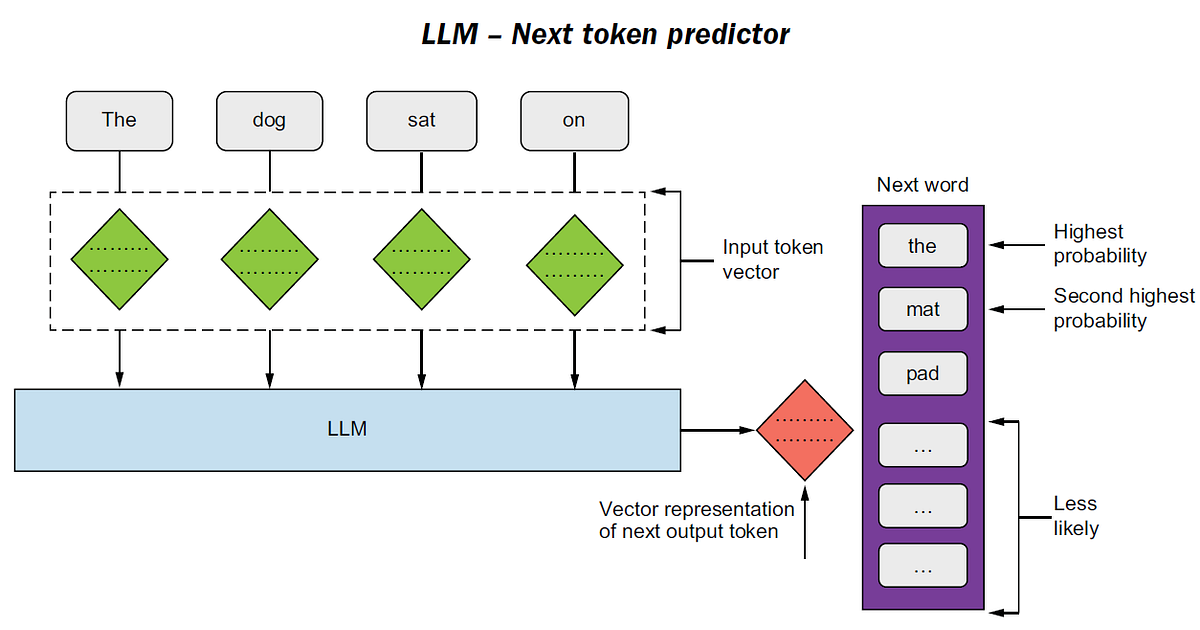
This process of scoring all possible next tokens is the fundamental computation the model performs. It doesn't "pick" the word directly; it assesses the likelihood of all candidates.
From a Single Token to Full Paragraphs: The Autoregressive Loop
If the model can only predict one token at a time, how does it generate long, coherent responses? It does so through an iterative process often called an autoregressive loop. The term "autoregressive" simply means that the model's next output depends on its previous outputs.
Here’s how the loop works:
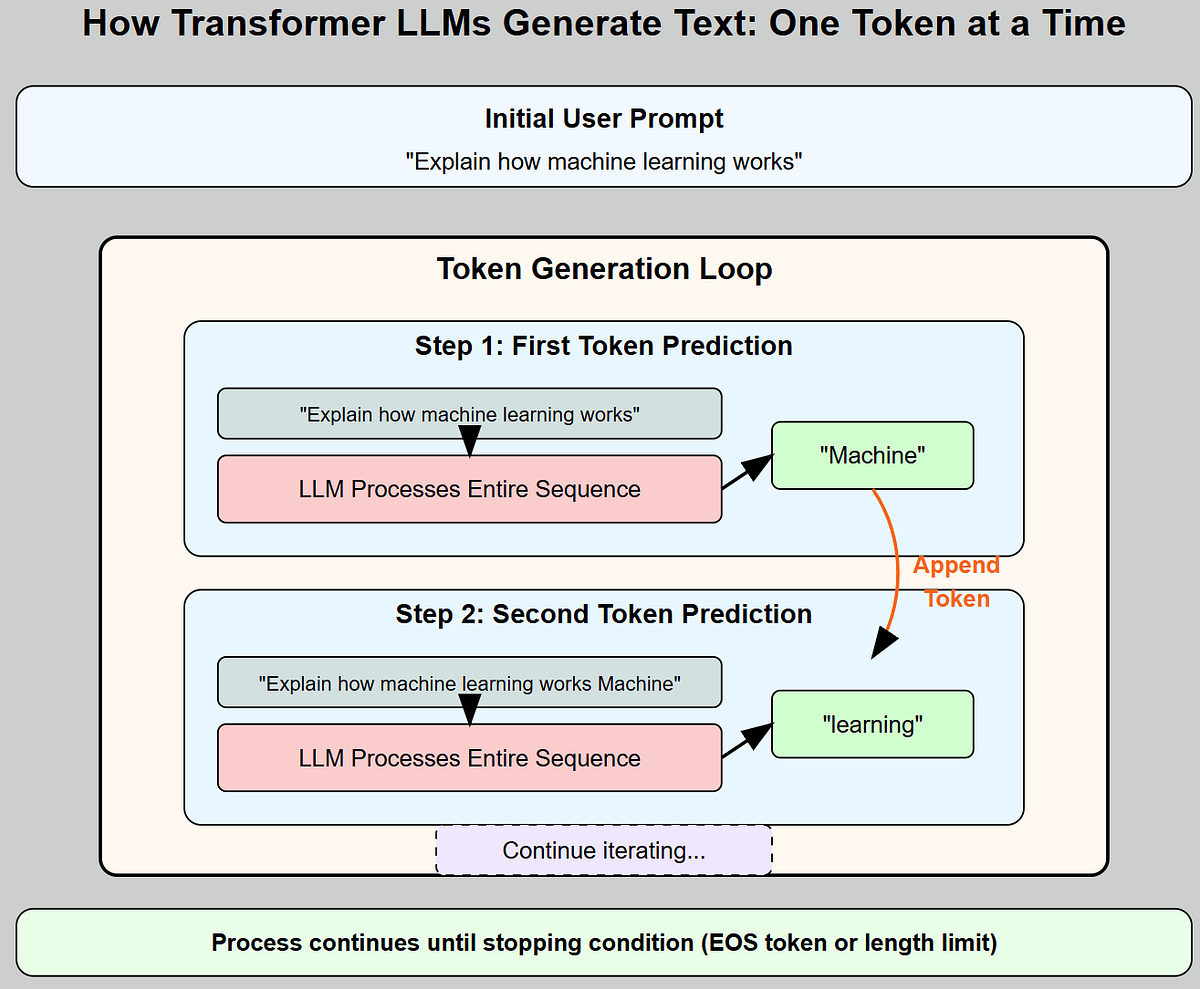
- Initial Prompt: The process starts with your input text (e.g., "Explain how machine learning works").
- First Prediction: The LLM takes this prompt and predicts the very first token of the response (e.g., "Machine").
- Append and Repeat: The newly predicted token is appended to the input text. The new, longer sequence ("Explain how machine learning works Machine") is then fed back into the model.
- Second Prediction: The model processes this new sequence and predicts the next token (e.g., "learning").
- Continue: This cycle of predicting a token, appending it to the sequence, and feeding it back into the model continues until a stopping condition is met, such as the model generating a special "end-of-sequence" token or reaching a predefined length limit.
The following diagram perfectly illustrates this iterative cycle.
Given your background in programming, this iterative process might remind you of building a result inside a for loop. The following article provides a clear explanation and even includes some Python-like pseudo-code that formalizes this generation loop.
How LLMs Work, Explained Without Math
This article by Miguel Grinberg breaks down the generation process into simple, understandable steps. It's a great non-mathematical explanation of the core concepts.
First, read the section Next Token Predictions to solidify your understanding of the model's core output. Then, carefully study the section Generating Long Text Sequences. The pseudo-code for the generate_text() function is particularly relevant, as it clearly shows the iterative loop we've been discussing.
The Generation Pipeline: A Four-Stage Process
We can formalize this entire process into a clear, four-stage pipeline that happens for every single token that is generated. The LearnThatStack video below provides a fantastic overview before we dive into a more detailed article.
How LLMs Actually Generate Text (Every Dev Should Know This)
The video "How LLMs Actually Generate Text" gives a dynamic, step-by-step walkthrough of the entire token generation pipeline.
Watch from the beginning to understand the five key steps the video identifies: the overview. Then, focus on the core generation mechanism. Watch how the model produces scores, converts them to probabilities (probabilities), and then repeats this process in a loop (the loop).
This process can be broken down as follows. The article "How LLMs Generate Text for the Rest of Us" provides a superb, structured explanation.
How LLMs Generate Text for the Rest of Us
This article provides an excellent breakdown of the text generation pipeline, clarifying the distinct roles of each stage. It's written with developers in mind and clarifies common points of confusion.
Read the sections from One token at a time... through to The Text Generation Pipeline. Focus on understanding the four stages: Tokenization, Inference, Decoding, and Detokenization. Pay special attention to the key insight: the inference stage scores tokens, it doesn't pick them.
Let's summarize the pipeline described in the article:
- Tokenization: The input text is converted into a sequence of tokens the model can understand.
- Inference: This is the heavy lifting. The model's neural network takes the token sequence and computes a raw score (called a logit) for every token in its vocabulary, representing how likely each one is to be the next token. This part of the process is deterministic; the same input will always produce the same logits.
- Decoding (Sampling): The raw logit scores are converted into a probability distribution (usually with a function called softmax). Then, a single token is selected from this distribution. This is where randomness is introduced. Instead of always picking the token with the highest probability (a greedy approach), we often sample from the distribution. This is why you can get different responses to the same prompt. The parameters you will learn to control, like
temperature, directly influence this selection stage. - Detokenization: The chosen token's ID is converted back into readable text and appended to the ongoing response.
This four-stage pipeline is the engine of the autoregressive loop. It executes once for every single token in the model's output.
Conclusion
In this lesson, we pulled back the curtain on Large Language Models. You now have a foundational understanding of how they generate text. This is not a magical or sentient process, but a powerful and complex algorithmic loop.
The key takeaways are:
- Core Function: LLMs are fundamentally next-token predictors. Their primary job is to calculate the probability distribution for the next token in a sequence.
- Iterative Generation: Long-form text is built one token at a time in an autoregressive loop, where each new token is added to the input for the next prediction cycle.
- Probabilistic, Not Deterministic: The model outputs scores (logits) for all possible next tokens. The "creativity" and variability of LLMs come from the decoding stage, where one token is sampled from these probabilities. The core inference step is deterministic.
Having established this high-level model of text generation, we are perfectly positioned for our next lesson. We will zoom in on the concepts we introduced today, defining exactly what tokens are, how tokenization works, the crucial role of the context window (the model's "memory"), and the nature of model parameters.