Hello! Welcome to the first lesson of our new module, Marketing Dashboards & Reporting.
In our previous module, we finished by connecting Google Analytics 4 and Google Ads. This created a powerful system for tracking conversions and building remarketing audiences. We ended with a crucial question: if a potential guest interacts with your hotel through multiple marketing channels—like seeing a Meta ad, then clicking a Google ad, and finally booking directly—which channel should get the credit for that booking?
This lesson will answer that question. We'll be tackling the learning outcome: Explain different attribution models (e.g., last-click, data-driven) and their implications. Understanding attribution is fundamental to accurately measuring the return on your marketing investments and making informed decisions about where to allocate your budget.
1. What is Marketing Attribution?
Imagine a potential guest's journey to booking a room at your hotel:
- Monday: They see a beautiful video ad for your hotel on Instagram while scrolling (Awareness).
- Wednesday: Thinking about a trip, they search on Google for "boutique hotels in [your city]" and click on your paid search ad (Consideration). They browse your site but don't book.
- Friday: They decide to book. They search for your hotel's name directly, click the organic search result, go to your website, and complete the booking (Conversion).
Which of these "touchpoints"—the Instagram ad, the Google ad, or the organic search result—was responsible for the booking? The honest answer is that they all played a role.
Marketing attribution is the science of assigning credit for conversions to the various touchpoints in a customer's journey. The "rule" you use to assign this credit is called an attribution model.
To get a clear overview of why this is so important in the hospitality industry, let's start with a short article from Additive, a hotel marketing agency.
Attribution models for campaign optimization in hotel marketing
This article, 'Attribution Models for Campaign Optimization', introduces the concept of attribution from a hotelier's perspective.
Please read the introduction, starting from 'Which marketing activities truly drive booking success?' down to the heading 'Types of attribution models'. Focus on how it frames the customer journey and the goal of attribution.
As the article explains, the model you choose determines how you value each of your marketing channels, directly influencing your future campaign strategy and budget allocation.
2. The Common Attribution Models
There are several standard attribution models, each with its own logic for distributing credit. These can be grouped into two main categories: single-touch models, which give 100% of the credit to one touchpoint, and multi-touch models, which spread the credit across several touchpoints.
Let's explore the most common ones. The following video from Paid Media Pros provides a concise and clear explanation of each.
This video clearly explains the six main attribution models available in Google Ads, from the simplest to the most complex. It will form the foundation of our understanding.
Watch the segment from 01:08 to 06:21. The speaker explains Last Click, First Click, Linear, Time Decay, Position Based, and Data-Driven models. Pay close attention to how each one works.
Let's summarize what you just watched.
Single-Touch Models
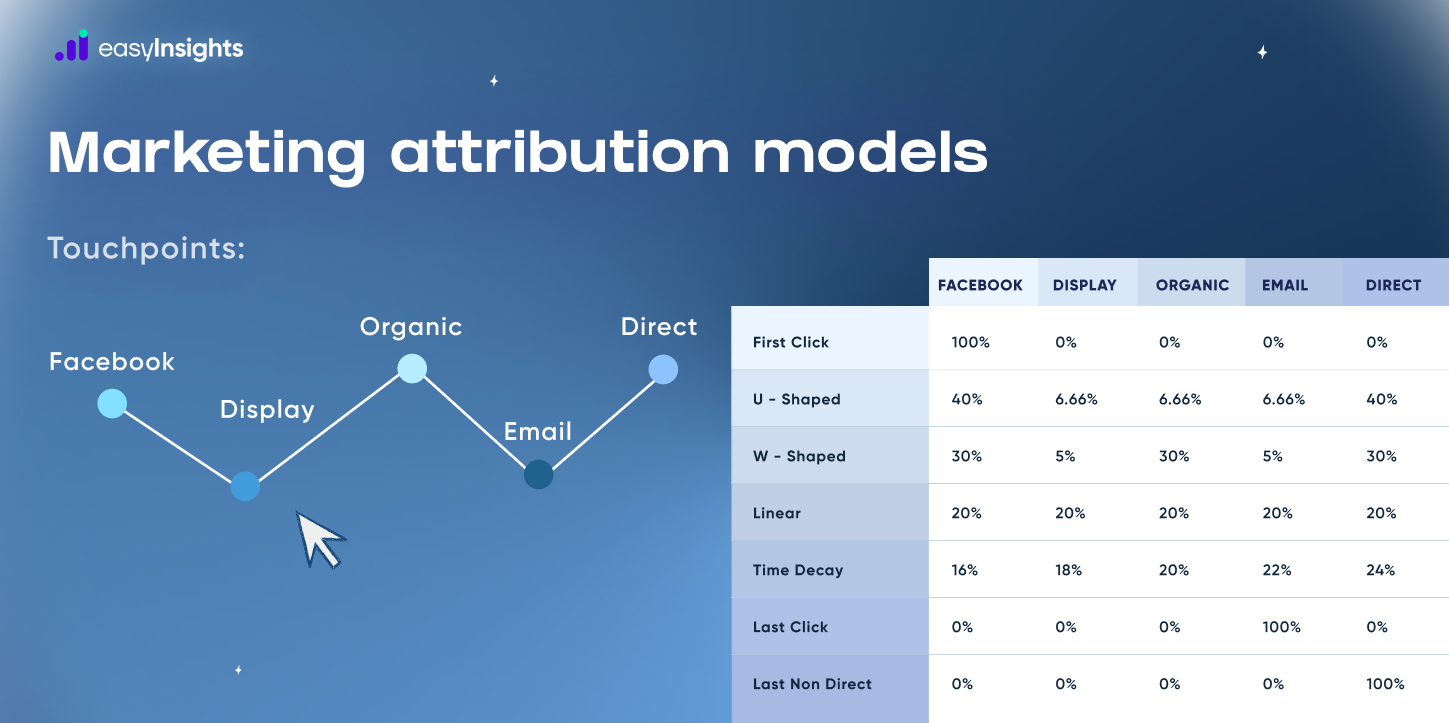
- Last-Click: Gives 100% of the credit to the very last touchpoint before the conversion. In our example, the organic search result would get all the credit. This is the historical default for many platforms.
- First-Click: Gives 100% of the credit to the very first touchpoint. In our example, the Instagram ad would get all the credit.
Multi-Touch Models (Rules-Based)
- Linear: Splits credit equally among all touchpoints. Our Instagram ad, Google ad, and organic search result would each get 33.3% of the credit.
- Time-Decay: Gives more credit to touchpoints closer in time to the conversion. The organic search result would get the most credit, the Google ad would get less, and the Instagram ad would get the least.
- Position-Based (or U-Shaped): Gives a large share of credit to the first and last touchpoints (e.g., 40% each) and distributes the remaining 20% among the middle touchpoints. This model values both the channel that created awareness and the one that closed the deal.
Algorithmic Model
- Data-Driven: This model uses your account's specific conversion data and machine learning to calculate the actual contribution of each touchpoint. It's not based on a fixed rule but on what the data shows is driving conversions for your hotel. It requires a significant amount of data to work effectively (as mentioned in the video, Google Ads requires at least 300 conversions in 30 days for this model to be available).
The following image provides a fantastic visual summary of how these models distribute credit across a hypothetical customer journey.
Test your understanding!
A potential guest's journey to booking a spa package is:
- Clicks a Meta ad promoting your hotel's wellness offerings.
- A week later, clicks a Google Search ad for "spa weekend deals."
- The next day, receives and clicks a link in a promotional email.
- Immediately books the spa package for $500.
Under a Position-Based (U-shaped) model (40% first, 40% last, 20% middle), how much revenue credit would the Google Search ad receive?
Show answer
The Google Search ad is the "middle" touchpoint. It would receive 20% of the credit.
- Meta Ad (First): 40% of $500 = $200
- Google Search Ad (Middle): 20% of $500 = $100
- Email (Last): 40% of $500 = $200
3. The Implications: Which Model is Right for Your Hotel?
Choosing an attribution model is not just a technical setting; it's a strategic decision that reflects your business goals. Your choice will dramatically change how you perceive the performance of your campaigns.
- If you use Last-Click: You will likely undervalue your awareness campaigns on platforms like Meta. You might conclude that "Meta ads don't work" because they rarely get the last click, even though they may be essential for introducing new guests to your hotel. Brand search campaigns (people searching for your hotel's name) will look extremely effective.
- If you use First-Click: You will better understand which channels are filling the top of your marketing funnel. This is useful if your primary goal is brand awareness and reaching new audiences.
- If you use a Multi-Touch or Data-Driven model: You will get a more balanced and holistic view of how your channels work together. This helps you justify budget for both awareness (Meta) and high-intent (Google Search) campaigns.
To think about this more strategically, let's turn to an article from Expedia Group. It outlines a practical framework for choosing a model.
Practical steps to develop a marketing attribution model
This article, 'Practical steps to develop a marketing attribution model', provides a strategic framework for thinking about which model to choose. It's written from the perspective of a major player in the travel industry.
Read 'Step 1: Define the scope' and 'Step 2: Design the model'. Focus on the questions it poses about the product sales cycle, customer type, and customer journey. These are the strategic considerations you should have for your hotel.
As the Expedia article suggests, the right model depends on your answers to key questions:
- What is your sales cycle? A booking for a family holiday has a much longer consideration period than a last-minute business trip. A longer lookback window might be necessary to capture the full journey.
- What is the campaign's goal? Are you trying to attract new guests who've never heard of you? A First-Click or Position-Based model might better reflect the value of your awareness ads. Are you trying to capture bookings from people ready to decide? Last-Click might seem relevant, but a Data-Driven model will more accurately weigh the final touchpoints.
- Where are you in the journey? Your Meta ads might be great for upper-funnel "discovery," while your Google Search ads are for mid-funnel "comparison." A model that credits both is essential for a balanced view.
For most businesses today, including hotels, the consensus is to move away from single-touch models like Last-Click. They provide a dangerously incomplete picture. Rules-based multi-touch models (Linear, Time-Decay, Position-Based) are a good step up. However, if you have enough conversion data, Data-Driven attribution is the recommended standard in both Google Ads and Google Analytics 4 because it removes the guesswork and uses your actual performance data to model reality.

Conclusion
In this lesson, we've demystified the complex but critical topic of marketing attribution. You now have the conceptual framework to understand not just what the different models are, but what they mean for your hotel's marketing strategy.
Key Takeaways:
- Attribution assigns value: It's the process of giving credit to the marketing efforts that lead to a booking.
- Last-Click is limited: While simple, the default last-click model ignores the crucial role of upper and mid-funnel marketing, like your social media campaigns.
- Multi-touch models tell a story: Models like Linear, Time-Decay, and Position-Based acknowledge that the entire customer journey has value.
- Data-Driven is the goal: When available, the Data-Driven model provides the most accurate and customized view of what's truly working for your hotel.
- Your model choice is strategic: The model you use should align with your business goals, whether it's growing awareness, maximizing direct bookings, or both.
What's Next?
Now that you understand how to measure the value of your marketing channels, the next step is to visualize this performance data in a way that's easy to understand and share with stakeholders.
In our next lesson, we will connect GA4 and Google Ads as data sources to Looker Studio (formerly Data Studio). You'll learn the first steps in building a professional marketing dashboard, moving us from theoretical understanding to practical reporting.