Hello! Welcome to the final lesson of our module on Cross-Platform Strategy & Budgeting.
In our last lesson, we established a framework for selecting and standardizing KPIs to compare performance between Google and Meta. You learned to focus on Primary KPIs like ROAS and CPA to make high-level decisions, and Diagnostic KPIs like CPC and CTR to understand why performance is what it is.
Now, we put that knowledge into action. This lesson addresses a critical question every advertiser faces: when should I invest more in what's working, and when should I seek out the next big win? We will tackle the learning outcome: Evaluate when to scale successful campaigns versus reallocating budget to testing. This is where data-driven insights translate into strategic budget decisions that directly impact your hotel's profitability.
1. The Core Principle: Balancing Exploitation and Exploration
Profitable advertising is a constant cycle of two activities:
- Exploitation (Scaling): Capitalizing on what you know works. This means putting more budget behind your proven, profitable campaigns to maximize returns.
- Exploration (Testing): Searching for new opportunities. This involves allocating a portion of your budget to test new creatives, audiences, or strategies to find your next winning campaign.
Relying only on scaling leads to stagnation and ad fatigue. Relying only on testing means you never fully capitalize on your successes. The key is a balanced budget.
A simple, effective model for allocating your advertising budget is the 70/20/10 rule:
- 70% to "Proven Winners" (Scaling): The majority of your budget goes to campaigns that consistently meet or exceed your target ROAS or CPA.
- 20% to "Informed Tests" (Testing Variations): This budget is for testing new creatives or audiences within a proven framework. For example, testing new ad copy for your best-performing Google Search campaign.
- 10% to "High-Risk Experiments" (New Initiatives): This is for exploring entirely new ideas, like testing a new platform or a campaign for a new service like a hotel spa package.
This framework, which is discussed in the guide you'll read below, ensures you are always protecting your core profits while simultaneously fueling future growth.
The Complete Guide to Profitable Ads Management
The article 'The Complete Guide to Profitable Ads Management' from Adsagenz provides a great high-level overview of this balanced approach. It emphasizes smart budget allocation and the principle of testing small before scaling.
Please read the subsections titled 'Step 2: Test Small, Then Scale', 'Step 3: Allocate Wisely', and the section '1. Smart Ad Budget Allocation and Planning'. Notice how they advocate for a structured, non-emotional approach to budget allocation.
2. The Decision Framework: When to Scale vs. Test
Your primary KPIs from the last lesson—ROAS and CPA—are your signals for action.
You should SCALE when:
- A campaign is consistently hitting or exceeding your target ROAS/CPA. For example, if your goal is a $150 cost per booking (CPA) and a campaign is delivering bookings at $100.
- The campaign is not limited by audience size or search volume. (e.g., Google Ads shows the campaign is "Limited by budget").
- Performance has been stable or improving over a significant period (e.g., 2-4 weeks).
You should REALLOCATE TO TESTING when:
- Performance of a scaled campaign is declining. Key diagnostic metrics like
Frequencyare high (e.g., >4-5 on Meta), suggesting ad fatigue. - You've maxed out the potential of a successful campaign and are seeing diminishing returns (i.e., increasing the budget further makes the CPA unprofitable).
- You have no proven winners yet and are in a discovery phase for a new offering (e.g., promoting your hotel's new restaurant).
- You want to proactively find new growth opportunities by targeting different guest personas (e.g., targeting "conference attendees" instead of just "leisure travelers").
3. Scaling and Testing on Meta Ads
With its powerful machine learning, Meta's platform thrives when you feed it diverse creative assets and clear signals. The most effective modern strategy involves separating your scaling and testing efforts into two distinct campaigns.
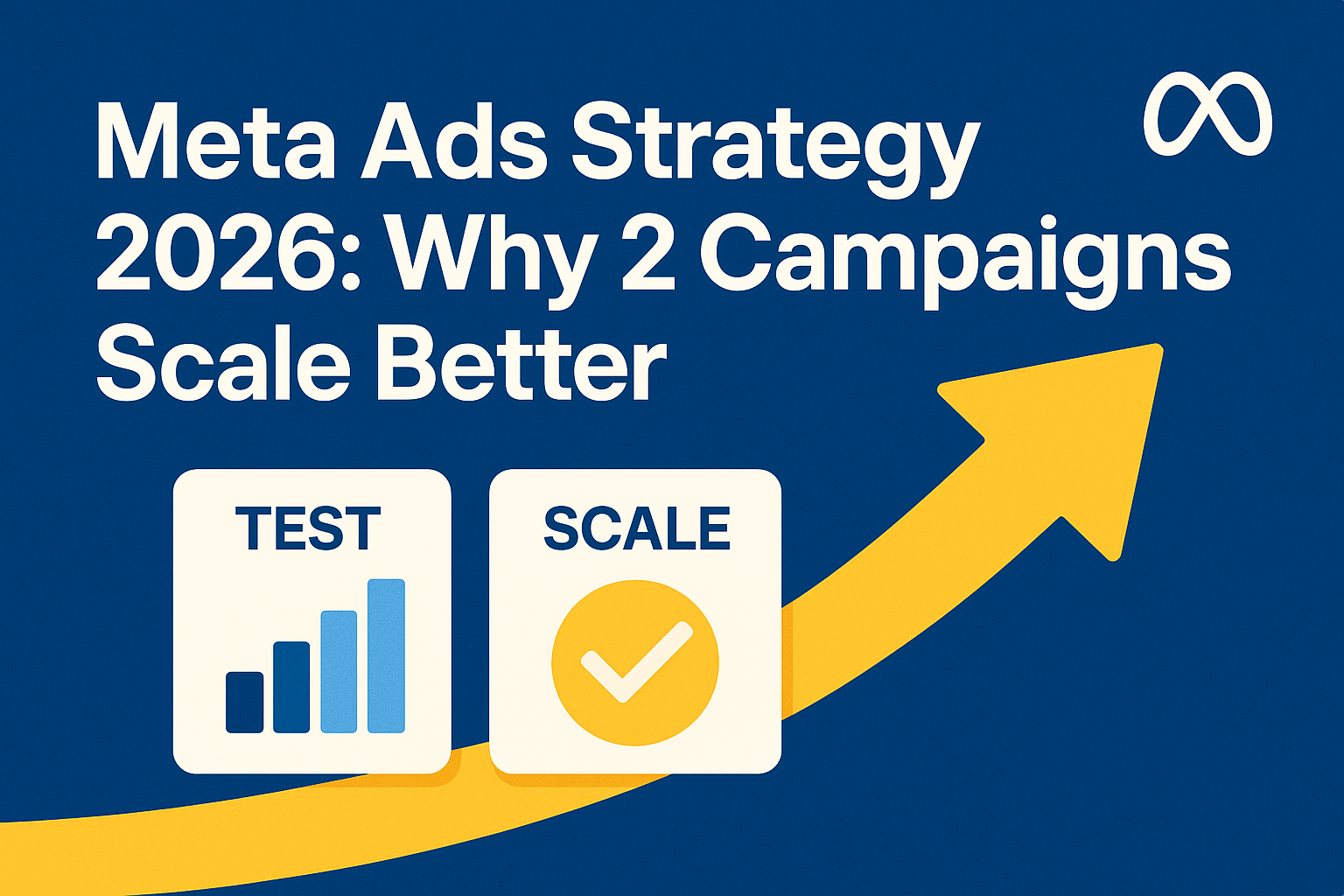
The following video provides an excellent, in-depth guide to this framework, tailored for how the platform operates today and will in the near future.
How to Actually Test Facebook Ads in 2026 (Meta Andromeda Update)
The video 'How to Actually Test Facebook Ads in 2026' by Ole Strand explains a powerful two-step framework that aligns perfectly with Meta's machine learning. Pay close attention to the concepts of 'creative diversity' and the specific campaign setups.
Please watch from 05:06 to 08:42 to understand 'Creative Diversity'. Then, watch from 12:31 to 19:54 to see exactly when and how to implement the testing vs. scaling framework. The speaker provides clear criteria for making the decision.
Summary of the Meta Framework:
1. The Structure:
- Scaling Campaign: One Advantage+ Shopping Campaign. This is where your proven, top-performing ads live. It should receive the majority of your budget (e.g., 70-80%) when performance is stable.
- Testing Campaign: One standard CBO (Campaign Budget Optimization) campaign. This is where you launch new ad sets with new ad variations weekly. It gets the remaining 20-30% of your budget.
2. The Evaluation: What to Test?
Your decision to test should be driven by what you want to learn. The video introduces two types of "creative diversity":
- Format Diversity: Testing different ad formats for a persona that is already working well.
- Hotel Example: If ads targeting "families" are performing well, you could test a video tour of the family suite vs. a carousel ad showing the pool and kids' play area vs. a static image of a family enjoying breakfast.
- Persona Diversity: Testing ads designed to appeal to entirely new guest segments.
- Hotel Example: If you've saturated the "families" audience, you could launch a test targeting "digital nomads" with ads highlighting your co-working space and high-speed Wi-Fi, or "foodie couples" with ads for a "dine and stay" package.
You prioritize format diversity when a persona is working well and you want to squeeze more performance out of it. You move to persona diversity when you see diminishing returns and need a new avenue for growth.
3. The Process: From Test to Scale
An ad "graduates" from the Testing campaign to the Scaling campaign only when it meets two criteria:
- It hits your target CPA/ROAS.
- It achieves a significant volume of conversions/spend. A single lucky conversion on a $20 spend isn't a proven winner. The ad needs to show it can perform with a meaningful budget.
Real-World Example: Palladium Hotel Group
Even major hotel groups are constantly testing. This case study shows how Palladium Hotel Group tested a new strategy against their existing successful campaign to see if they could improve it.
Palladium Hotel Group - Meta for Business
This case study on the Palladium Hotel Group is a perfect real-world example of testing in action. It shows how they used an A/B test to evaluate a new feature and ultimately gained confidence in their existing scaling strategy.
Read the 'Goal', 'Solution', and 'Results' sections. Note how they formed a hypothesis, set up a clear A/B test between two approaches, and used the results to make a strategic decision.
Palladium's test confirmed their existing Advantage+ campaign was more effective on its own. This is a crucial outcome of testing: it not only finds new winners but also validates your current scaling strategy, giving you the confidence to continue investing in it.
4. Scaling and Testing on Google Ads
Scaling on Google Search is different because you are constrained by search intent and volume. You can't simply create more demand like on Meta; you have to capture the demand that already exists. When a campaign is profitable but hitting its budget cap, it's a prime candidate for scaling. However, increasing the budget too quickly can disrupt the algorithm.
This is where the "stairstep" method comes in.
How to Scale Google Ads Campaigns in 2025
The video 'How to Scale Google Ads Campaigns in 2025' from Grow My Ads provides a clear, practical method for safely increasing the budget of successful Google Ads campaigns.
Please watch from the beginning to 04:13. Focus on the logic behind the 'stairstep' approach and the recommended 20% budget increase rule.
Summary of the Google Framework:
1. The Scaling Process (Stairstep Method):
- Identify: Find a campaign that is hitting your target CPA/ROAS and is labeled "Limited by budget."
- Increase: Raise the daily budget by a controlled 10-20%. A large, sudden increase can shock the algorithm and lead to inefficiency.
- Wait: Allow 1-2 weeks for the campaign to re-optimize at the new spend level. Your CPA might temporarily increase during this "learning phase."
- Evaluate: If the CPA stabilizes back at your target, you can repeat the process. If it stays too high, you may have found the campaign's scaling limit.
2. When to Test on Google:
While scaling on Google is often about budget increases, testing is about improving efficiency and finding new pockets of intent. You would reallocate budget to test:
- New Ad Groups: Based on insights from the Search Terms Report (which we will cover in a later module).
- New Ad Copy: Using Responsive Search Ads to test different headlines and descriptions (e.g., "Free Breakfast" vs. "Book Direct & Save").
- Different Bidding Strategies: Testing 'Target CPA' vs. 'Maximize Conversion Value'.
- New Keyword Match Types or expanding to new, related keywords.
Test your understanding!
Here are three scenarios for your hotel. Based on what you've learned, would you SCALE or TEST, and what specific action would you take?
- Scenario A: Your Google Search campaign for "hotel near downtown" has a target CPA of $200 and is consistently getting bookings for $150. It is marked as "Limited by budget."
- Scenario B: Your Meta retargeting campaign, which shows ads to recent website visitors, used to have a 10x ROAS. Over the last month, the ROAS has fallen to 6x and the
Frequencymetric is 6.2. - Scenario C: Your Meta campaign targeting "users interested in luxury travel" is delivering an 8x ROAS. You have only been using video ads. You believe you can get even more bookings from this audience.
Show answer
-
Decision: SCALE. The campaign is profitable and has room to grow.
- Action: Apply the stairstep method. Increase the daily budget by 20% and monitor performance for the next 1-2 weeks.
-
Decision: TEST. Performance is declining and ad fatigue is the likely cause (high frequency).
- Action: Keep the existing campaign running (perhaps with a slightly lower budget) but allocate budget to your testing campaign to launch a new set of creatives for this retargeting audience. Use fresh images, new video testimonials, or a different offer to combat the fatigue.
-
Decision: TEST (specifically, test for Format Diversity). The persona is working well, but you might be leaving money on the table by only using one format.
- Action: In your testing campaign, launch an ad set targeting the same "luxury travel" interest group, but test new formats like high-quality carousel ads showcasing different rooms and amenities, or stunning static images of the hotel's best features. If they perform well, you can add them to your scaling campaign.
Conclusion
You have now completed the final piece of your cross-platform strategy puzzle. The decision to scale or test isn't a one-time choice but a continuous rhythm that drives sustainable growth.
Key Takeaways:
- Balance is key: A healthy ad account exploits proven winners through scaling while exploring new opportunities through testing. The 70/20/10 rule is a great starting point for budget allocation.
- Use KPIs as your guide: Let your target ROAS and CPA tell you when a campaign is ready to scale or when it's time to re-evaluate.
- Tailor your approach to the platform:
- On Meta, use a two-campaign (Test/Scale) structure to manage creative diversity and feed the algorithm.
- On Google, use the methodical "stairstep" approach to scale profitable search campaigns without sacrificing efficiency.
- Testing confirms success: Running tests not only uncovers new winners but also validates your current scaling choices, giving you the confidence to invest.
What's Next?
In this module, you've learned how to map out a cross-platform strategy, select KPIs to measure it, and decide when to scale or test. Now, you need to become an expert at digging into the data to understand customer behavior more deeply.
In our next module, Actionable Insights with Google Analytics 4, we will shift our focus to your website. You'll learn how to build reports that show you exactly what users are doing after they click your ads, identify drop-off points in your booking funnel, and uncover the user journeys that lead to the most valuable guests. This will provide you with even richer data to inform your future testing and scaling decisions.