Hello! In our last session, we established a foundational vocabulary for understanding Large Language Models by defining tokens, parameters, inference, and the context window. You then began building "The Artificer's Lexicon" to create clear, layered explanations for your future students.
Today, we shift our focus from the internal mechanics to the external impact. Our goal is to identify real-world Generative AI applications relevant to working professionals across industries. For the course you're designing, this is a critical step. Your students, as working professionals, will need to see not just what GenAI is, but what it does for them and their fields. We'll survey the landscape of GenAI use cases, providing you with a rich inventory of examples to draw from when creating compelling, relevant learning quests.
A Landscape of Opportunity
Generative AI is not a niche technology for a single purpose; it's a versatile engine for innovation that's being applied across the entire economy. To get a sense of this breadth, let's start with a high-level overview.
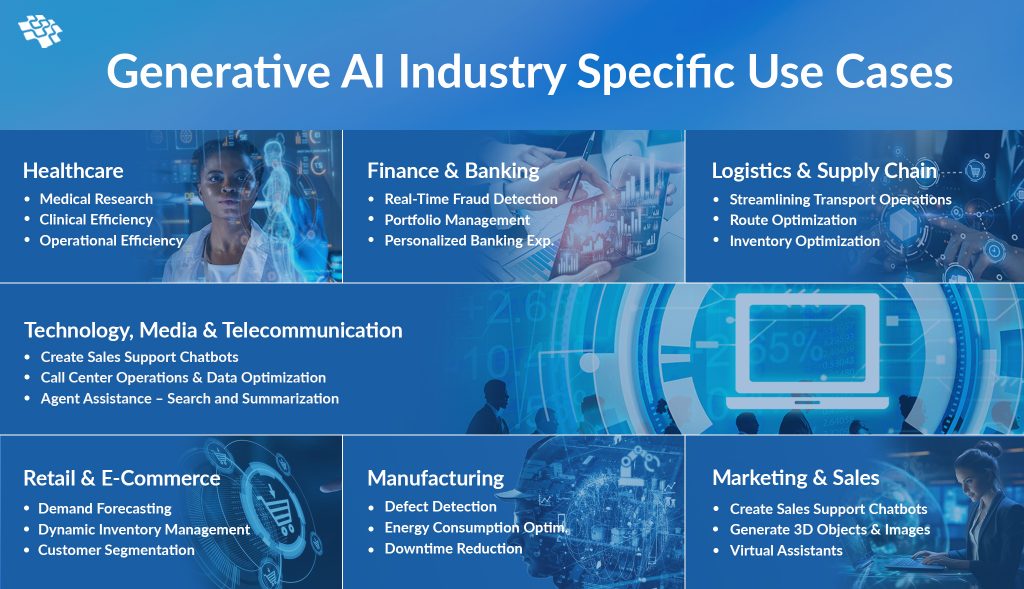
As you can see, the applications range from highly technical (drug discovery, route optimization) to creative and customer-facing (personalized banking, chatbot support). We will explore several of these areas to understand the specific problems GenAI is solving.
Exploring Key Professional Domains
To ground our exploration, we'll examine how GenAI is being deployed in several key industries. We won't just list applications; we'll look at the value they create.
16 Examples of Generative AI Applications - RTB House
This article from RTB House offers a superb, well-structured overview of GenAI use cases. It provides concrete examples that are perfect for illustrating the technology's practical value to a professional audience.
First, read the brief introduction, "What is Generative AI?", to refresh the distinction between generative and traditional AI. Next, explore the "8 Generative AI applications in marketing" section. Focus on these three examples to see how GenAI is used in a creative and business context: Personalized ad copy Visual content generation Conversational chatbots Finally, jump to the section "8 applications of Generative AI in business, science, and education." Read the following subsections to get a broader perspective: Healthcare and life sciences Finance and banking Education and training This last one is especially relevant to your work as an educator and course designer.
The examples you've just read—from synthesizing molecular data in drug discovery to creating adaptive learning platforms in education—show that GenAI's value lies in its ability to both automate repetitive work and augment human expertise in complex, creative tasks.
A Strategic View on Adoption
Understanding individual applications is one thing; understanding how they fit into a business strategy is another. As you design a course for professionals, it's helpful to frame GenAI adoption not as a single event, but as a journey.
Integrating Generative AI Into Business Strategy: Dr. George Westerman
In this talk from MIT, Dr. George Westerman provides a management-level perspective on integrating GenAI. He moves beyond technical descriptions to discuss how organizations are actually implementing this technology.
First, watch the segment from this section on GenAI examples. Dr. Westerman provides a rapid-fire tour of applications, including coding assistants, call center tools, and personalized tutoring. Notice how he connects these tools to tangible business improvements. Next, jump to this later segment, where he outlines a three-level framework for how companies are adopting GenAI: Individual Productivity: Giving employees safe, internal LLMs to help with daily tasks like summarizing documents. Specialized Roles and Tasks: Transforming specific functions like call centers or coding, often with a human in the loop. Direct Customer Impact: Using GenAI in customer-facing applications like conversational e-commerce. This framework is a powerful tool for you as a course designer. It can help you tailor your learning activities to professionals whose companies might be at different stages of this journey.
Deep Dive: Software Engineering
Given your M.Tech in Computer Science and extensive experience as a technical trainer, let's take a closer look at the domain where you have the most expertise: software development. GenAI isn't just a topic for developers to learn about; it's becoming a fundamental tool of the trade.
Generative AI for Software Engineering: Use Cases and Limitations - Edvantis
This article from Edvantis focuses squarely on the software development lifecycle, a topic you know well. It provides a balanced view of both the powerful use cases and the practical limitations of today's AI coding assistants.
Please read the following three sections: Code Generation and Reviews. This discusses how tools like GitHub Copilot are used for boilerplate code and speeding up reviews. Code Refactoring. This explores using AI for documentation, reducing technical debt, and even code conversion, while noting the risks of incorrect suggestions. Test Case Generation. This covers how AI can automate the creation of unit tests, a significant time-saver in the QA process.
These applications in software engineering are prime examples of the "augmentation" we discussed earlier. The AI doesn't replace the developer but acts as a tireless partner, handling repetitive tasks and offering suggestions, which frees up the developer to focus on higher-level system design and complex problem-solving. This is a crucial point to convey to the professionals in your course.
Your Project: The "Scenario Scavenger Hunt"
Now, let's translate this knowledge into another building block for your course. Your students will learn best when they can connect these abstract applications to their own professional lives. You'll design an activity to help them do just that.
Quest: "Scenario Scavenger Hunt"
Objective: Create a set of challenge-based learning scenarios that map real-world GenAI applications to specific professional roles.
Your Task:
- Select Three Industries: Choose three different industries from the ones we've discussed (e.g., Finance, Healthcare, Retail, Software Development, Marketing).
- Define a Role and a Problem: For each industry, identify a specific job role (e.g., Financial Analyst, Clinical Research Coordinator, E-commerce Manager). Then, describe a realistic, recurring problem or a time-consuming task that person faces in their job.
- Design a "Challenge Card": For each role, create a "challenge card" or "mini-quest." This card should:
- Briefly introduce the professional's role and their problem.
- Pose a challenge: "How could Generative AI help [Role] solve [Problem]?"
- Prompt the learner to propose a solution, specifying what kind of GenAI application (e.g., text summarization, data analysis, image generation, chatbot) would be most effective.
Example Challenge Card:
- Role: Marketing Manager, Small Tech Startup
- Problem: "We're launching in three new countries next quarter, but our small team has no time or budget to manually translate and adapt all our website copy, blog posts, and social media campaigns for each region's language and cultural nuances."
- Challenge: "Propose a GenAI-powered workflow to help the marketing manager tackle this localization challenge. What specific GenAI capabilities would be most useful?"
This quest will create a set of reusable, role-playing scenarios that make the impact of GenAI tangible and personal for your future students.
Conclusion
In this lesson, we've moved from the microscopic world of tokens and parameters to a panoramic view of GenAI's real-world impact. We've seen how it's being used to:
- Accelerate research and development in fields like healthcare and manufacturing.
- Enhance decision-making and efficiency in finance and logistics.
- Augment human creativity and productivity in marketing, education, and software engineering.
You also now have a strategic framework for thinking about how organizations adopt this technology, which will be invaluable as you guide professionals on their own learning journeys.
In our previous lessons, we've covered what GenAI is and where it's used. Now, we're ready to tackle the big question: how does the underlying technology actually work? In our next session, we will finally open the black box and explore the transformer architecture at a conceptual level, focusing on the revolutionary mechanism of self-attention that powers modern LLMs.