Hello! In our previous lessons, we surveyed the vast landscape of Generative AI applications, moving from the internal mechanics of tokens and parameters to the technology's real-world impact. You designed a "Scenario Scavenger Hunt" to help your future students connect these applications to their professional lives.
Having covered what GenAI is and where it's used, we're now ready to address the fundamental question of how it works. This lesson fulfills that promise by opening up the "black box." Our goal is to explain the transformer architecture at a conceptual level, including the role of self-attention. For you as an educator, this is the foundational knowledge required to explain the magic behind modern LLMs. We'll dissect the architecture that powers models like GPT, providing you with the clarity needed to design effective learning activities for your own course.
A Bird's-Eye View of the Transformer
The transformer architecture was introduced in a 2017 paper titled "Attention Is All You Need." It revolutionized the field by demonstrating a new way to process sequential data, like text, that was more parallelizable and effective at capturing long-range dependencies than its predecessors (like Recurrent Neural Networks).
Most modern Large Language Models, including those in the GPT family, are based on this architecture. Let's start with a high-level diagram.

The original design had two main parts:
- The Encoder: Its job is to read and "understand" an input sequence (e.g., a sentence in English). It builds a rich numerical representation of the input.
- The Decoder: Its job is to generate an output sequence (e.g., the translation in Spanish), using the encoder's understanding of the input as context.
While this two-part structure is essential for tasks like translation, many popular generative models you use today (like GPT-3 and ChatGPT) are decoder-only transformers. They are exceptionally good at one core task: predicting the next word in a sequence. For this lesson, we will focus on the components of a decoder-only model, as it is the foundation of most modern text-generation tools.
The Journey of a Token: From Word to Vector
A transformer, like any neural network, doesn't understand words; it understands numbers. The first step in the process is to convert the input text into numerical vectors that capture both the meaning and the position of each word. This happens in the Embedding layer.
LLM Transformer Model Visually Explained
This interactive article provides a fantastic, step-by-step visualization of how a GPT-2 model processes text. We'll use it to walk through the key components.
Start by reading the section on Embedding. This covers the four key steps involved: Tokenization: Breaking text into pieces. Token Embedding: Converting each token into a vector that represents its meaning. Positional Encoding: Creating another vector that represents the token's position in the sequence. Final Embedding: Combining the token and positional embeddings. Pay close attention to why positional encoding is necessary. Unlike older models that process words one by one, transformers look at the entire sequence at once. Without positional encoding, the model would see the input text as a "bag of words" with no order.
The StatQuest video below offers another excellent and clear visualization of how positional encoding works using sine and cosine functions to give each position a unique signal.
Transformer Neural Networks, ChatGPT's foundation, Clearly Explained!!!
This video from StatQuest with Josh Starmer is known for its clear, step-by-step explanations.
Watch the segment on positional encoding. The animation of the sine and cosine "squiggles" provides a strong intuition for how each word's position is given a unique numerical signature.
The Core Mechanism: Self-Attention
Once we have our position-aware embeddings, they are fed into the main processing units of the model: a stack of Transformer Blocks. The revolutionary component inside each block is the self-attention mechanism.
Self-attention allows the model to weigh the importance of different words in the input sequence when processing a specific word. It's how the model builds contextual understanding. Consider the sentence: "The animal didn't cross the street because it was too tired." To understand what "it" refers to, a human naturally pays attention to "animal." Self-attention enables the model to do the same thing.
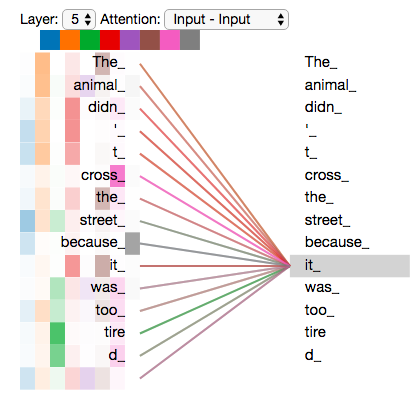
So, how does this work computationally? The 3Blue1Brown video below provides one of the best conceptual explanations available.
Attention in transformers, step-by-step | Deep Learning Chapter 6
This video by Grant Sanderson (3Blue1Brown) is a masterclass in building intuition for complex mathematical concepts. We will watch it in segments to understand the attention mechanism from the ground up.
The Goal of Attention (Watch this first): This segment sets the stage, explaining why context is crucial and how attention helps refine a word's meaning (e.g., the different meanings of "mole"). Query, Key, and the Attention Pattern (Next, watch this part): This is the core of the mechanism. It introduces the three key vectors—Query (Q), Key (K), and Value (V)—that are created for each input token. Pay attention to the analogy: a token sends out a "query" (what I'm looking for), and all other tokens present their "keys" (what I have). The dot product between a query and a key creates a relevance score. Softmax, Masking, and Values (Continue with this segment): This part explains how the raw relevance scores are normalized into weights (using softmax) to form the "attention pattern." It also introduces the Value (V) vector, which represents the information a token offers. The final output for a token is a weighted sum of all other tokens' Value vectors. Multi-Head Attention (Finally, watch this segment): A single attention mechanism is powerful, but "multi-head" attention is even better. This explains how the model runs multiple self-attention processes in parallel, each with its own set of Q, K, and V matrices. This allows different "heads" to learn to focus on different kinds of relationships (e.g., one head for syntax, another for semantic meaning).
To summarize the self-attention process for a single token:
- Create Vectors: From the token's embedding, generate three smaller vectors: a Query (Q), a Key (K), and a Value (V).
- Calculate Scores: Calculate an attention score by taking the dot product of this token's Query with the Key of every other token in the sequence. This measures relevance.
- Normalize Scores: Pass the scores through a softmax function to turn them into weights that sum to 1. This is the attention pattern.
- Calculate Output: Create the final output vector for this token by summing all the Value vectors in the sequence, weighted by the attention scores from the previous step. The result is a new representation of the token that is now rich with context from its neighbors.
The Full Transformer Block
The multi-head attention mechanism is the star, but it's part of a larger structure called a Transformer Block. A complete block typically includes:
- A Multi-Head Self-Attention layer.
- An Add & Norm layer. This involves a residual (or "shortcut") connection, which adds the original input of the layer to its output, followed by layer normalization. Given your CS background, you can think of the residual connection as being analogous to its use in ResNet architectures to help with training deep networks.
- A Feed-Forward Network (FFN). This is a standard two-layer neural network that processes each token's vector independently. While attention allows tokens to exchange information, the FFN provides additional computational depth to process that new information.
- Another Add & Norm layer.
An input sequence passes through this entire block, and the output vectors become the input for the next identical block. A model like GPT-2 stacks 12 of these blocks, while larger models like GPT-3 stack 96. Each block refines the token representations further, allowing the model to capture increasingly complex and abstract patterns.
From Final Vector to Final Word
After passing through the entire stack of transformer blocks, we are left with a final set of processed vectors. To predict the next word, the model takes the vector corresponding to the last token in the sequence. This vector is passed through a final linear layer and a softmax function. This produces a probability score for every single word in the model's vocabulary. The model can then sample from this probability distribution to pick the next word.
Your Project: "The Oracle's Insight" Quest
Now it's time to apply this new knowledge. For the course you're designing, one of the biggest challenges is explaining a complex topic like self-attention to beginners. A well-crafted analogy or simulation can be incredibly effective. This task ties directly into a learning outcome in Module 5 of our course plan.
Quest: "The Oracle's Insight"
Objective: Design a game-based activity (an analogy or simulation) that teaches the concept of self-attention to a non-technical audience.
Your Task:
- Choose a Metaphor: Brainstorm and select a compelling core analogy for self-attention. Some ideas to get you started:
- A team of detectives in an evidence room, where each detective (token) looks for clues (values) based on a specific query.
- A group of chefs in a kitchen, where each chef adjusts their part of the meal based on what the other chefs are doing.
- A magical library where words physically glow and connect to other relevant words to reveal a hidden meaning.
- Define the Game Mechanics: Flesh out your chosen metaphor.
- What are the "rules" of your game or story?
- How do you represent the core concepts: Tokens, Queries, Keys, and Values? For example, in the detective analogy, the Query might be the detective's current line of questioning, the Keys are the labels on evidence boxes, and the Value is the content of the box.
- How do you represent the "attention score"? Perhaps it's the "relevance" a detective assigns to a piece of evidence.
- How do you represent the final weighted sum? Maybe it's the summary of the most relevant clues the detective writes in their notebook.
- Draft an Explainer: Write a short (2-3 paragraph) narrative explanation of this activity, as if you were presenting it to students in your course. This text should introduce the analogy and explain how it helps them understand how an AI "thinks" about context.
This will become a valuable asset for your course, turning an abstract technical concept into an engaging and memorable learning experience.
Conclusion
In this lesson, we deconstructed the transformer architecture that powers modern LLMs. We saw how it's not magic, but a sequence of well-defined computational steps.
Key Takeaways:
- Transformers process text by first converting words into numerical embeddings and adding positional encodings to retain sequence order.
- The core innovation is self-attention, which allows the model to dynamically weigh the importance of all words in a sequence when processing any single word.
- The mechanism of Query, Key, and Value vectors is the computational engine behind self-attention, allowing the model to measure relevance and aggregate contextual information.
- Multi-head attention allows the model to learn different types of relationships in parallel, increasing its power and nuance.
- These components are packaged into Transformer Blocks which are stacked to form a deep network capable of learning complex language patterns.
We've now seen how the model is structured. In our next lesson, we will explore the LLM training pipeline. We'll cover how these millions (or billions) of parameters in the Q, K, V, and FFN matrices get their values through processes like pre-training, supervised fine-tuning (SFT), and reinforcement learning from human feedback (RLHF).