Hello! Welcome to our next lesson.
In our last session, we went deep "under the hood" of hash tables, focusing on what makes them fast: the design of effective hash functions. We saw how techniques like polynomial rolling hash and the theory of universal hashing ensure that keys are distributed evenly, which is the secret to achieving the coveted average time complexity for lookups, insertions, and deletions.
Today, we shift from theory to practice. You've built the engine; now it's time to drive it. We will apply our robust understanding of hash tables to solve three of the most common and representative problems you'll encounter in technical interviews and real-world system development: Two Sum, Group Anagrams, and Frequency Counting. Mastering these patterns will show you how to leverage hash tables to transform inefficient algorithms into highly performant ones.
1. The 'Lookup' Pattern: Finding Pairs with Two Sum
The "Two Sum" problem is arguably the most famous coding interview question. Its simplicity hides a crucial lesson about trading space for time.
Problem Statement: Given an array of integers nums and an integer target, return the indices of the two numbers such that they add up to target. You may assume that each input would have exactly one solution, and you may not use the same element twice.
The Brute-Force Approach
The most intuitive solution is to check every possible pair of numbers in the array. This involves a nested loop:
# Brute-force: O(n^2)
for i in range(len(nums)):
    for j in range(i + 1, len(nums)):
        if nums[i] + nums[j] == target:
            return [i, j]
This works, but its time complexity is . For an array with 1 million items, this is a trillion operations—far too slow for any real application.
The Hash Table Optimization
The bottleneck is the inner loop, which is just searching for a number. And what's the best data structure for fast searching? A hash table.
The core insight is this: as we iterate through the array, for each number x, the value we need to find is its complement, which is target - x. Instead of scanning the rest of the array for the complement, we can just look it up in a hash table in average time.
To see exactly how this works, let's watch a detailed walkthrough.
Two Sum - Leetcode 1 - HashMap - Python
This video from NeetCode provides an excellent explanation of the Two Sum problem, starting with the naive approach and then building up to the optimized one-pass hash table solution.
Please watch the entire video (around 8 minutes). Pay close attention to: The analysis of the brute-force O(n^2) solution. The core idea of searching for the 'complement' (target - num). The clever one-pass technique where you check for the complement before adding the current number to the hash map. Understand why this guarantees a correct solution without using the same element twice.
Metaphor: The Dance Partner Board
Imagine you're at a party where everyone wants to find a dance partner who likes a specific song.
- Brute-Force: You ask every single person at the party what song they like, one by one. Then the next person does the same. It's chaotic and slow.
- Hash Table: There's a "Partner Wanted" board at the entrance. When you arrive, you first check the board to see if someone is looking for a partner for your favorite song.
- If yes, you've found your partner instantly! The party starts.
- If no, you write your name and your favorite song on the board and go get a drink.
The next person who arrives looking for your song will find you immediately. The board acts as a constant-time lookup for "complements."
Python Implementation
Here is the clean, one-pass Python code embodying this logic.
def two_sum(nums: list[int], target: int) -> list[int]:
    """
    Finds two numbers in a list that sum to a target using a hash map.

    Time Complexity: O(n)
    Space Complexity: O(n)
    """
    # Hash map to store seen numbers and their indices: {number: index}
    seen_map = {}

    for i, num in enumerate(nums):
        # Calculate the complement we are looking for
        complement = target - num

        # Check if the complement exists in our map
        if complement in seen_map:
            # If it exists, we found our pair
            return [seen_map[complement], i]

        # If complement is not found, add the current number and its index to the map
        # We do this *after* the check to avoid using the same element twice.
        seen_map[num] = i

    return [] # Should not be reached based on problem constraints

# Example
nums = [2, 7, 11, 15]
target = 9
print(f"Indices for target {target}: {two_sum(nums, target)}") # Output: [0, 1]
Real-World Application: This pattern is fundamental in systems that need to find matching pairs in large datasets. For example, in a financial trading system, you might use this to find a buy order and a sell order that match in price, or to reconcile a list of debits and credits that should sum to zero.
2. The 'Grouping' Pattern: Identifying Anagrams
Another common task is to group items based on some intrinsic property. The "Group Anagrams" problem is the canonical example.
Problem Statement: Given an array of strings strs, group the anagrams together. You can return the answer in any order. Anagrams are words with the same letters, just in a different order (e.g., "eat", "tea", "ate").
The challenge here is to find a unique "signature" or "key" for each anagram group. A hash map is the natural choice to store these groups, but what should we use for the key?
There are two primary strategies for generating a key.
Learning Data Structures & Algorithms By Creating Real-world Applications - Netflix
Before we dive into the code, let's see how this problem is framed in a real-world scenario. This article from VsNinja explains the business value of grouping anagrams for a feature similar to Netflix's search.
Read the first three sections ('Feature #1', 'Solution', and the step-by-step breakdown). Focus on how the abstract problem of grouping anagrams directly translates to improving user experience in a search feature.
Now, let's analyze the technical implementation, which hinges on creating a hashable key.
Group Anagrams - Leetcode 49 - Hashmaps & Sets (Python)
This video from Greg Hogg clearly contrasts the two main strategies for solving Group Anagrams and explains a critical detail about what can (and cannot) be used as a key in a hash map.
Watch from 01:24 to 06:29. Focus on these points: The character frequency count approach. This is more efficient than sorting. The problem: Why can't a list (or array) be used as a key in a hash map? (Hint: mutability). The solution: Why a tuple works as a key. This is a crucial Python-specific detail about hashing.
Metaphor: Sorting Lego Bags
Imagine you have dozens of bags, each filled with Lego bricks of various colors. You want to group the bags that contain the exact same collection of pieces.
- Sorting Approach (): You could empty each bag, sort the bricks by color and size, and then put them back. Bags that are anagrams would now have their bricks in the identical sorted order. This sorted order is your key.
- Counting Approach (): A faster way is to just count the pieces in each bag: "3 red 2x2s, 5 blue 1x4s...". You write this count on a label. If two bags get the exact same label, they are anagrams. To make this label "hashable" in our program, we use an immutable format (a
tuple), not a mutable one (alist).
Python Implementation
The counting approach is more efficient. We'll use a character array of size 26 to store the frequency of characters 'a' through 'z'.
import collections

def group_anagrams(strs: list[str]) -> list[list[str]]:
    """
    Groups anagrams together using a hash map with a character count key.

    Time Complexity: O(n * k), where n is the number of strings and k is the max length of a string.
    Space Complexity: O(n * k), to store the result.
    """
    # defaultdict(list) initializes a key with an empty list if it's not found.
    anagram_map = collections.defaultdict(list)

    for s in strs:
        # Create a count array of size 26 for 'a' through 'z'
        count = [0] * 26

        for char in s:
            # Increment the count for the character.
            # ord(char) - ord('a') maps 'a'->0, 'b'->1, etc.
            count[ord(char) - ord('a')] += 1

        # Lists are mutable and cannot be keys. Convert the count to a tuple.
        # Tuples are immutable and therefore hashable.
        key = tuple(count)
        anagram_map[key].append(s)

    return list(anagram_map.values())

# Example
strs = ["eat", "tea", "tan", "ate", "nat", "bat"]
print(f"Grouped anagrams: {group_anagrams(strs)}")
# Output: [['eat', 'tea', 'ate'], ['tan', 'nat'], ['bat']]
Real-World Application: Beyond fuzzy search, this pattern appears in data analysis for grouping semantically equivalent but syntactically different data points, or in bioinformatics for finding permutations in genetic sequences.
3. The 'Frequency Counting' Pattern
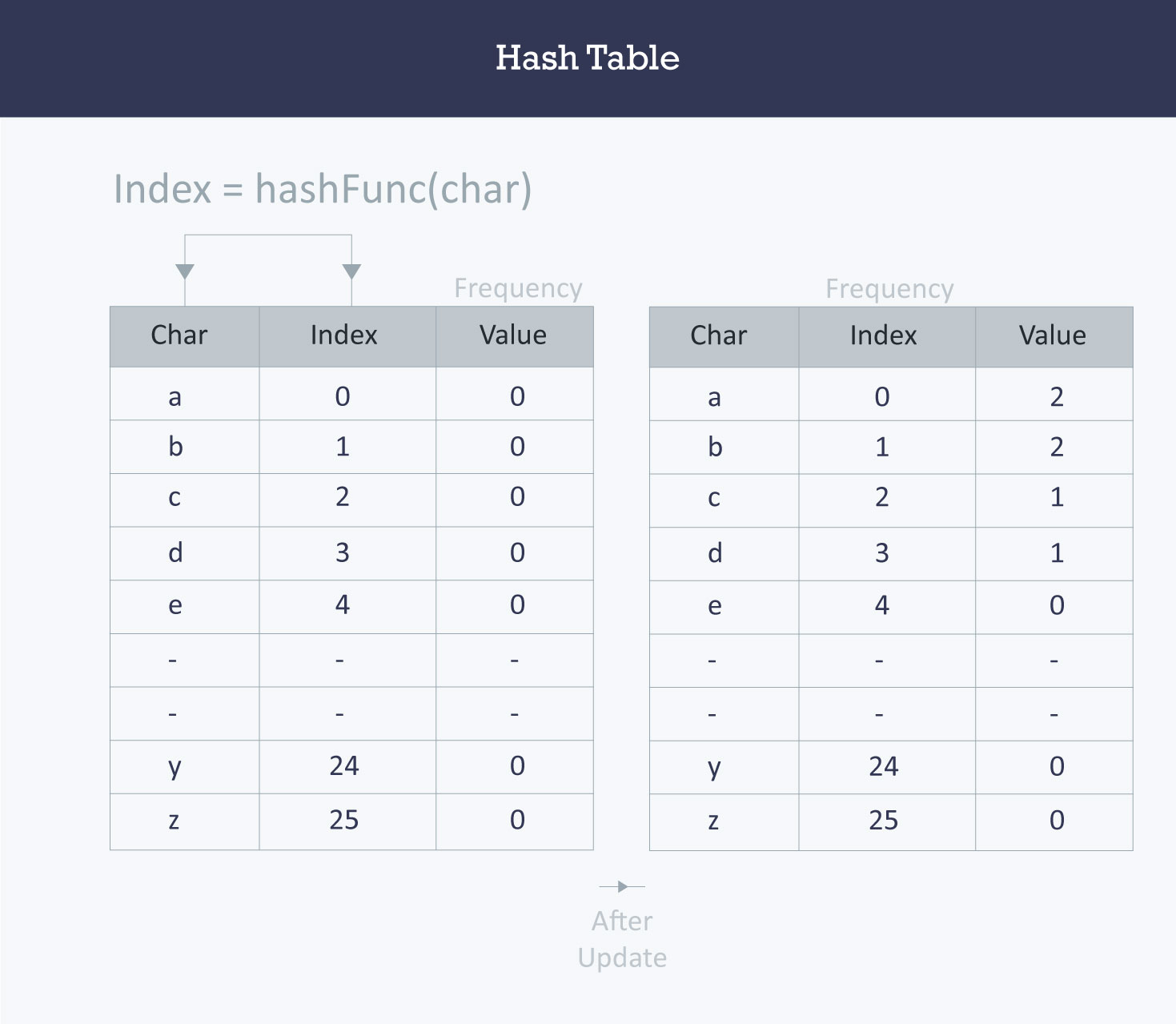
This is one of the most direct and common applications of hash maps. The goal is to count the occurrences of items in a collection.
Problem Example: First Non-Repeating Character
Problem Statement: Given a string s, find its first non-repeating character and return it. If it does not exist, return None.
The logic typically involves two passes:
- First Pass: Iterate through the string to build a frequency map of all characters.
- Second Pass: Iterate through the string again. For each character, look up its count in the map. The first character you find with a count of 1 is your answer.
Hash Maps & Sets - Interview Patterns | DSA Tutorial
This pattern is a fundamental building block. The article 'Hash Maps & Sets - Interview Patterns' provides a concise explanation and a clear code example for this pattern.
Read section 3, 'Counting Frequencies'. It provides the problem statement and a Python solution for finding the first non-repeating character, perfectly illustrating the two-pass frequency count pattern.
Metaphor: Tallying Votes
Imagine you are manually tallying votes from a pile of ballots.
- First Pass: You go through the entire pile of ballots. For each ballot, you find the candidate's name on your master sheet and add a tally mark. This is building the frequency map.
- Second Pass: A supervisor asks, "Who was the first candidate on the ballot list to receive only one vote?" You look at your original list of candidates in order, check your master sheet for their total tally, and announce the first one who has a single tally mark.
Python Implementation
def first_non_repeating_char(s: str) -> str | None:
    """
    Finds the first non-repeating character in a string.

    Time Complexity: O(n), because we iterate through the string twice. O(2n) is O(n).
    Space Complexity: O(k), where k is the number of unique characters. In this case, O(26) or O(1).
    """
    freq_map = {}

    # First pass: build the frequency map
    for char in s:
        freq_map[char] = freq_map.get(char, 0) + 1

    # Second pass: find the first character with a count of 1
    for char in s:
        if freq_map[char] == 1:
            return char

    return None # No non-repeating character found

# Example
s = "leetcode"
print(f"First non-repeating char in '{s}': {first_non_repeating_char(s)}") # Output: l

s = "loveleetcode"
print(f"First non-repeating char in '{s}': {first_non_repeating_char(s)}") # Output: v
Real-World Application: Frequency counting is ubiquitous.
- Web Analytics: Counting page views or API endpoint hits to find popular or heavily-loaded parts of a system.
- Data Science: Building histograms of word frequencies for Natural Language Processing (NLP).
- Security: Counting requests from IP addresses to detect potential DDoS attacks (a sudden, massive spike in frequency from one IP).
Test your understanding!
You are given two strings, s and t. Write a function to determine if t is an anagram of s. How would you use one of the patterns from today's lesson to solve this in an efficient way? Describe the algorithm and its complexity.
Show answer
This problem can be solved efficiently using the Frequency Counting pattern.
Algorithm:
- First, check if the lengths of
sandtare different. If they are, they cannot be anagrams, so returnFalse. - Create a frequency map (a hash map) for the characters in string
s. Iterate throughsand populate the map with character counts. - Iterate through the second string,
t. For each character int:- Decrement its count in the frequency map.
- If a character from
tis not in the map, or if its count is already zero, thenthas a character thatsdoesn't (or has too many of one), so they aren't anagrams. ReturnFalse.
- If you successfully complete the loop over
t, it means every character was accounted for. ReturnTrue.
Complexity:
- Time Complexity: , where is the length of the strings. We iterate through
sonce andtonce. - Space Complexity: , where is the number of unique characters in the character set (e.g., 26 for lowercase English letters). This is effectively because the character set is fixed.
This is more efficient than the sorting-based approach () for the same problem.
Conclusion
Today, we saw how the theoretical power of hash tables translates directly into practical, efficient solutions for common programming challenges. By providing average time for lookups, they enable us to solve problems in linear time that would otherwise require quadratic time.
Key Takeaways:
- Time-Space Trade-off: Hash tables are the classic example of using extra space () to achieve a dramatic speedup in time (e.g., from to ).
- The Lookup Pattern: For problems involving finding pairs or complements (like Two Sum), use a hash map to store what you've seen for instant lookups.
- The Grouping Pattern: For problems like Group Anagrams, the key is to devise a canonical, hashable representation (a "key") for each group. This often involves sorting or counting, with careful attention to immutability.
- The Frequency Counting Pattern: This is the most direct use of a hash map and is a fundamental building block for a vast range of problems in analytics, data processing, and security.
Preview of the Next Lesson:
We've mastered how to use hash tables for fast lookups and grouping. In our next lesson, we will explore another powerful specialized data structure: the Disjoint Set Union (DSU). While hash tables group items by a defined key, DSU is designed to dynamically track connectivity and merge groups of elements, making it the perfect tool for problems involving networks, connected components, and equivalence classes.