Welcome back! In our last lesson, we explored the complex world of distributed training, mastering how to split the immense computational workload of training massive models using data, tensor, and pipeline parallelism. We now know how to build the engine. Today, we focus on the high-octane fuel that powers it: the data.
This lesson addresses the learning outcome: Design the architecture of a feature store to prevent training-serving skew and serve features at scale. Managing the data lifecycle for machine learning is one of the most significant challenges in building production AI systems. A feature store is the cornerstone of a robust MLOps strategy, and understanding its architecture is a key differentiator in senior and staff-level engineering interviews at companies like Google and Meta.
We will deconstruct this topic using our established five-concept structure:
- The Problem of Scale & Skew: Why Feature Stores Exist
- The Core Design Pattern: A Tale of Two Stores (Offline vs. Online)
- Feature Ingestion: The "Write Path" for Batch and Streaming Data
- Feature Consumption & Consistency: The "Read Path" for Training and Serving
- The Complete Architecture: A Real-World Blueprint with Uber's Michelangelo
1. The Problem of Scale & Skew: Why Feature Stores Exist (Easy)
-
Technical Explanation:
In a naive ML system, data scientists often write a script to transform raw data into features for model training. Later, software engineers might re-implement that same logic in a production service for real-time inference. This separation is a ticking time bomb.Training-Serving Skew is the critical problem where the features used for training a model are not computed in the same way as the features used for serving it in production. This can happen due to subtle bugs, different library versions, or logic drift over time. The result is silent model performance degradation that is notoriously difficult to debug. According to industry reports, this skew affects as many as 40% of production models.
A Feature Store is a centralized, version-controlled repository for features. It acts as a single source of truth for both model training and serving, architecturally designed to eliminate training-serving skew.

*This diagram illustrates the root cause of training-serving skew: separate, uncoordinated feature engineering pipelines for training and inference. A feature store unifies these paths.*
-
Metaphor for a 5-Year-Old:
Imagine a baker is developing a new cookie recipe (the model). In his test kitchen (training), he carefully measures ingredients and writes down the recipe. He uses a special, expensive vanilla extract. He gives the recipe to a large bakery chain to mass-produce the cookies (serving). The bakery, trying to be efficient, uses a cheaper, artificial vanilla flavoring. Even though they follow the recipe, the cookies taste completely different and customers are unhappy. The training-serving skew is the difference in vanilla.A feature store is like a central, quality-controlled pantry. It provides exactly the same pre-packaged, labeled ingredients (features) to both the test kitchen and the bakery chain, guaranteeing every cookie tastes the same.
-
Anchor Reading:
The following article provides a concise overview of the problem and the solution a feature store provides.
Feature Stores and MLOps Databases: Infrastructure for Production ...
The introduction of the blog post 'Feature Stores and MLOps Databases' highlights the real-world impact of feature inconsistency and data pipeline issues, citing massive losses at major companies.
Read the introductory section, specifically the paragraph beginning 'Uber's Michelangelo feature store...'. Focus on the statistics about project failures and financial losses attributed to data issues and training-serving skew. This establishes the 'So what?' factor for why feature stores are critical.
-
Conceptual Python Snippet (The Problem):
This illustrates how easily skew can be introduced.def feature_eng_training(raw_data): # Data scientist uses a convenient but specific library version # Let's say this version fills missing values with the mean return raw_data['user_age'].fillna(raw_data['user_age'].mean()) def feature_eng_serving(raw_data_point): # Engineer in production service just fills with a default # to avoid a complex calculation for a single user if raw_data_point['user_age'] is None: return 30.0 # Default age return raw_data_point['user_age'] # The feature value for the same user with a missing age # will be different in training vs. serving, causing skew.
2. The Core Design Pattern: A Tale of Two Stores (Offline vs. Online) (Medium)
-
Technical Explanation:
Feature stores are not a single database. They are built on a dual-database architecture to serve two fundamentally different use cases: training and serving.-
Offline Store: This is a data warehouse or data lake (e.g., BigQuery, Snowflake, or Parquet files on S3/HDFS) that stores large volumes of historical feature data. It's optimized for high-throughput, analytical queries that scan massive datasets. The primary consumer is the model training pipeline, which needs to pull terabytes of data to create a training set. Latency is not the primary concern; throughput and cost-efficiency are.
-
Online Store: This is a low-latency key-value store (e.g., Redis, DynamoDB, Cassandra). It stores only the latest feature values for each entity (like a user or a product). It's optimized for fast point lookups, serving feature vectors for a single entity in milliseconds. The primary consumer is the real-time inference service, which needs features right now to make a prediction.
Data is typically computed and first written to the offline store, then a materialization process loads the necessary subset into the online store.
-
-
Metaphor for a 5-Year-Old:
Our central pantry has two main areas.- The Offline Store is the giant, Costco-style warehouse in the back. It holds pallets of ingredients dating back years. When a chef wants to plan a new seasonal menu (train a model), they go here to analyze historical sales and ingredient usage. It might take them a whole afternoon to gather the data.
- The Online Store is the small, perfectly organized "line cook station" at the front. It has just enough of each ingredient, pre-chopped and ready to go for today's service. When an order comes in (a prediction request), the cook can grab what they need in seconds.
-
Anchor Video:
This video gives a clear breakdown of the components inside a feature store, focusing on this dual-storage architecture.
ML System Design: Feature Store
In this video, 'ML System Design: Feature Store', the presenter provides a fantastic architectural overview, explicitly detailing the two-part storage system.
Watch from 20:16 to 26:33. Pay close attention to the separation of concerns: the HDFS/database/columnar store for 'bulk extract' for training, and the fast key-value store (Redis/Memcache) for low-latency model serving. This is the heart of the feature store design.
-
Conceptual Python Snippet (The SDK Experience):
A feature store SDK would abstract this complexity.import feature_store_sdk as fs # For TRAINING: The SDK queries the OFFLINE store under the hood # Returns a large Spark/Pandas DataFrame for model training. training_data = fs.get_historical_features( feature_names=['user_clicks_last_30d', 'user_country'], start_time='2023-01-01', end_time='2023-06-30' ) # For SERVING: The SDK queries the ONLINE store under the hood # Returns a single feature vector (e.g., a dictionary or numpy array) for one user. # Must be very fast (e.g., <10ms). online_features = fs.get_online_features( entity_id='user-12345', feature_names=['user_clicks_last_30d', 'user_country'] )
3. Feature Ingestion: The "Write Path" for Batch and Streaming Data (Medium)
-
Technical Explanation:
Features must be computed from raw data and loaded (ingested) into the feature store. This happens via two main pathways:- Batch Ingestion: These are scheduled jobs (e.g., daily Spark jobs orchestrated by Airflow) that process large amounts of raw data from sources like data lakes or databases. They compute features that don't need to be perfectly fresh, like "a user's average session length over the last 7 days." The output is written to the offline store and can be loaded into the online store.
- Stream Ingestion: These are continuous jobs (e.g., using Flink or Spark Streaming) that process real-time event streams from sources like Kafka. They compute features that need to be very fresh, such as "number of clicks in the last 1 minute." The output is typically written directly to the online store for immediate availability and also archived to the offline store for future training purposes.
-
Metaphor for a 5-Year-Old:
How does our pantry get stocked?- The Batch Ingestion is the big delivery truck that comes once a day. It unloads pallets of non-perishable goods like flour, sugar, and canned tomatoes into the big warehouse in the back (offline store).
- The Stream Ingestion is the local farmer who drops off a small basket of fresh herbs and vegetables every 15 minutes. This produce goes directly to the line cook's station (online store) because it needs to be used right away. A copy of the delivery receipt is filed in the back office (archived to offline store).
-
Anchor Video:
The same "Applied AI Course" video also has a great section explaining these two ingestion paths.
ML System Design: Feature Store
This segment clearly contrasts the two ways data gets into the feature store, tying them to the type of data being processed.
Watch from 08:16 to 15:45. The video walks through a batch processing system operating on raw data in HDFS/S3 and a stream processing system using Kafka for real-time data.
4. Feature Consumption & Consistency: The "Read Path" (Hard)
-
Technical Explanation:
The "read path" is where the feature store delivers on its promise of consistency.Consumption for Training: To prevent data leakage (using future information to predict the past), data scientists can't just join tables. They need point-in-time correct joins. This means that for each event or label (e.g., a user churned on May 5th), the training data must only include feature values that were known at or before that exact moment. Feature stores provide an abstraction (often called a "Feature View") that performs these complex temporal joins on the offline store automatically.
Consumption for Serving: A prediction service queries the online store with one or more entity IDs and gets back the latest feature vector, ready for the model.
How Consistency is Enforced:
- Unified Transformation Logic: The code that transforms raw data into a feature is defined once. This single definition is used by both the batch and streaming ingestion pipelines.
- Feature Registry: This is a metadata catalog that serves as a schema for all features. It versions the features, documents their definitions, tracks their owners, and defines their data types. When a model requests a feature, it's requesting a specific, versioned definition from the registry, ensuring no ambiguity.
-
Metaphor for a 5-Year-Old:
How do chefs get ingredients from our pantry?- For Training: To invent a new dish, a chef consults the pantry's master logbook (Feature Registry). They ask for a special report: "Show me all the ingredients we had in stock on the day we sold each of our top 100 most popular dishes last year" (point-in-time join). The system generates this report from the warehouse records without accidentally including ingredients that arrived the next day.
- For Serving: A line cook gets an order for a burger. They shout "Burger parts for ticket #77!" to the service counter. The counter staff, using their pre-defined "Burger Kit" recipe from the master logbook (Feature Registry), instantly hands them a patty, bun, and cheese (online features).
Because both the historical report and the instant kit are based on the same master logbook, the ingredients are guaranteed to be consistent.
-
Anchor Reading:
The Hopsworks guide provides one of the clearest explanations of point-in-time correctness.
Feature Store: The Definitive Guide - MLOps Dictionary
The article 'Feature Store: The Definitive Guide' from Hopsworks.ai has a crucial section on creating valid training data.
First, read the section 'Point-in-Time Correct Training Data'. The diagram and explanation are essential for understanding how to prevent data leakage. Then, read 'Taxonomy of Data Transformations' to understand how a feature store manages and unifies transformation logic to prevent skew.
5. The Complete Architecture: A Real-World Blueprint with Uber's Michelangelo (Harder)
-
Technical Explanation:
Let's assemble all the pieces and look at a real-world system: Uber's Michelangelo. Their architecture elegantly demonstrates how to serve features at massive scale.- Data Sources & Ingestion: Data resides in HDFS (offline). Batch jobs (Spark) compute historical features (e.g., a restaurant's average meal prep time over 2 weeks) and load them into an online Cassandra store. Real-time events from Kafka are processed by Flink jobs to compute streaming features (e.g., meal prep time over the last hour) and are also written to Cassandra.
- Storage: HDFS/Hive serves as the offline store, and Cassandra serves as the high-availability, low-latency online store.
- Serving/Consumption: When you request an ETA in Uber Eats:
- The app sends request-time features (your location, time of day).
- The backend service queries Michelangelo's online store (Cassandra) using the restaurant ID.
- It pulls both the historical batch features and the fresh streaming features.
- All three types of features are combined into a single feature vector and fed to the prediction model.
This hybrid approach provides the model with a rich, multi-faceted view of the world, blending long-term trends with up-to-the-minute context.
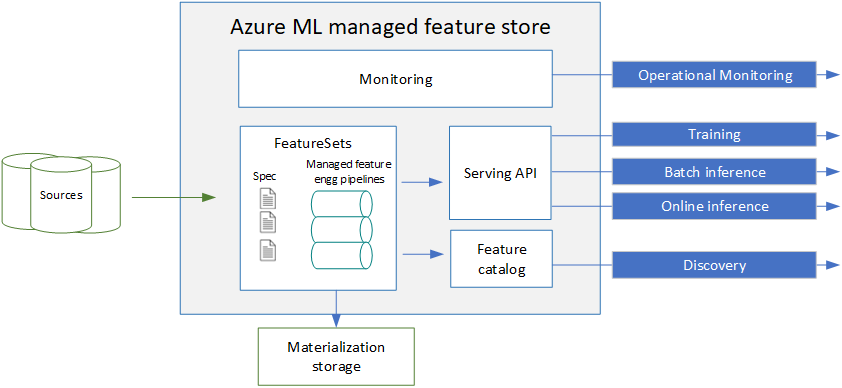
*This conceptual diagram from Azure shows a modern, managed feature store architecture. It includes all the key components we've discussed: sources, feature engineering pipelines, materialization storage (the offline/online stores), a serving API, a feature catalog for discovery, and monitoring.*
-
Metaphor for a 5-Year-Old:
Let's predict how long your pizza will take (the ETA model).- Request-time features: You tell us you're at home and it's 6 PM.
- Streaming features: The chef at the pizza place tells our system, "I just put the pizza in the oven right now." This is a fresh update from the line cook station (online store).
- Batch features: Our system also knows from the warehouse records (offline store) that this pizza place is, on average, 10% slower on Friday nights.
The final prediction combines all three pieces of information: where you are, what's happening this second, and long-term historical patterns.
-
Industry Deep Dive:
This is the capstone resource for the lesson. It shows a complete, battle-tested feature store architecture in action.
Michelangelo - Machine Learning @Uber
The InfoQ talk on Uber's Michelangelo platform provides a detailed walkthrough of their ML system, with a focus on the feature store architecture.
Watch from 22:08 to 27:36. This is the most important segment. Pay close attention to the architectural diagram and the explanation of how offline batch data (from Hadoop), online streaming data (from Flink), and request-time data are blended together at prediction time. This is a perfect example of serving features at scale.
Test your understanding! (System Design Question)
You are tasked with designing a feature store for a large e-commerce company to power its product recommendation engine. The goal is to provide both highly relevant, up-to-the-minute recommendations on the homepage and to retrain the model weekly with fresh data.
Identify at least two distinct types of features you would need (one batch, one streaming) and describe how your feature store architecture (ingestion, storage, serving) would handle each of them to ensure consistency and performance.
Show answer
Here's a proposed design:
Architecture Overview:
I would design a dual-store architecture with an offline store (e.g., using Parquet files on S3) and an online store (e.g., using Redis or DynamoDB). A central feature registry would manage all feature definitions.
1. Batch Feature: product_historical_popularity_score
- Definition: A score for each product based on its total sales and views over the last 30 days. This is a slow-moving feature.
- Ingestion: A daily Spark job would run, reading raw sales and clickstream data from the data lake (S3). It would compute this score for all products and write the results to a new partitioned table in the offline store. A subsequent materialization job would then load only the latest score for each product ID into the online store (key:
product_id, value:{..., 'popularity_score': 0.87, ...}). - Consumption:
- Training: The weekly model retraining pipeline would query the offline store using a point-in-time correct join to get the historical popularity scores for all products as they were on each day of the previous week.
- Serving: The recommendation service would query the online store with a list of product IDs to get their latest popularity scores with low latency.
2. Streaming Feature: user_recent_category_views_5min
- Definition: A count of how many times a user has viewed products in each category in the last 5 minutes. This is a fast-moving feature critical for real-time personalization.
- Ingestion: A Flink or Spark Streaming job would consume a real-time Kafka topic of user click events. It would maintain a 5-minute sliding window aggregation for each user. As the window slides, the updated feature vector (e.g.,
{'electronics': 5, 'books': 2}) would be written directly to the online store (key:user_id, value:{..., 'category_views_5min': {...}, ...}). The events would also be archived to the data lake (our offline store's source) for future batch processing. - Consumption:
- Training: When retraining the model, the pipeline would read the archived raw clickstream data from the offline store and re-apply the exact same transformation logic (defined in the feature registry) to simulate the 5-minute window features for the training period.
- Serving: When a user visits the homepage, the recommendation service queries the online store with the
user_idto get their up-to-the-second category view counts, enabling highly responsive recommendations.
This design prevents training-serving skew because the logic for the windowed aggregation is defined once but applied to historical data for training and to live data for serving. The dual-store architecture meets the different latency/throughput requirements of training and serving.
Conclusion
Today we dissected the architecture of a feature store, a critical piece of infrastructure for any serious ML operation. You've moved beyond just knowing what it is to understanding how it's designed to solve specific, difficult problems in production ML.
Key Takeaways:
- A feature store's primary mission is to solve training-serving skew by providing a single source of truth for features.
- The core design is a dual-store architecture: a high-throughput offline store for training and a low-latency online store for serving.
- Features are ingested via batch pipelines for historical data and stream pipelines for real-time data.
- Consistency is guaranteed through unified transformation logic and a central feature registry, while point-in-time correct joins prevent data leakage during training.
- Real-world systems like Uber's Michelangelo blend batch, streaming, and request-time features to power sophisticated models at massive scale.
Next Lesson Preview
We now have a trained model and the data infrastructure to support it in production. But how do we know if a new model is actually better than the old one? And how do we roll out a new model without risking a major outage? Our next lesson will dive into A/B testing and canary deployment strategies for safely comparing and deploying ML models in production.