Hello! Welcome to your next lesson.
In our previous session, we dissected the sales funnel, learning how to identify bottlenecks that hinder conversion. We focused on the process of acquiring customers. Today, we shift our perspective to the value of those customers once they are acquired. This brings us to one of the most important metrics in business strategy: Customer Lifetime Value (CLV).
This lesson addresses how to calculate CLV using a simple historical method from CRM records. For your goal of spearheading a pan-African market entry, understanding CLV is not just an analytical exercise; it's a strategic necessity. It helps you answer critical questions like: Which customer segments are the most profitable in the long run? How much can we afford to spend to acquire a new customer in a new market? Where should we focus our marketing and retention efforts for maximum return?
By the end of this lesson, you will understand the concept of CLV and know how to calculate it using historical data readily available in a CRM system.
1. What is Customer Lifetime Value (CLV)?
At its core, Customer Lifetime Value is a metric that predicts the total net profit a business can expect to earn from a single customer over the entire duration of their relationship. It encourages a shift in focus from short-term, transactional wins to long-term, relationship-based value.
This short video provides a clear and simple introduction to the concept and why it's so important for businesses to prioritize profitable customers.
Customer Lifetime Value - Concept, Calculations and Examples - Simplest Explanation Ever
Watch this video from Mister Simplify for a concise explanation of CLV.
Pay attention to the initial definition of CLV and the explanation of its importance in relationship marketing from the beginning.
As the video explains, CLV helps you identify which customers are worth investing in. When entering new markets, not all customers are created equal. Some may make a large initial purchase but never return, while others might start small but grow into highly valuable, long-term partners. CLV provides the financial lens to distinguish between them.
2. The Simple Historical CLV Formula
There are many ways to calculate CLV, ranging from simple to highly complex predictive models. As per our learning goal, we will focus on a simple, historical approach. The most common formula for this looks at three key variables from your past data.
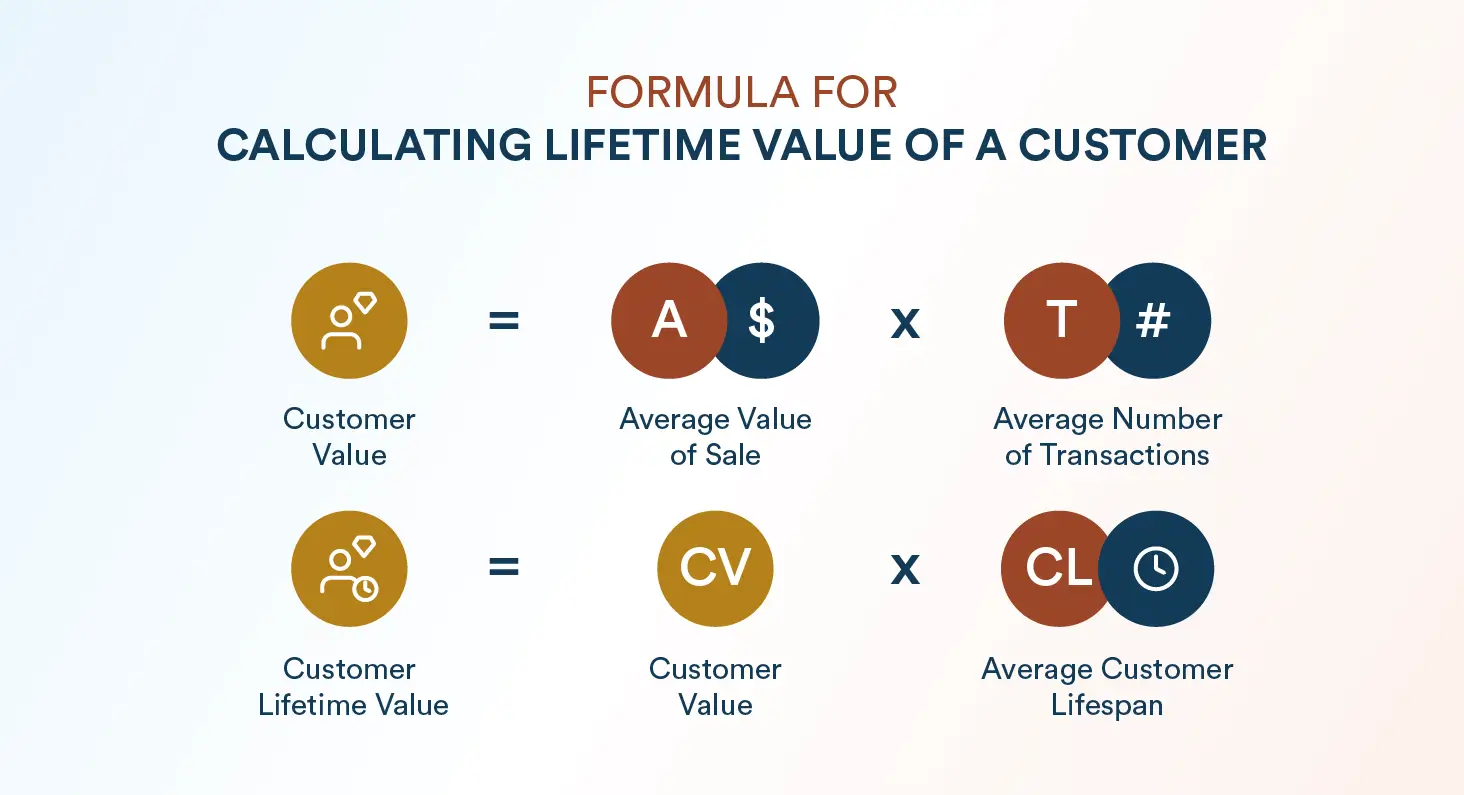
Customer Lifetime Value = (Average Purchase Value) x (Average Purchase Frequency) x (Average Customer Lifespan)
Let's break down each component:
- Average Purchase Value (APV): The average amount of money a customer spends in one transaction. You calculate this by dividing your total revenue over a period by the number of orders in that same period.
- Average Purchase Frequency (APF): How often a customer makes a purchase from you in a given period. You calculate this by dividing the total number of orders by the number of unique customers during that period.
- Average Customer Lifespan (ACL): The average length of time a customer continues to buy from you. This can be estimated by averaging the time between the first and last purchase of all your customers.
The image below provides a great visual summary of how these components build up to the final CLV.
To see this formula in action, let's look at a concrete example. The following article from Salesgenie provides clear definitions and a relevant B2B example that aligns well with your work in technology sales.
Customer Lifetime Value: 2025 Formula & Guide - Salesgenie
This guide will solidify your understanding of the CLV formula and its components.
First, read the introduction What is customer lifetime value to reinforce the concept's importance. Then, focus on the section "The complete customer lifetime value formula with example calculations." Pay close attention to the B2B calculation example, as it shows how contract values and renewals, common in your field, are factored in.
3. Calculating CLV Directly from CRM Records
The formula above is excellent for creating an average CLV for your entire customer base or a large segment, which is useful for high-level planning and forecasting. However, your CRM holds the key to calculating the actual historical value of each individual customer account. This is the most direct and simple method of all.
For any given customer account in your CRM, the historical CLV is simply the sum of all their past purchases. In a system like Salesforce, this translates to the sum of the value of all "Closed Won" opportunities associated with that account.
This approach is incredibly powerful. It requires no complex formulas—just simple aggregation of the data you already track. The Salesforce Ben article below provides a step-by-step guide on how you would set this up in Salesforce. While we will cover Salesforce navigation in the next module, seeing the process now will give you a concrete understanding of how CRMs make this calculation possible.
Calculating Customer Lifetime Value (CLV) With Salesforce | Salesforce Ben
This article explains the practical steps to automate CLV calculation on a per-account basis within Salesforce.
Start by reading the section What is CLV? to see how it can be used for segmentation. Then, carefully review Step 1: Set Up the Lifetime Value Field and Step 2: Set the Calculation. These sections detail how to create a Roll-Up Summary field that automatically sums up the Amount from all Closed Won opportunities for an account. Finally, skim Step 3 and Step 4 to see how this calculated field is made visible on the account page and can be used in powerful reports.
By following the method in the article, you transform your CRM from a simple record-keeping system into an analytical tool. With a "Customer Lifetime Value" field on every account record, you can instantly sort, filter, and segment your customer base by their proven historical value.
4. Strategic Application for Market Entry
So, how does this help you with pan-African expansion?
Imagine you have entered three new markets: Nigeria, Kenya, and Ghana. After one year, you can use your CRM to analyze the CLV of the customers you've acquired in each country.
- Segmentation: You can create reports comparing the average CLV by country, industry, or company size. You might discover that while Nigeria brought in the highest number of new customers, customers from Kenya have a 50% higher CLV due to more repeat business and upselling.
- Budgeting: You can compare the CLV to the Customer Acquisition Cost (CAC) for each market. A high CLV:CAC ratio in Kenya indicates a very profitable acquisition strategy, while a low ratio in Ghana might signal that your marketing spend is too high for the value of the customers you are attracting.
- Prioritization: Based on this data, you can decide to double down on your marketing efforts in Kenya, adjust your product offering or pricing in Ghana to attract higher-value clients, and investigate why Nigerian customers are not making repeat purchases.
This data-driven approach, grounded in the CLV metric you calculate from your CRM, is precisely the kind of advanced analytics that separates successful market entries from expensive failures.
Conclusion
In this lesson, we have defined Customer Lifetime Value and explored its strategic importance, particularly for new market entry. You've learned two simple, historical methods for its calculation: one formula-based for averages and one direct aggregation method for individual accounts within a CRM.
Here are the key takeaways:
- CLV is the total net profit you expect from a customer over their entire relationship with your business.
- It shifts focus from single transactions to long-term customer relationships and profitability.
- A simple historical formula is
Average Purchase Value × Average Purchase Frequency × Average Customer Lifespan. - A more direct method within a CRM is to sum the value of all
Closed Wonopportunities for each account. - Analyzing CLV by segment (e.g., by country or industry) provides critical insights to guide your market entry strategy, resource allocation, and marketing budget.
This lesson completes our module on CRM Analytics Foundations. You've learned about key metrics, data quality, segmentation, funnel analysis, and now, CLV. You now have a solid conceptual framework for analyzing a CRM database.
In our next lesson, we will begin the next module, "Navigating and Managing Data in Salesforce," and take our first practical steps inside the platform. We will start by learning how to navigate the Salesforce interface, setting the stage to eventually build out the very analytics, like the CLV field, that we have just discussed.