Hello! Welcome to the fifth lesson in our module on Algorithmic Design Paradigms.
In our previous lessons, we explored the Greedy paradigm. We saw that for a greedy strategy to work, the problem must have optimal substructure, allowing a globally optimal solution to be built from locally optimal choices. You successfully applied this to solve problems like Activity Selection and Fractional Knapsack.
However, we also hinted at a limitation. What happens when making the best local choice doesn't lead to the best overall outcome, as in the 0/1 Knapsack problem? This often occurs when a problem's recursive solution involves solving the same subproblems over and over.
Today's lesson addresses this precise scenario. Our goal is to learn how to identify problems with optimal substructure and overlapping subproblems, which are the two hallmarks of problems suitable for Dynamic Programming (DP). Mastering this identification skill is a crucial step towards developing the architectural mindset you're aiming for, as it allows you to select the right tool for complex optimization tasks.
1. From Greedy to Dynamic Programming
Greedy algorithms are fast and simple, but they can fail when a problem requires a more exhaustive search of possibilities. Dynamic Programming is a more powerful technique that, like the greedy approach, is used for optimization problems. However, it guarantees an optimal solution by being more thorough.
Let's start with a short video that contrasts the two approaches and introduces the core idea of DP.
L-5.1: Introduction to Dynamic Programming | Greedy Vs Dynamic Programming | Algorithm(DAA)
The video 'Introduction to Dynamic Programming' from Gate Smashers provides a clear comparison between the Greedy method and Dynamic Programming, explaining why DP succeeds where Greedy can fail.
Watch the first 3 minutes of the video (00:00 - 03:09). Focus on: The definition of an optimization problem. The shortest path example used to illustrate how a greedy choice can lead to a suboptimal solution. The key difference: DP explores all sequences of decisions to find the best one, while greedy commits to a choice at each step.
As the video highlighted, dynamic programming finds the optimal solution by exploring all possibilities in a structured way. To do this efficiently, it relies on two fundamental properties of a problem. Let's dissect them.
2. The Two Pillars of Dynamic Programming
For a problem to be a candidate for a DP solution, it must exhibit two specific characteristics.
Pillar 1: Optimal Substructure
You've already encountered this property in our study of greedy algorithms. A problem has optimal substructure if its overall optimal solution can be constructed from the optimal solutions of its subproblems.
This property is what allows us to think about solving a problem recursively.
Optimal Substructure and Overlapping Subproblems
The article 'Optimal Substructure and Overlapping Subproblems' from AfterAcademy provides a concise definition and powerful examples to clarify this concept.
Read just the section 'Optimal Substructure'. Notice the excellent contrast between the Shortest Path Problem (which has optimal substructure) and the Longest Path Problem (which does not). This highlights that not all problems that can be broken down have this property.
The key takeaway is that if subproblem_solution_1 + subproblem_solution_2 = main_problem_solution, then you likely have optimal substructure. For example, the shortest path from point A to C through B is simply the shortest path from A to B plus the shortest path from B to C.
Pillar 2: Overlapping Subproblems
This is the property that truly distinguishes Dynamic Programming from other paradigms like Divide and Conquer. A problem is said to have overlapping subproblems if a naive recursive algorithm solves the same subproblems repeatedly.
Dynamic Programming capitalizes on this by computing the solution to each subproblem only once and storing the result in a table or cache. Any subsequent time the same subproblem is encountered, the stored result is simply looked up.
The classic example to illustrate this is calculating Fibonacci numbers.
L-5.1: Introduction to Dynamic Programming | Greedy Vs Dynamic Programming | Algorithm(DAA)
Let's return to the Gate Smashers video, which now explains the concept of overlapping subproblems using the Fibonacci sequence.
Watch the segment from 04:15 to 08:11. Pay close attention to the recursion tree for f(4). See how f(2) and f(1) are calculated multiple times? This is the 'overlapping subproblem' property in action. The video explains that DP's main trick is to store these results to avoid re-computation.
Algorithms like Merge Sort also use a recursive, divide-and-conquer approach. However, at each step, they work on entirely new, distinct subarrays. They exhibit optimal substructure but do not have overlapping subproblems. Dynamic Programming is specifically for problems that have both.
3. The Litmus Test for Dynamic Programming
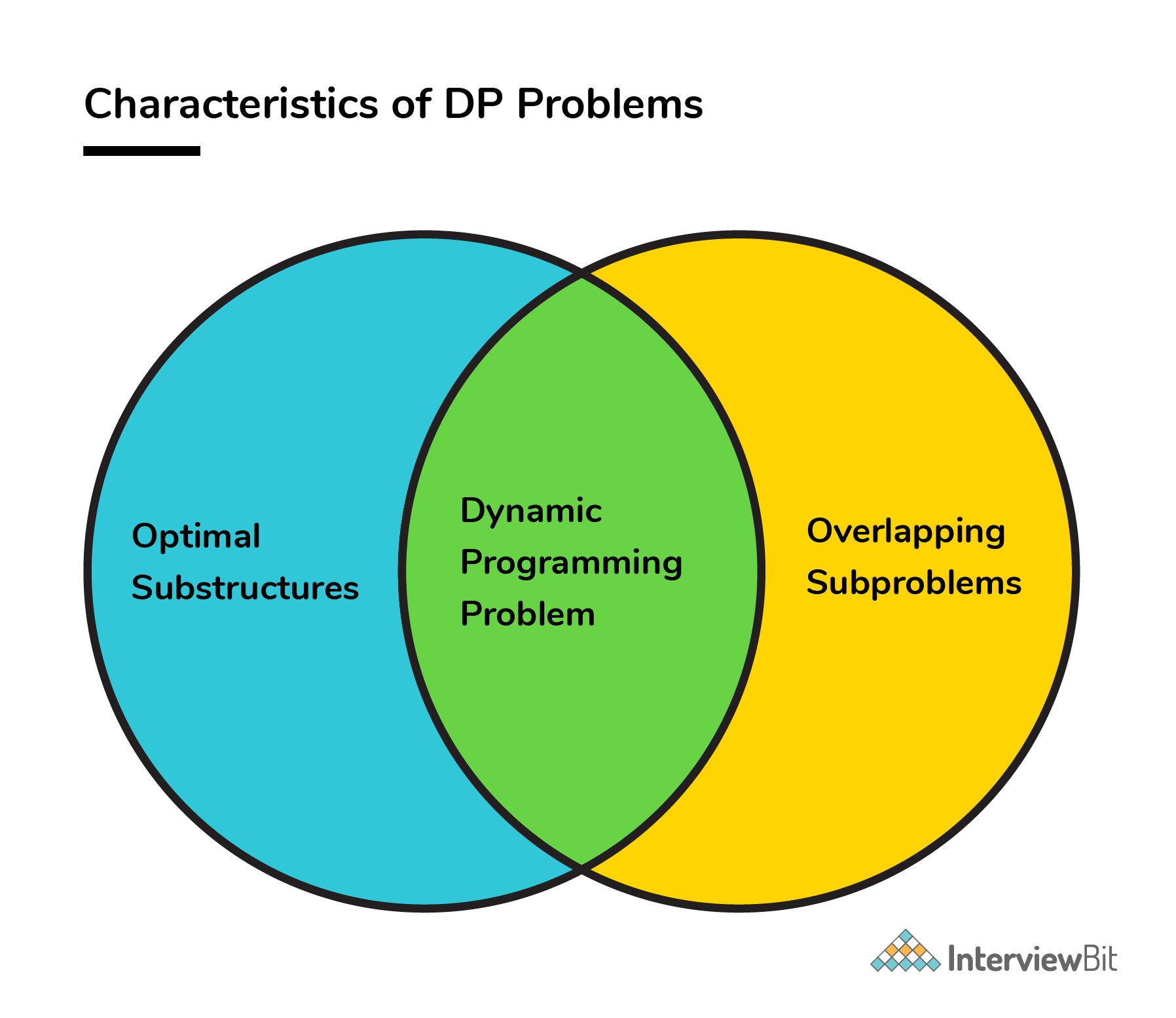
So, the rule is simple. To determine if a problem is a good candidate for Dynamic Programming, you must verify that it has both properties:
- Optimal Substructure: Can you solve the problem recursively by combining optimal solutions to smaller subproblems?
- Overlapping Subproblems: Does the recursive solution involve solving the exact same subproblems multiple times?
This relationship is perfectly captured in the following diagram.
Test your understanding!
Consider the 0/1 Knapsack problem: You have a set of items, each with a weight and a value. You want to choose a subset of items to place in a knapsack of a fixed capacity to maximize the total value. You cannot take fractions of items.
Does this problem exhibit the two properties of Dynamic Programming? Think it through before revealing the answer.
Show answer
Yes, it does.
-
Optimal Substructure: To decide whether to include item
i, we need to make a choice.- If we don't include item
i, the optimal solution is the optimal solution for the remaining items (i-1) with the same knapsack capacity. - If we do include item
i, the optimal solution is the value of itemiplus the optimal solution for the remaining items (i-1) with the capacity reduced by the weight of itemi.
The overall optimal solution is the maximum of these two choices. Since the main solution depends on optimal solutions to smaller subproblems (fewer items, less capacity), it has optimal substructure.
- If we don't include item
-
Overlapping Subproblems: Imagine a recursive function
knapsack(items_left, capacity_left). As the recursion unfolds, you will encounter many situations where you need to calculate the optimal value for the same number of items and the same remaining capacity through different decision paths. For example,knapsack(5, 10)might be needed after excluding item 7, and also after including item 8 and excluding item 6. These repeated calculations indicate overlapping subproblems.
4. A Case Study: Identifying DP in the "Climbing Stairs" Problem
Let's walk through a complete example to see how you would identify these properties in a typical coding challenge. The "Climbing Stairs" problem is a classic introduction to DP.
This article provides a superb, step-by-step analysis that starts with a simple recursive solution and uses it to reveal the two DP properties we've just discussed.
Dynamic Programming Fundamentals
The article 'Dynamic Programming Fundamentals' from Hello Interview will guide you through the thought process of analyzing a problem for DP suitability.
Read the article from the beginning down to the end of the 'Overlapping Subproblems' section. Focus on: Brute-Force Solution: Understand the simple recursive logic. This is your first step in tackling such a problem. Call Tree Visualization: Pay close attention to the diagrams. The tree structure shows how the problem is broken down recursively. Optimal Substructure Section: See how the article formally defines this property in the context of the problem. Overlapping Subproblems Section: Observe how the call tree diagram is used again to point out the repeated calculations (e.g., climbStairs(3) being called twice).
This process—starting with a brute-force recursion and then examining its call tree for optimal substructure and overlapping subproblems—is a powerful framework you can apply to many different problems.
5. Developing Your Intuition: Common DP Patterns
As you gain experience, you'll start to develop an intuition for which problems are likely DP problems. The following video outlines five common patterns to look for. Recognizing these can give you a head start in your analysis.
A Beginner's Guide to Dynamic Programming
To help build your 'architectural' intuition, this clip from 'A Beginner's Guide to Dynamic Programming' by Matt Guest outlines five common indicators of DP problems.
Watch the segment from 04:36 to 06:51. Listen for the five patterns: Sequential decision-making Greedy choice property (if a greedy solution exists, a DP one often does too) State transition Problems involving paths or arrays Counting, maximization, or minimization tasks These are not hard rules, but excellent heuristics to guide your thinking.
Conclusion
In this lesson, we've established the theoretical foundation for Dynamic Programming. You now know how to identify problems that are prime candidates for a DP solution.
Key Takeaways:
- Dynamic Programming is an optimization technique used for problems that can be broken down into smaller, recurring pieces.
- A problem is suitable for DP if it exhibits both optimal substructure (an optimal solution can be built from optimal solutions of subproblems) and overlapping subproblems (the same subproblems are solved repeatedly in a naive recursive approach).
- The general strategy for identifying a DP problem is to first formulate a brute-force recursive solution and then analyze its structure for these two properties.
Preview of the Next Lesson:
We have now touched upon three major algorithmic paradigms: Divide and Conquer (implicitly with Merge Sort), Greedy algorithms, and Dynamic Programming. Each has its own strengths and is applicable to different types of problems. In the next lesson, we will compare and contrast these three paradigms directly, helping you build a mental map of when to use each one, solidifying your high-level algorithmic design skills.