Hello! Welcome to the first lesson in our new module, Algorithmic Design Paradigms.
In the previous module, we completed our deep dive into specific graph algorithms, focusing on comparing their strengths and weaknesses to make informed design choices. Now, we're shifting our perspective. Instead of focusing on single algorithms for specific problems (like finding a shortest path), we will explore the high-level strategies, or "paradigms," that are used to design efficient algorithms for a wide range of problems. This is a fundamental step in developing an "architectural mindset."
Our first paradigm is Divide and Conquer. To understand it, we'll start with one of the most classic and efficient searching algorithms in computer science. Today's lesson will focus on how to implement binary search on a sorted array and analyze its logarithmic complexity.
This algorithm is a perfect illustration of how a clever strategy can lead to a dramatic performance improvement over a more straightforward approach.
1. The Problem: Searching in a Collection
Imagine you have a large collection of data—say, an array of user IDs—and you need to find out if a specific ID exists within it.
The most straightforward method is a linear search: you start at the first element and check each one until you either find your target or reach the end of the array. For an array of size , this takes up to comparisons in the worst case, giving it a time complexity of . This works, but it's inefficient for large datasets.
What if we could do better? What if the array was sorted?
This single constraint unlocks a much more powerful approach.
2. Binary Search: The "Divide and Conquer" Strategy
If an array is sorted, we don't need to check every element. We can be much smarter. This is the core idea behind binary search. It follows a simple, recursive pattern:
- Divide: Find the middle element of the current search space.
- Conquer: Compare the middle element with your target value.
- If they match, you're done!
- If your target is smaller, you know it must be in the left half of the array.
- If your target is larger, it must be in the right half.
- Combine: Repeat the process on the new, smaller search space (the chosen half).
With each step, you eliminate half of the remaining possibilities. This is the essence of the "Divide and Conquer" strategy applied to searching.
To get a great intuitive feel for this, watch the following video. It demonstrates the inefficiency of linear search and introduces the "divide and conquer" concept using a simple analogy.
Binary Search Algorithm - Computerphile
The video 'Binary Search Algorithm' from the Computerphile channel provides an excellent introduction. It contrasts the naive linear search with the much more efficient binary search.
Watch from the beginning to 04:14. Pay attention to how moving from a linear approach (opening boxes one by one) to a divide-and-conquer approach (jumping to the middle) dramatically reduces the problem size with each step.
3. Implementing the Algorithm
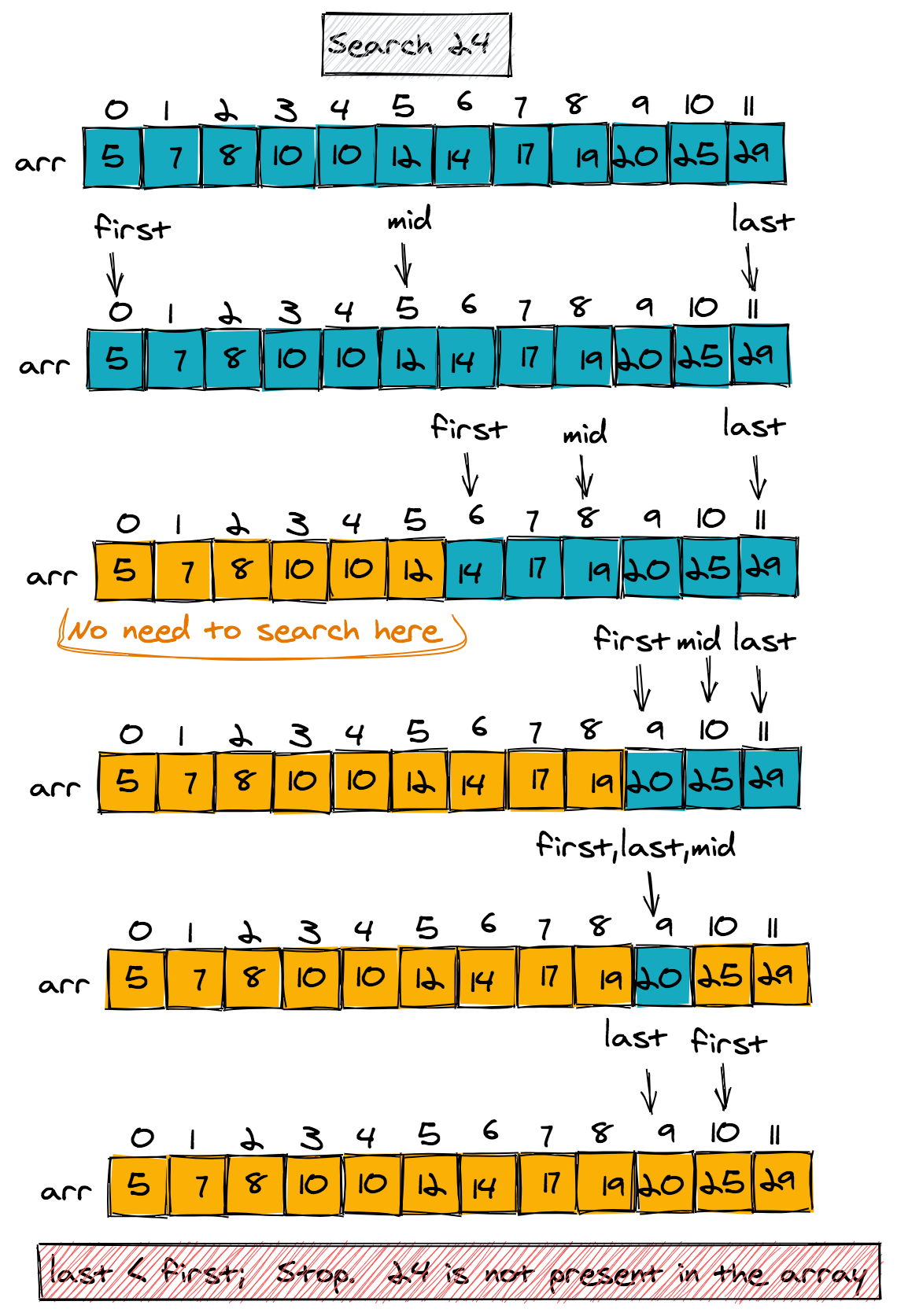
Now let's translate this idea into a concrete algorithm. To implement an iterative binary search, we need to keep track of the portion of the array we are currently searching. We can do this with two pointers, left and right, which define the boundaries of our search space.
The algorithm looks like this:
- Initialize
left = 0andright = N-1, whereNis the number of elements in the array. - Start a loop that continues as long as
left <= right. - Inside the loop, calculate the middle index:
mid = left + (right - left) // 2.- Note for engineers: Using
(left + right) // 2can lead to an integer overflow in languages like C++ or Java ifleftandrightare very large positive numbers. Theleft + (right - left) // 2form avoids this potential bug.
- Note for engineers: Using
- Compare the element at
array[mid]with thetarget:- If
array[mid] == target, the element is found. Returnmid. - If
target < array[mid], the target must be in the left half. Update the search space by moving the right boundary:right = mid - 1. - If
target > array[mid], the target must be in the right half. Update the search space by moving the left boundary:left = mid + 1.
- If
- If the loop finishes (meaning
lefthas become greater thanright), the search space is empty, and the target was not in the array. Return an indicator like-1orfalse.
The following images visually trace this process for both a successful and an unsuccessful search.

For a detailed walkthrough and code examples in multiple languages (which you may find useful as a full-stack developer), the following article is an excellent resource.
What is Logarithmic Time Complexity? A Complete Tutorial
The article 'What is Logarithmic Time Complexity?' from GeeksforGeeks provides a clear explanation of binary search and its complexity, along with complete code implementations.
Please read 'Example 2: Binary search algorithm (log N)'. Focus on the explanation of how the search space is reduced and review the implementation in the language of your choice. The code demonstrates the logic we just discussed.
4. Analysis: The Power of Logarithmic Complexity
We've established that binary search is fast, but how fast? Its efficiency comes from its logarithmic time complexity, noted as . Let's break down why.
The core question is: "For an array of size , how many times can we divide it in half until we're left with just one element?" This number of divisions is the maximum number of steps the algorithm will take.
Let's say it takes steps.
- After step 1, we have elements left to search.
- After step 2, we have elements.
- After steps, we have elements.
The search ends when we have only one element left, so we set the equation to 1:
Solving for :
This means the number of steps, , grows logarithmically with the size of the array, .
The following video provides a fantastic deep dive into what logarithms mean in the context of computer science and directly connects it to binary search.
Deeply Understanding Logarithms In Time Complexities & Their Role In Computer Science
The video 'Deeply Understanding Logarithms' from Back To Back SWE is perfect for cementing the link between the algorithm's actions and its time complexity.
Watch the segments from 00:29-03:21 and 06:55-09:46. The first part explains what log base 2 intuitively means: the number of times you can cut something in half. The second part applies this concept directly to a binary search example, showing how the number of halvings equals log N.
Why is a Game-Changer
The difference between linear and logarithmic is staggering at scale.
- If you have 1,000 items, a linear search takes up to 1,000 steps. A binary search takes at most steps.
- If you have 1,000,000 items, a linear search takes up to 1,000,000 steps. A binary search takes at most steps.
- If you have 1,000,000,000 items, linear search takes a billion steps. Binary search takes about 30 steps.
The algorithm barely slows down as the input size explodes. Regarding memory, the iterative implementation uses a constant amount of extra memory (for the left, right, and mid variables), giving it a space complexity of .
Test your understanding!
You are given the following sorted array: [3, 7, 11, 15, 19, 23, 27, 31, 35, 39]. Your task is to find the target 7.
Trace the values of left, right, and mid for each iteration of the binary search algorithm until the target is found. What are the values at each step?
Show answer
The array has 10 elements, so indices are 0 to 9.
-
Step 1:
left= 0,right= 9mid=0 + (9 - 0) // 2= 4array[4]is 19. Since7 < 19, we search the left half.- New
right=mid - 1= 3.
-
Step 2:
left= 0,right= 3mid=0 + (3 - 0) // 2= 1array[1]is 7. Since7 == 7, the element is found!- The algorithm returns index 1.
It took only two comparisons to find the element in an array of ten.
5. The Architectural Trade-Off
Binary search is incredibly powerful, but it's not a silver bullet. Its Achilles' heel is the requirement that the array must be sorted.
This introduces a critical trade-off for a system architect:
- Search Performance: is excellent.
- Maintenance Cost: If you frequently add or remove elements, you must keep the array sorted. Sorting an array takes, at best, time.
So, when should you use it? Binary search is ideal for data that is written or updated infrequently but read or searched very often.
Think of a dictionary, a set of country codes, or a product catalog in an e-commerce backend that gets updated nightly but is queried thousands of times per second. The one-time cost of sorting is easily paid back by the millions of lightning-fast searches. In a system with constant writes, the cost of re-sorting might be too high, and other data structures (like a hash table or a self-balancing binary search tree) might be more appropriate.
Conclusion
In this lesson, we introduced our first algorithmic paradigm, Divide and Conquer, through the lens of binary search. You learned how to implement this fundamental algorithm and, more importantly, how to analyze its efficiency.
Key Takeaways:
- Binary Search is a high-performance algorithm for finding an element in a sorted array.
- It uses a Divide and Conquer strategy, repeatedly halving the search space.
- Its time complexity is , making it exceptionally scalable for large datasets.
- Its iterative implementation has a space complexity of .
- The primary trade-off is the need for pre-sorted data, making it best suited for read-heavy applications.
Preview of the Next Lesson:
We will continue our exploration of the Divide and Conquer paradigm by applying it to a different problem: sorting. In the next lesson, we will examine Mergesort, an elegant and efficient sorting algorithm that perfectly embodies the divide-and-conquer strategy of breaking a problem down into smaller, manageable pieces and then combining the results.