Hello!
In our last lesson, we took a deep dive into REST, establishing it as a robust architectural style for creating scalable and standardized APIs. We saw how its constraints, particularly HATEOAS, can lead to decoupled and discoverable systems. However, as an architect, it's crucial to recognize that no single solution fits every problem. REST has limitations, especially concerning data fetching and high-performance internal communication.
This lesson directly addresses that challenge. We will compare the trade-offs of different API paradigms: REST, GraphQL, and gRPC. Your goal is to understand the fundamental principles, strengths, and weaknesses of each, so you can make informed architectural decisions about which communication style is best suited for a specific use case. This is a cornerstone of the "architectural mindset" you're aiming to develop.
1. The API Landscape: Beyond REST
While REST is the lingua franca of public web APIs, other paradigms have emerged to solve problems where REST falls short. Let's briefly meet the two main contenders we'll be discussing today: GraphQL and gRPC.
A great starting point is a short video that introduces REST's common challenges and how GraphQL and gRPC address them.
tRPC, gRPC, GraphQL or REST: when to use what?
The video 'tRPC, gRPC, GraphQL or REST: when to use what?' provides a concise and clear overview of the core value propositions for each of these API styles.
Please watch the following segments: REST (00:09 - 01:56): Pay attention to the discussion of 'overfetching' and 'underfetching'. This is a key problem that GraphQL aims to solve. GraphQL (01:56 - 03:20): Focus on how GraphQL's query language allows the client to request exactly the data it needs. gRPC (08:27 - 10:04): Note the emphasis on performance, binary protocols (Protobuffers), and its primary use case for internal microservice communication.
Now, let's break down the core ideas of each paradigm.
GraphQL: The Query Language for APIs
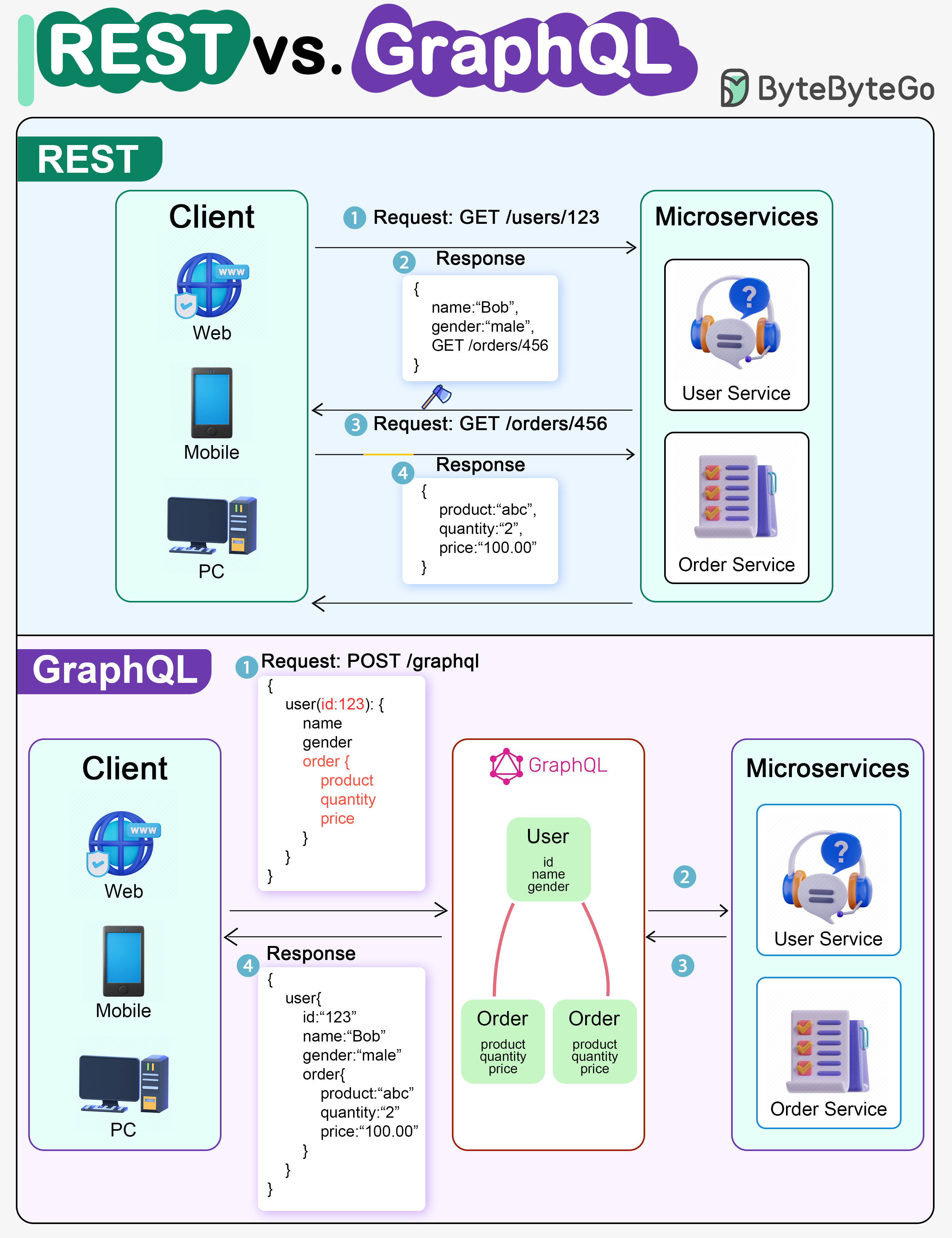
GraphQL was developed by Facebook to address the needs of their complex mobile applications. Unlike REST's resource-based model with multiple endpoints, GraphQL typically exposes a single endpoint. The client sends a query that specifies the exact data fields and relationships it needs, and the server returns a JSON object with precisely that data—no more, no less.
- Key Idea: Empower the client to ask for what it needs.
- Solves: Over-fetching (getting more data than needed) and under-fetching (having to make multiple requests to get all related data).
gRPC: High-Performance RPC
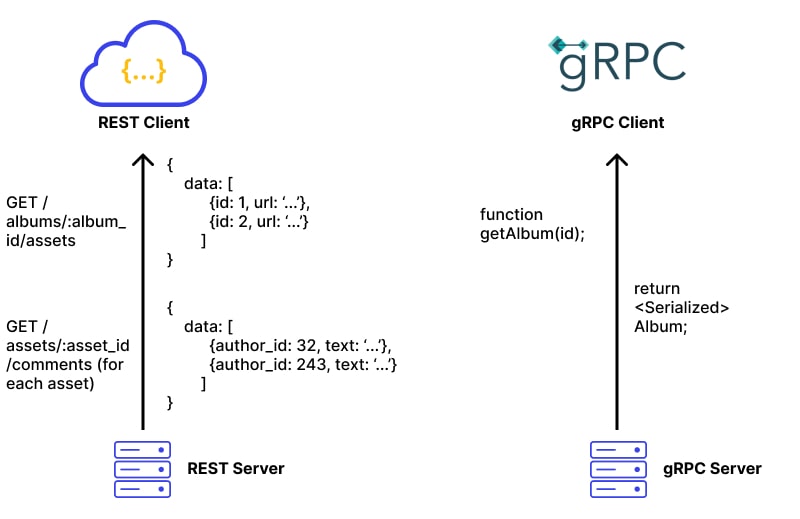
gRPC (gRPC Remote Procedure Call) was developed by Google. It's a modern take on the older RPC paradigm. Instead of a client communicating with resources, it directly invokes methods on a remote server as if they were local methods. gRPC is designed for maximum performance.
- Key Idea: Make remote procedure calls as fast and efficient as possible.
- How it works:
- It uses Protocol Buffers (Protobuf) as its data format. This is a binary serialization format, which is much more compact and faster to parse than text-based JSON.
- It operates over HTTP/2, which supports features like multiplexing (sending multiple requests over a single connection) and bidirectional streaming.
2. A Head-to-Head Comparison: The Architect's Matrix
Now that we have a high-level understanding, let's dive into a structured comparison. Making an architectural choice involves weighing multiple factors. The following article provides an excellent decision matrix that we can use as our guide.
The Ultimate API Architecture Guide: REST vs. gRPC vs ...
The article 'The Ultimate API Architecture Guide' offers a fantastic, enterprise-focused comparison of REST, gRPC, and GraphQL. We'll focus on its decision matrix and real-world case studies.
First, carefully study the 'The Enterprise Decision Matrix' table. This gives a quick, at-a-glance comparison across several critical criteria. Then, read the section 'Billion-Scale Production Battle Stories' to see how major companies like Netflix, Google, and Shopify have successfully applied these paradigms to solve specific, large-scale challenges.
Let's use the criteria from that article and others to build our comparative analysis.
| Criterion | REST | GraphQL | gRPC |
|---|---|---|---|
| Paradigm | Architectural Style (Resource-based) | Query Language & Runtime | Remote Procedure Call (RPC) Framework |
| Data Format | Primarily JSON (human-readable, flexible) | JSON (human-readable, defined by schema) | Protocol Buffers (binary, compact, fast) |
| Performance | Good, but can be "chatty" with multiple requests | Efficient for data fetching, but can have server overhead (query parsing) | Highest performance, low latency, low bandwidth usage |
| Data Fetching | Server defines fixed data structures; Prone to over/under-fetching. | Client specifies exact data needs, solving over/under-fetching. | Server defines available methods and fixed return structures. |
| Client-Server Coupling | Loosely coupled. Client only needs to know the resource structure. | Decoupled. The schema is the contract, but clients can change queries freely. | Tightly coupled through a rigid contract (.proto file). Great for internal stability. |
| Browser Support | Native (uses standard HTTP). | Native (uses standard HTTP POST). |
Requires a proxy (gRPC-Web) for full browser support. |
| Caching | Simple and effective via standard HTTP caching mechanisms. | Complex. Most requests are POST, bypassing standard browser/HTTP caching. |
Not natively supported by HTTP caches due to binary protocol. |
| Learning Curve | Lowest. Most developers are familiar with HTTP/JSON. | Moderate. Requires understanding schemas, queries, and tooling. | Moderate to Steep. Requires learning Protobuf and new tooling. |
Test your understanding!
You are designing a system with the following components:
- A public-facing API for third-party developers to access your company's product catalog.
- A new, feature-rich mobile application for end-users that needs to display complex, interconnected data on a single screen.
- A set of 50 internal microservices that handle financial transactions and need to communicate with each other with extremely low latency.
Which API paradigm(s) would you choose for each part, and why?
Show answer
A well-architected system would likely use a hybrid approach:
-
Public API: REST. REST is the ideal choice here. It's the industry standard for public APIs. Its simplicity, excellent documentation tools (like OpenAPI/Swagger), and universal HTTP compatibility make it easy for third-party developers to adopt and use. Its stateless nature and strong caching support are perfect for a public, scalable service.
-
Mobile App Backend: GraphQL. GraphQL shines in this scenario. The mobile app needs to be fast and minimize data usage. GraphQL allows the mobile client to fetch all the data it needs for a complex screen in a single request, avoiding the multiple round-trips and over-fetching common with REST. This directly translates to a better user experience and lower battery/data consumption. It acts as a "Backend for Frontend" (BFF).
-
Internal Microservices: gRPC. For high-performance, low-latency internal communication, gRPC is the winner. The binary Protobuf format and HTTP/2 transport are significantly faster than JSON over HTTP/1.1. The strong, contract-based approach ensures that communication between the 50 services is reliable and type-safe, preventing breaking changes. Since this is all internal, the lack of native browser support is irrelevant.
3. The Architect's Decision Framework
As the exercise above illustrates, the key is not to declare one paradigm superior but to choose the right one for the job. Here's a simple decision framework to guide your thinking, inspired by the resources we've reviewed.
Ask yourself these questions when designing a new service interface:
-
Who is the client?
- External/Public Users? → Start with REST. Its ubiquity and simplicity are major advantages.
- A mobile app or a complex single-page web app? → Strongly consider GraphQL. Its ability to tailor data requests is a huge benefit for frontend performance.
- Internal microservices? → gRPC is likely the best choice for performance and stability.
-
What are the performance requirements?
- Is sub-millisecond latency a critical business advantage? → gRPC.
- Is network bandwidth a major concern (e.g., IoT, emerging markets)? → gRPC (for its binary payload) or GraphQL (for fetching only what's needed).
- Is cachability at the CDN/edge level important? → REST has the most mature and straightforward caching story.
-
What does the data look like?
- Simple, resource-oriented data (e.g., CRUD operations on users, products)? → REST is a natural fit.
- A complex graph of interconnected data (e.g., social network feeds, nested comments)? → GraphQL was designed for this.
The most mature systems often use a hybrid approach, leveraging the strengths of each paradigm for different parts of the architecture. For example, a company might use REST for its public API, gRPC for its internal service mesh, and a GraphQL layer that sits in front of the services to serve its web and mobile apps.
Conclusion
You've now explored three major paradigms for API design. You understand that the choice between them is not about ideology, but about making deliberate, context-aware trade-offs—the very essence of software architecture.
Key Takeaways:
- REST is the universal standard for public and simple resource-based APIs, prized for its simplicity, scalability, and robust caching.
- GraphQL is a powerful tool for client-driven data fetching, ideal for mobile and complex frontends where minimizing data transfer and round-trips is critical.
- gRPC is the champion of performance, best suited for low-latency, high-throughput communication between internal microservices.
- The Hybrid Approach is common in large-scale systems, where you pick the best tool for each specific communication need.
Preview of the Next Lesson:
So far, we've focused on high-level architectural patterns for communication between services. In our next module, we will shift our focus inward to the principles that govern the design within a single service or component. We will begin by exploring the first two SOLID principles: the Single Responsibility Principle and the Open/Closed Principle. These foundational concepts will help you write code that is more maintainable, flexible, and robust.