Hello! Welcome back to our module on "Designing Scalable & Resilient Systems."
In our last lesson, we focused on the load balancer, a crucial component for distributing computational workload across multiple servers. We saw how choosing the right algorithm—like Round Robin or Least Connections—is a key architectural decision. However, scaling the compute layer often reveals the next bottleneck: the data layer. Constantly querying a database is slow and expensive.
Today, we'll address this by tackling one of the most powerful techniques for improving system performance: caching. Our goal is to learn how to design a caching strategy, which involves more than just adding a cache. We'll explore where to place a cache, the different patterns for reading and writing data, and how to manage what's stored inside. This lesson is fundamental to building fast, responsive, and cost-effective applications.
1. Why Cache? And Where?
At its core, caching is about storing frequently accessed data in a faster, closer storage layer. The performance difference is staggering: accessing data from in-memory caches like Redis can be thousands of times faster than fetching it from a database stored on an SSD.
But where should this cache live? It's not just about placing a Redis instance between your app and your database. Caching can be implemented at multiple layers of a system. To get a high-level overview of these layers, let's watch a video from a staff engineer at Meta.
Caching in System Design Interviews w/ Meta Staff Engineer
This video, 'Caching in System Design Interviews', provides an excellent introduction to the core concepts of caching, starting with the 'why' and then exploring the different locations or 'layers' where caching can be implemented.
Please watch the video from 00:50 to 07:59. The first minute explains the motivation for caching. The subsequent section details four primary caching layers. Focus on understanding the purpose and trade-offs of each layer.
As the video explained, we can place caches in several key locations:
- External Cache: A separate service (like Redis or Memcached) shared by all application servers. This is the most common pattern in system design and will be our primary focus. It's great for sharing cached data across a horizontally scaled application.
- In-Process Cache: Storing data directly in the memory of the application server. This is incredibly fast as it avoids network calls, but the data is not shared between servers. It's best for small, frequently accessed, and rarely changed data like feature flags or configuration settings.
- Content Delivery Network (CDN): A geographically distributed network of servers that caches content close to users. We'll touch on this today, but it's the main topic of our next lesson. It's primarily used for static assets like images, videos, and CSS to reduce network latency.
- Client-Side Cache: Storing data on the user's device itself (e.g., in the browser or mobile app). This offers the fastest access but gives you the least control over data freshness and invalidation.
For the rest of this lesson, we will primarily focus on designing strategies for an external cache, as it's the most common and versatile solution for backend systems.
2. Core Caching Patterns: The "How"
Once you've decided to use an external cache, the next critical question is: how should your application interact with it? This is defined by your caching architecture or pattern. These patterns determine the logic for reading and writing data, and each comes with distinct trade-offs regarding performance, consistency, and complexity.
To explore these patterns, we'll use a detailed article that breaks them down clearly.
Caching for System Design Interviews
The article 'Caching for System Design Interviews' by Hello Interview (the same source as the video) provides a clear, text-based explanation of the core caching architectures. This will allow you to study the data flows at your own pace.
Please read the section titled 'Cache Architectures'. Focus on understanding the mechanics and the pros/cons of Cache-Aside, Write-Through, and Write-Behind. Don't worry about memorizing the names; the behavior is what matters.
Let's summarize and compare the main patterns you just read about. The following diagram is an excellent visual reference for these flows.
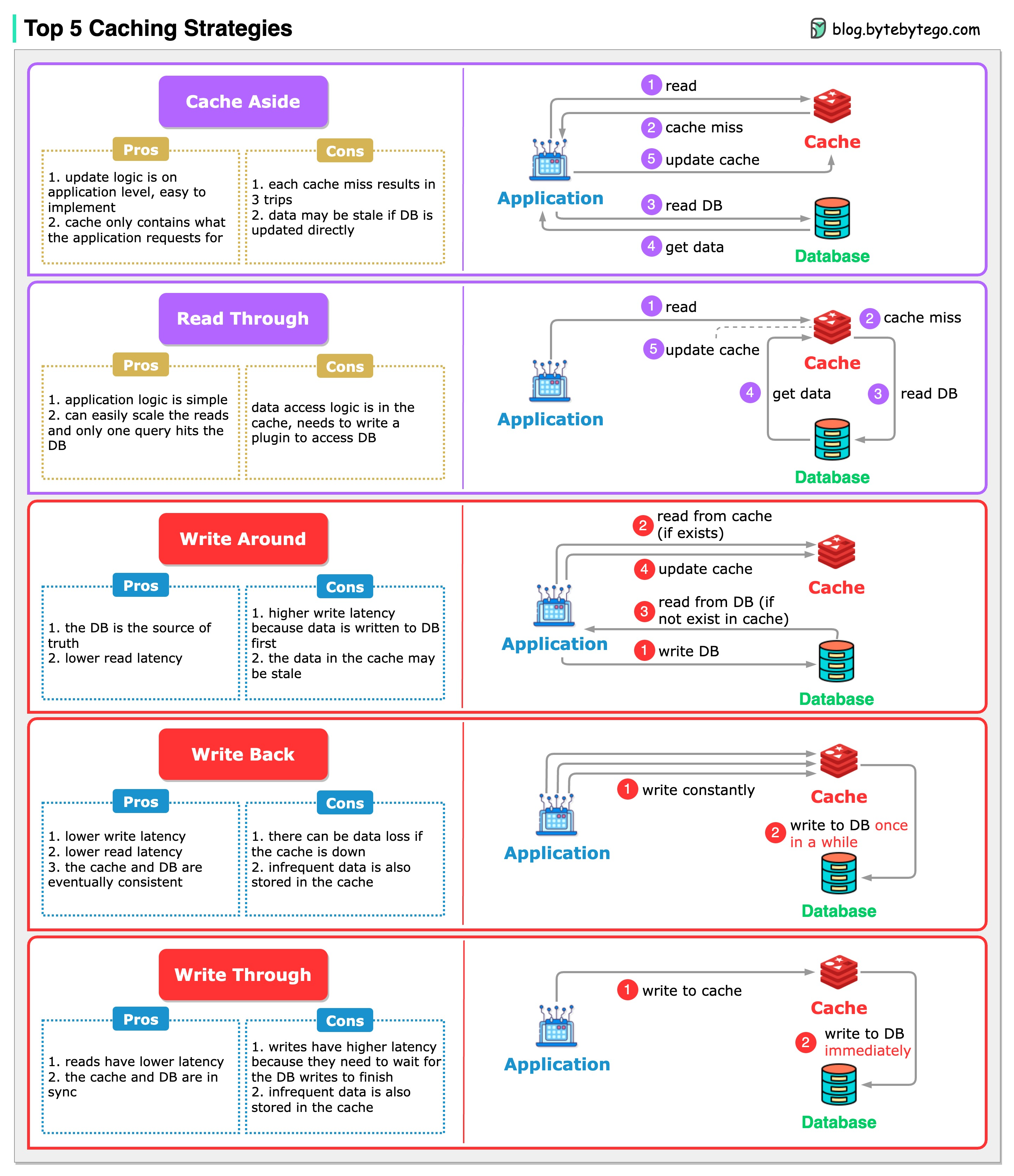
Here’s a breakdown of the trade-offs, which is crucial for making architectural decisions:
| Strategy | Read Path | Write Path | Write Latency | Data Consistency | Use Case |
|---|---|---|---|---|---|
| Cache-Aside | App checks cache first. On miss, app reads DB & writes to cache. | App writes directly to DB. May invalidate cache. | Fast (1 write to DB) | Eventual consistency. Cache can be stale until invalidated or expired. | Read-heavy workloads. The most common, general-purpose strategy. (e.g., user profiles, product catalogs) |
| Write-Through | Same as Cache-Aside. | App writes to cache, which synchronously writes to DB. | Slow (waits for both cache & DB writes) | Strong consistency. Cache and DB are always in sync. | Write-heavy workloads needing strong consistency. (e.g., banking transactions, real-time inventory) |
| Write-Behind | Same as Cache-Aside. | App writes to cache, which asynchronously writes to DB later. | Fastest (only waits for cache write) | Weak consistency (eventual). High risk of data loss if cache fails before flushing to DB. | Very high-throughput writes where some data loss is acceptable. (e.g., logging, analytics, social media likes) |
Cache-Aside (Lazy Loading) is the most popular pattern. It's simple to implement and ensures that only data that is actually requested gets cached, keeping the cache lean. Its main downside is the "cold start" problem: the first request for a piece of data will always be slow (a "cache miss").
Write-Through prioritizes data consistency over write performance. It's more complex to set up because the cache itself needs to manage the database write.
Write-Behind (or Write-Back) prioritizes write performance above all else, accepting the risks of data loss and eventual consistency.
3. Managing Cache Contents: Eviction and Invalidation
A cache has limited memory. What happens when it gets full? And how do you handle data that has been updated in the database, making the cached version stale? A complete caching strategy must answer these two questions.
- Cache Eviction: This is the process of removing items from the cache to make room for new ones.
- Cache Invalidation: This is the process of marking cached data as "stale" or removing it because the original data has changed.
Let's quickly review the common policies.
Caching for System Design Interviews
We'll refer back to the 'Caching for System Design Interviews' article to look at the standard approaches for managing cache memory.
Please read the short section 'Cache Eviction Policies'. Focus on the definitions of LRU, LFU, and TTL.
Here's a summary of the key policies:
- Least Recently Used (LRU): Evicts the item that hasn't been accessed for the longest time. This is a great general-purpose policy and a very common default.
- Least Frequently Used (LFU): Evicts the item that has been accessed the fewest number of times. This is useful when you have a clear set of "popular" items that you want to keep cached, even if they aren't accessed for a short period.
- Time To Live (TTL): This isn't an eviction policy on its own but a mechanism. You set an expiration time on each cache entry. When the time is up, the item is automatically removed. This is essential for ensuring that stale data doesn't live in the cache forever.
For invalidation, the most common strategy used with Cache-Aside is invalidate-on-write. When your application writes an update to the database, it also sends a command to the cache to DELETE the old entry. The next time the data is requested, it will be a cache miss, and the application will fetch the fresh data from the database and populate the cache.
4. Putting It All Together: A Framework for Design
You now have the building blocks. Let's structure them into a repeatable design process. The best way to approach caching in a system design context is to follow a clear, logical sequence.
The "How to Introduce Caching" section in the article we've been using provides an excellent framework for this.
Caching for System Design Interviews
This final reading provides a step-by-step guide on how to articulate a caching strategy, which is exactly what the learning outcome requires.
Please read the section 'How to Introduce Caching'. Pay attention to the five steps it outlines for systematically designing and explaining your caching layer.
Let's recap that design process:
- Identify the Bottleneck: Be specific. Is it high read latency on the database? Is it expensive computations? Quantify the problem (e.g., "User profile queries take 50ms and are our most frequent operation.").
- Decide What to Cache: Focus on data that is read frequently and updated infrequently. Define your cache keys (e.g.,
user:{id}:profile). - Choose Your Cache Architecture: Select a pattern (e.g., Cache-Aside, Write-Through) based on your system's read/write patterns and consistency requirements. Justify your choice. For most general-purpose applications, Cache-Aside is the safe and correct default.
- Set an Eviction/Invalidation Policy: Define how you'll manage cache size and stale data. A common combination is LRU with a TTL. Also, specify your invalidation strategy (e.g., "We will invalidate the user profile cache entry whenever a user updates their profile.").
- Address the Downsides: Show you've considered the trade-offs. What happens if the cache fails? (Your app should gracefully fall back to the database). How will you prevent a Cache Stampede (Thundering Herd), where a popular item expires and thousands of requests hit the database at once? (Solutions include request coalescing or proactive refreshing).
Test your understanding!
You are designing the caching strategy for a blog platform.
- The platform gets a huge number of reads for articles, especially popular ones.
- Articles are written and edited infrequently by authors.
- Comments on articles are posted frequently by users.
- It's acceptable for users to see a slightly outdated view count on an article, but comments should appear almost immediately.
Based on this, propose a high-level caching strategy. Address what you would cache and what strategy you would use for each.
Show answer
Here is a possible strategy, applying the principles we've discussed:
-
Cache Articles:
- What to cache: The full content of published articles. The cache key could be
article:{article_id}. - Architecture: Cache-Aside is perfect here. Reads are very high, and writes (edits) are infrequent.
- Policy: LRU with a TTL of 5-10 minutes. LRU ensures popular articles stay in the cache. The TTL ensures that any minor edits eventually become visible without needing complex invalidation, which might be overkill if immediate updates aren't critical.
- What to cache: The full content of published articles. The cache key could be
-
Cache Comments:
- What to cache: The list of comments for an article. The key could be
article:{article_id}:comments. - Architecture: Cache-Aside is still a good choice.
- Policy: Invalidate-on-write. When a new comment is posted, the application should write it to the database and then immediately issue a
DELETEcommand to the cache for the keyarticle:{article_id}:comments. The next user to load the page will trigger a cache miss, fetching the fresh list of comments (including the new one) and repopulating the cache. A short TTL (e.g., 60 seconds) could be added as a backup.
- What to cache: The list of comments for an article. The key could be
-
Do Not Cache View Counts (Directly):
- Since view counts are updated on every read, caching them with a traditional pattern would be inefficient (you'd be invalidating constantly). A better approach would be to update the count in the database and either accept that the cached article shows a slightly stale count (updated only when the article's TTL expires) or use a separate, more advanced mechanism (like an in-memory counter that flushes to the DB periodically), which is outside the scope of this basic strategy.
This hybrid approach uses different policies for different types of data, which is common in real-world systems.
Conclusion
Today we've moved from simply "adding a cache" to systematically "designing a caching strategy." This is a fundamental skill for building scalable systems and a core part of the architectural mindset you're developing.
Key Takeaways:
- Caching is a multi-layered concept, existing from the client all the way to the database.
- The Cache-Aside pattern is the most common and versatile strategy for read-heavy applications. Write-Through offers strong consistency at the cost of write speed, while Write-Behind offers maximum write speed at the cost of consistency and data safety.
- A complete caching strategy must include eviction policies (like LRU) to manage memory and invalidation strategies (like TTL or invalidate-on-write) to manage data freshness.
- Designing a strategy involves identifying the bottleneck, choosing what to cache, selecting an architecture, defining policies, and considering the potential problems.
Preview of the Next Lesson:
We briefly mentioned Content Delivery Networks (CDNs) as a form of globally distributed caching. In our next lesson, we will do a deep dive into the purpose and architecture of a CDN, exploring how it dramatically reduces latency for users around the world and offloads traffic from your origin servers.