Hello! Welcome to your next lesson in the "Database Architecture & Design" module.
In our last lesson, we explored database replication, a powerful technique for scaling read operations and ensuring high availability. We saw that whether using a Master-Slave or Master-Master model, every server still holds a complete copy of the data. This leaves two critical scaling questions unanswered:
- What happens when your write traffic becomes too high for a single master server to handle?
- What happens when your dataset grows so large that it can no longer fit on a single machine?
Today, we will answer these questions by exploring a fundamental concept in distributed databases. Our learning outcome is to explain database sharding (partitioning) strategies and their impact on scalability and complexity. Sharding, also known as horizontal partitioning, is the process of splitting a large database into smaller, more manageable pieces called shards. This lesson is crucial for understanding how to design systems that can scale to handle massive amounts of data and traffic.
1. The Need for Sharding: When Vertical Scaling Isn't Enough
Imagine your application is a runaway success. User numbers are growing, and so is the data they generate. Your single, powerful database server is starting to struggle. The first instinct is often vertical scaling—upgrading to a bigger machine with more CPU, RAM, and faster storage. But this approach has its limits. Eventually, you can't buy a bigger machine.
This is the point where you must scale horizontally. Sharding is the database equivalent of horizontal scaling. Instead of one giant database, you distribute your data across multiple smaller, independent databases.
Sharding in System Design Interviews w/ Meta Staff Engineer
To understand the motivation behind sharding, let's watch this excellent introduction from a former Meta staff engineer. It clearly illustrates the limits of vertical scaling and sets the stage for why sharding is a necessary step for large-scale systems.
Watch the first 3 minutes of this video (00:00 - 02:55). Focus on the transition from a single large database to the realization that no single machine can handle the load, leading to the introduction of sharding.
As the video explains, each shard is its own standalone database, holding a subset of the total data. Together, all the shards constitute the complete logical database. This approach allows you to scale storage capacity and write throughput simply by adding more servers (shards).
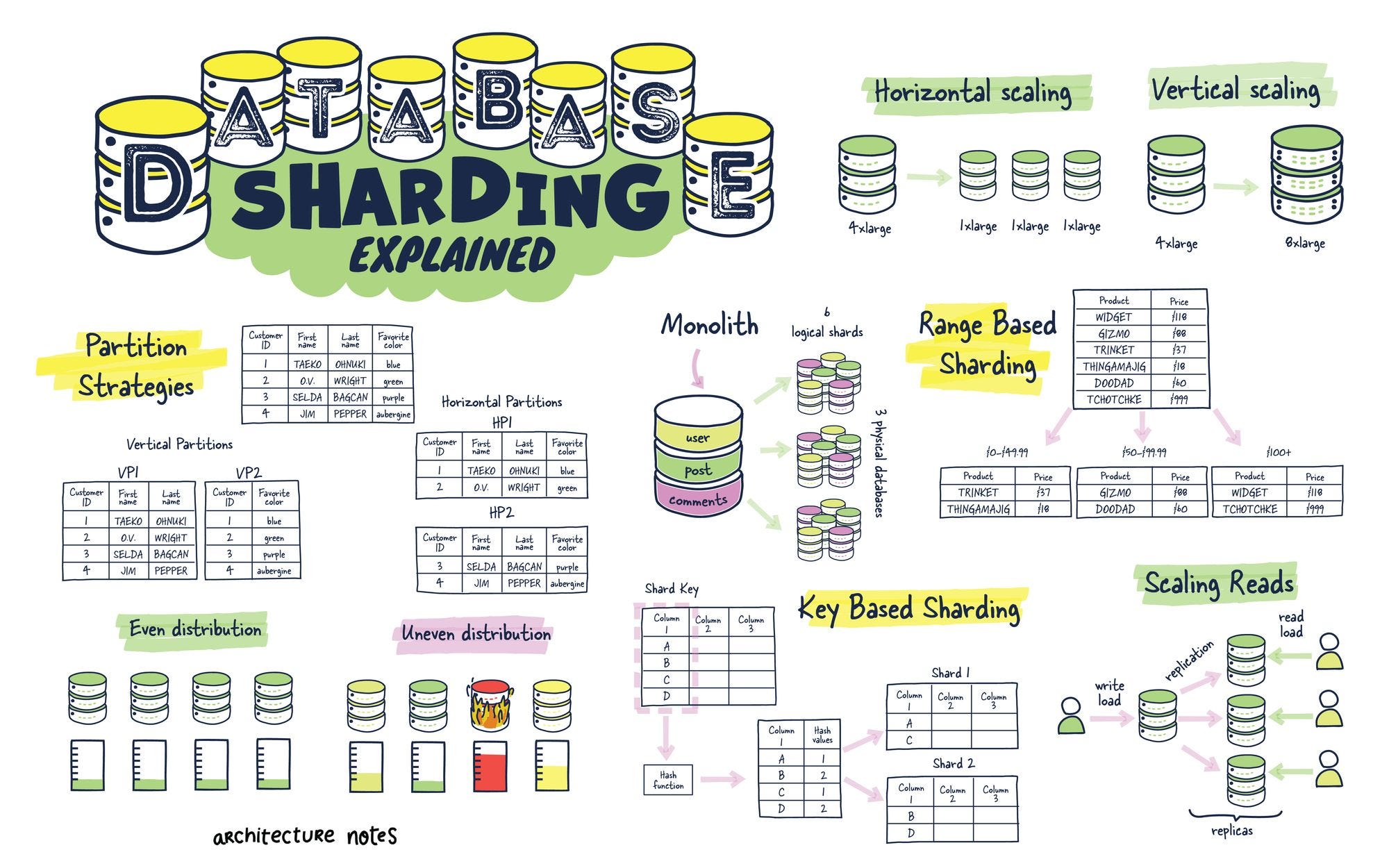
2. The Core of Sharding: Choosing a Shard Key
The most critical decision in any sharding strategy is choosing the shard key (also called a partition key). This is the specific column or piece of data that the system uses to determine which shard a particular row of data belongs to. For example, in a users table, you might choose user_id as the shard key.
The quality of your shard key will determine the success of your sharding strategy. A good shard key has three essential properties.
Sharding in System Design Interviews w/ Meta Staff Engineer
Let's continue with the same video to understand what makes a shard key effective. The speaker does a fantastic job of breaking down the key properties and provides clear examples of good and bad choices.
Watch from 03:26 to 08:43. Pay close attention to the three properties of a good shard key: high cardinality, even distribution, and query alignment.
To summarize the key properties:
- High Cardinality: The shard key should have many unique values. A boolean
is_premiumfield would be a terrible shard key because it has low cardinality (only two values), limiting you to just two shards.user_idororder_idare good examples because they have very high cardinality. - Even Distribution: The key should distribute data and, consequently, the workload evenly across all shards. Sharding by
creation_datemight create a "hotspot" on the most recent shard, as new data and active users tend to cluster there. - Query Alignment: The key should align with your most frequent query patterns. If your application constantly fetches all posts for a user, sharding by
user_idis ideal because all the data needed for that query will be on a single shard.
3. Sharding Strategies: How to Distribute the Data
Once you've chosen a shard key, you need a strategy to map key values to specific shards. There are three common strategies.
Sharding pattern - Azure Architecture Center
Microsoft's Azure Architecture Center provides a canonical text-based explanation of the three primary sharding strategies. Reading this will give you a solid, structured understanding of each approach.
Read the sections titled 'Sharding strategies' and the summary table that follows it. Focus on understanding how the Lookup, Range, and Hash strategies work, and their core advantages and disadvantages.
Let's quickly review these strategies, which are also visualized in the diagram below.

-
Range-Based Sharding: Data is partitioned based on a range of values. For example, user IDs 1-1,000,000 go to Shard 1, 1,000,001-2,000,000 to Shard 2, and so on.
- Pro: Excellent for range queries (e.g., "find all users who registered in May"). The data is located on a single shard.
- Con: Prone to hotspots. If new users are assigned sequential IDs, all new writes will go to the last shard.
-
Hash-Based Sharding: The shard is determined by applying a hash function to the shard key (e.g.,
shard_id = hash(user_id) % number_of_shards).- Pro: Provides much better, more random distribution of data, avoiding the hotspot issue of range sharding.
- Con: Range queries become very inefficient. Finding all users who registered in May would require querying every single shard (a "scatter-gather" query). Adding new shards is also complex, as it changes the result of the modulo operation, requiring a massive reshuffle of data. This is often mitigated by using consistent hashing, a topic the video from LINK touches upon (at 11:34).
-
Directory-Based (or Lookup) Sharding: A lookup table (or "locator service") maintains the mapping of which shard key value lives on which shard. To find data, the application first queries the lookup table to get the shard location and then queries the correct shard.
- Pro: Extremely flexible. You can move individual tenants or hot data to different shards simply by updating the lookup table.
- Con: The lookup table can become a single point of failure and adds an extra network hop (latency) to every query.
Test your understanding!
You are designing a database for two different applications:
- An e-commerce platform where the most common query is to retrieve a customer's complete order history.
- An analytics service that frequently runs queries to find all events that occurred within a specific time window (e.g., "all user logins between 9:00 AM and 10:00 AM yesterday").
Which sharding strategy (Range, Hash, or Directory) and shard key would be most appropriate for each? Justify your choices.
Show answer
-
E-commerce Platform: A Hash-based strategy using
customer_idas the shard key would be ideal. This ensures that all orders for a single customer are located on the same shard, making order history queries very efficient (single-shard query). The hash function would also distribute customers evenly across the shards, preventing hotspots. -
Analytics Service: A Range-based strategy using the event
timestampas the shard key would be the best fit. This strategy groups related items (events in a time window) together in the same shard. A query for events in a specific time range can be directed to a small number of shards (or even just one), which is far more efficient than the scatter-gather approach required by hash sharding.
4. The Impact: Increased Complexity and New Challenges
Sharding solves the problems of storage and write scaling, but it's not a silver bullet. It introduces significant architectural complexity. An "architectural mindset" involves not just knowing the solution, but deeply understanding its trade-offs and consequences.
Sharding in System Design Interviews w/ Meta Staff Engineer
Now for the most important part of the lesson: the challenges. This video provides a structured walkthrough of the three biggest problems that arise from sharding and how to address them.
Watch the segment from 16:01 to 26:30. It's broken into three parts, each tackling a major challenge: Hotspots (16:01 - 18:41): The 'celebrity problem' and how to solve it. Cross-Shard Operations (18:41 - 22:36): Why these are expensive and how to mitigate them. Consistency (22:26 - 26:30): The difficulty of atomic transactions across shards.
The article from the "System Design Review" substack, "The Hidden Art of Scaling Data at 10M+ Requests", provides excellent real-world context on these issues, noting that Instagram faced a hotspot problem with celebrity posts and that cross-partition queries are the "performance killer in partitioned systems."
Here’s a summary of the key complexities:
- Rebalancing: As data grows or access patterns change, shards can become unbalanced. Moving data between shards to rebalance them is a complex and risky operational task.
- Hotspots: Even with a good hash-based strategy, some data can become "hot." The classic example is a celebrity on a social network. If sharded by
user_id, all activity related to that celebrity will hammer a single shard. Solutions include using a compound shard key (e.g.,user_id+post_id) or moving the celebrity to a dedicated shard. - Cross-Shard Queries: Queries that can't be satisfied by a single shard are expensive. They must be sent to all relevant shards, and the results must be aggregated at the application layer. While sometimes unavoidable, a good sharding scheme minimizes these.
- Transactions & Consistency: Standard ACID database transactions do not work across multiple shards. A transaction that needs to modify data on Shard A and Shard B requires a distributed transaction coordinator, using complex and slow protocols like Two-Phase Commit (2PC), or alternative patterns like Sagas.
- Operational Overhead: Managing, monitoring, backing up, and restoring a fleet of sharded databases is exponentially more complex than managing a single one.
Conclusion
You have now explored the why, what, and how of database sharding, as well as its significant impact on system complexity. This is a crucial step in developing your architectural thinking, as it forces you to move beyond the guarantees of a single database and into the trade-offs of distributed systems.
Key Takeaways:
- Sharding (Horizontal Partitioning) is the solution for scaling a database when data volume or write throughput exceeds the capacity of a single server.
- The Shard Key is the most critical decision, and a good key ensures high cardinality, even distribution, and alignment with common queries.
- The main sharding strategies—Range, Hash, and Directory-based—each offer different trade-offs between query performance and data distribution.
- Sharding is not a free lunch; it introduces significant complexity, including the challenges of hotspots, expensive cross-shard queries, loss of native ACID transactions, and major operational overhead.
Preview of the Next Lesson:
We've just seen how sharding makes database transactions across multiple nodes extremely difficult. But even within a single database, managing concurrent transactions is a complex balancing act between performance and data integrity. In our next lesson, we will dive into the purpose and trade-offs of different transaction isolation levels, a concept that governs how a database handles concurrent operations to ensure consistency.