Hello! Welcome to the next lesson in our "Database Architecture & Design" module.
In our last lesson, we focused on optimizing the performance of a single database node by designing effective indexing strategies. We saw how data structures like B-Trees can dramatically speed up queries. However, a high-performance system needs more than just a fast database; it also needs to be resilient and scalable. What happens if your single database server fails? How do you handle read traffic that overwhelms one machine?
Today, we'll address these critical architectural concerns. Our learning outcome is to explain database replication strategies (e.g., master-slave, master-master) and their trade-offs. Replication is the process of keeping copies of your data on multiple servers. This lesson is fundamental to designing systems that are both highly available and can scale to meet user demand.
1. The "Why" of Replication: Beyond a Single Server
A single database server represents a single point of failure. If it goes offline due to a hardware crash, network outage, or even routine maintenance, your entire application can become unavailable. Furthermore, as an application's popularity grows, a single server can be overwhelmed by the sheer volume of read requests.
Replication solves these problems by creating and synchronizing copies (replicas) of your database across multiple servers.
Database Replication Explained (in 5 Minutes)
To start, let's get a quick, high-level overview of why replication is so essential in modern system design. This short video from Exponent clearly lays out the primary motivations.
Watch the first minute of the video (00:00 - 01:02). Focus on the three key reasons for replication: protecting against data loss, handling increased traffic, and improving latency.
As the video highlighted, the main goals of replication are:
- High Availability: If one server fails, a replica can take over, ensuring the application remains operational.
- Read Scalability: Read requests can be distributed across multiple replicas, allowing the system to handle a much higher volume of traffic.
- Lower Latency: Replicas can be placed in different geographic locations, closer to users, reducing the time it takes to fetch data.
Now, let's explore the two most common architectural patterns for achieving this.
2. Master-Slave (Leader-Follower) Replication
This is the most common replication strategy. The architecture is simple and hierarchical:
- One server is designated as the Master (also called Leader or Primary). It is the single source of truth and handles all write operations (INSERT, UPDATE, DELETE).
- One or more servers are designated as Slaves (also called Replicas or Followers). They receive a copy of the data from the master and handle all read operations.
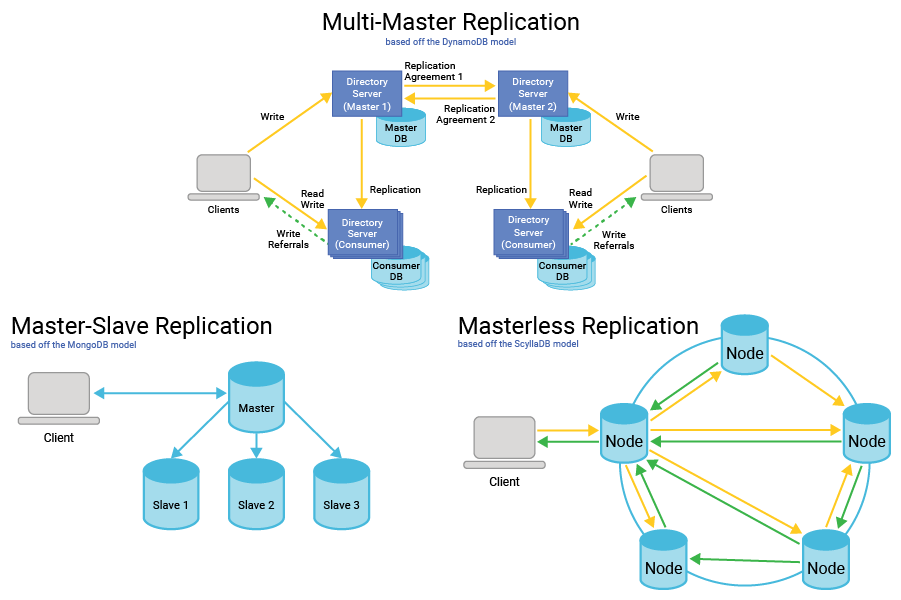
This separation of reads and writes is a powerful pattern for read-heavy applications, which are very common (e.g., blogs, e-commerce sites, news portals where content is read far more often than it's written).
The Critical Trade-off: Synchronous vs. Asynchronous Replication
How the master sends updates to the slaves is a crucial design decision that directly impacts consistency and performance.
Distributed Consensus and Data Replication strategies on the server
The concepts of synchronous and asynchronous replication are best understood with a clear explanation of the flow. Let's watch this segment from Gaurav Sen's video, which breaks down the difference and its consequences.
Watch from 01:21 to 02:34. Pay close attention to the trade-offs he describes between consistency and performance for both synchronous and asynchronous approaches.
To summarize the video's points:
-
Synchronous Replication: The master performs a write, sends the update to the slave(s), and waits for confirmation from the slave(s) before it reports success to the client.
- Pro: Guarantees strong consistency. If the master fails, there is no data loss, as the slave is guaranteed to be up-to-date.
- Con: Increases write latency significantly. The master's write performance is now tied to the slowest slave. If a slave goes down, the master cannot complete writes.
-
Asynchronous Replication: The master performs a write, sends the update to the slave(s), and immediately reports success to the client without waiting for the slaves.
- Pro: Very low write latency and high write availability. The master's performance is not impacted by the slaves.
- Con: Introduces replication lag. There is a small window of time where the slaves are not fully caught up with the master. This can lead to stale reads (a user reads data that is slightly out of date) and potential data loss if the master fails before an update has reached any slaves.
Most production systems use asynchronous replication for performance reasons and implement monitoring to ensure replication lag stays within acceptable limits.
Master-Slave vs Master-Master: Key Differences
To solidify your understanding, let's read a detailed breakdown of the Master-Slave model, including its pros, cons, and ideal use cases. This article from Hokstad Consulting provides excellent, practical detail.
Please read the following sections: 'Master-Slave Replication: How It Works': This gives a clear architectural overview. 'Pros and Cons of Master-Slave': This section summarizes the trade-offs we've discussed. 'When to Use Master-Slave': This provides concrete examples like e-commerce and CMS platforms, helping you connect the theory to real-world application.
3. Master-Master (Multi-Leader) Replication
What if you need higher write availability or have users distributed globally who all need to write data with low latency? This is where Master-Master replication comes in.
In this model, there are two or more master nodes. Each master can handle both read and write operations. When a master receives a write, it processes it and then replicates the change to the other master(s).
Advantages and a Huge Challenge
This architecture provides two key benefits:
- High Write Availability: If one master fails, the system can continue accepting writes through the other master(s).
- Distributed Writes: For a global application, users can write to the master that is geographically closest to them, reducing latency.
However, this flexibility introduces a significant and complex problem: write conflicts. What happens if two users modify the same record on different masters at the same time? The system needs a conflict resolution strategy to decide which write "wins."
Even more dangerous is the split-brain problem.
Distributed Consensus and Data Replication strategies on the server
The 'split-brain' scenario is a classic failure mode in distributed systems. Gaurav Sen's video provides one of the best and most intuitive explanations of how this can happen in a Master-Master setup.
Watch from 03:41 to 06:09. Focus on understanding how a simple network partition (not a server crash) can lead to two masters becoming out of sync, potentially corrupting data.
The split-brain scenario highlights the core trade-off of the master-master model: you gain write availability at the cost of significantly increased system complexity and the risk of data inconsistency.
Master-Slave vs Master-Master: Key Differences
Now, let's dive into the details of the Master-Master model with the Hokstad Consulting article. It covers the architecture, its trade-offs, and when it's the right choice.
Please read these sections: 'Master-Master Replication: How It Works': Focus on the bidirectional replication and the need for conflict resolution. 'Pros and Cons of Master-Master': Pay attention to the challenges of conflict resolution and network partitions. 'When to Use Master-Master': Note the use cases like multi-site deployments and high-availability systems.
Test your understanding!
You are the architect for two different systems:
- A banking application where data consistency is paramount (e.g., account balances must always be accurate).
- A collaborative document editor (like Google Docs) where users in different continents need to make edits with low latency and the system must remain available even if a data center has a temporary outage.
Which replication model (Master-Slave or Master-Master) would you choose for each system, and why?
Show answer
-
Banking Application: The best choice here is a Master-Slave model, likely with synchronous replication. The primary requirement is strong consistency. The performance hit from synchronous writes is an acceptable trade-off to prevent any possibility of data loss or inconsistency with account balances. The single master ensures all transactions are processed in a clear, serializable order.
-
Collaborative Document Editor: This is a prime candidate for a Master-Master architecture. The requirements are high write availability and low latency for a geographically distributed user base. Users in Europe can write to a European master, while users in Asia write to an Asian master. The system can tolerate eventual consistency (it's okay if one user's edits take a fraction of a second to appear for another user). The complexity of conflict resolution (e.g., merging text changes) is a necessary price to pay for the required availability and performance.
4. Choosing the Right Model: An Architectural Decision
As the exercise demonstrates, there is no universally "better" model. The choice is a classic architectural trade-off. To help you structure this decision-making process, the final reading from the Hokstad Consulting article provides a direct comparison and a checklist of factors to consider.
Master-Slave vs Master-Master: Key Differences
This final reading assignment brings everything together, helping you develop the 'architectural mindset' needed to make an informed decision.
Please read these two concluding sections: 'Master-Slave vs Master-Master: Direct Comparison': The comparison table is an invaluable summary of the key differences. 'Choosing the Right Replication Model': This section provides a practical framework for making a decision based on your application's specific workload, scalability, and consistency requirements.
Conclusion
You now have a solid framework for understanding and choosing between the two primary database replication strategies. This moves you from thinking about a database as a single box to seeing it as a distributed system component, with all the trade-offs that entails.
Key Takeaways:
- Replication is essential for high availability, read scalability, and lower latency.
- Master-Slave is simple and ideal for read-heavy workloads. Its primary trade-off is between consistency and performance (synchronous vs. asynchronous replication). Write capacity is limited by the single master.
- Master-Master provides high write availability and is great for geographically distributed applications. Its main challenge is the immense complexity of conflict resolution and avoiding split-brain scenarios.
- The Choice is a Trade-off: The right model depends entirely on your application's specific needs, balancing Consistency, Availability, Performance, and Operational Complexity.
Preview of the Next Lesson:
We've seen how replication can scale read operations and improve availability. However, in both Master-Slave and Master-Master models, every server still holds a full copy of the entire dataset. What happens when your data grows so large that it won't fit on a single server, or your write volume overwhelms even a powerful master? In the next lesson, we will explore database sharding (partitioning) strategies, which solve the problem of scaling both data storage and write throughput.