Hello! Welcome to the next lesson in our journey through Conformal Field Theory.
In our previous lessons, we developed the abstract and powerful machinery of the conformal bootstrap. We saw how the fundamental principles of OPE associativity (crossing symmetry) and unitarity constrain the space of possible CFTs, allowing us to derive universal bounds on CFT data. You might be wondering where these abstract theories show up in the physical world. Today, we make that connection.
This lesson will bridge the gap between the formal structure of CFT and the concrete physics of phase transitions. Our goal is to understand how the scale invariance observed at critical points in statistical systems, like a magnet at its Curie temperature, is often enhanced to full conformal symmetry. This phenomenon is what makes CFT an indispensable tool for modern physics.
From Phase Transitions to Scale Invariance
Many-body systems can exist in different macroscopic phases. A familiar example is water, which can be a liquid or a gas. The transition between these phases can be abrupt (first-order), like boiling water at standard pressure, or continuous (second-order). We are interested in the latter.
At a critical point, a system undergoes a continuous phase transition. At this precise point, the system exhibits remarkable properties. Perhaps the most important is the divergence of the correlation length, .
The correlation length measures the typical distance over which fluctuations in the system are correlated. For example, in a magnet, it's the distance over which the orientation of one spin significantly influences another.
- Away from the critical point, correlations decay exponentially with distance, e.g., , and is finite.
- At the critical point, the correlation length diverges: . The system loses its characteristic length scale.
What does it mean for a system to have no preferred length scale? It means the system looks the same at all scales of observation. Fluctuations occur on all length scales simultaneously. This property is called scale invariance. At a critical point, correlation functions no longer decay exponentially but instead follow power laws, a hallmark of scale invariance.
Conformal Field Theory and Gravity
The following text from the textbook Conformal Field Theory and Gravity by João Penedones provides a concise introduction to these core concepts of statistical mechanics. It defines continuous phase transitions, correlation length, and the power-law behavior that emerges at criticality.
Please read the beginning of Chapter 1, specifically section 1.1 "Phase transitions" (pages 1-4). Focus on the definitions of a continuous phase transition, the correlation length \xi, and how its divergence (\xi o \infty) at a critical point leads to power-law behavior in the two-point function, as shown in equation (1.16).
From Scale Invariance to Conformal Invariance
The emergence of scale invariance is a profound simplification. However, in many physical systems, the symmetry at the critical point is even larger. It is often enhanced from simple scale invariance to full conformal invariance.
Recall that scale transformations, , are a subset of conformal transformations. Conformal transformations are angle-preserving coordinate changes. While a scale transformation resizes everything uniformly, a general conformal transformation can locally stretch and rotate the space in a position-dependent way, as long as angles between intersecting lines remain unchanged.
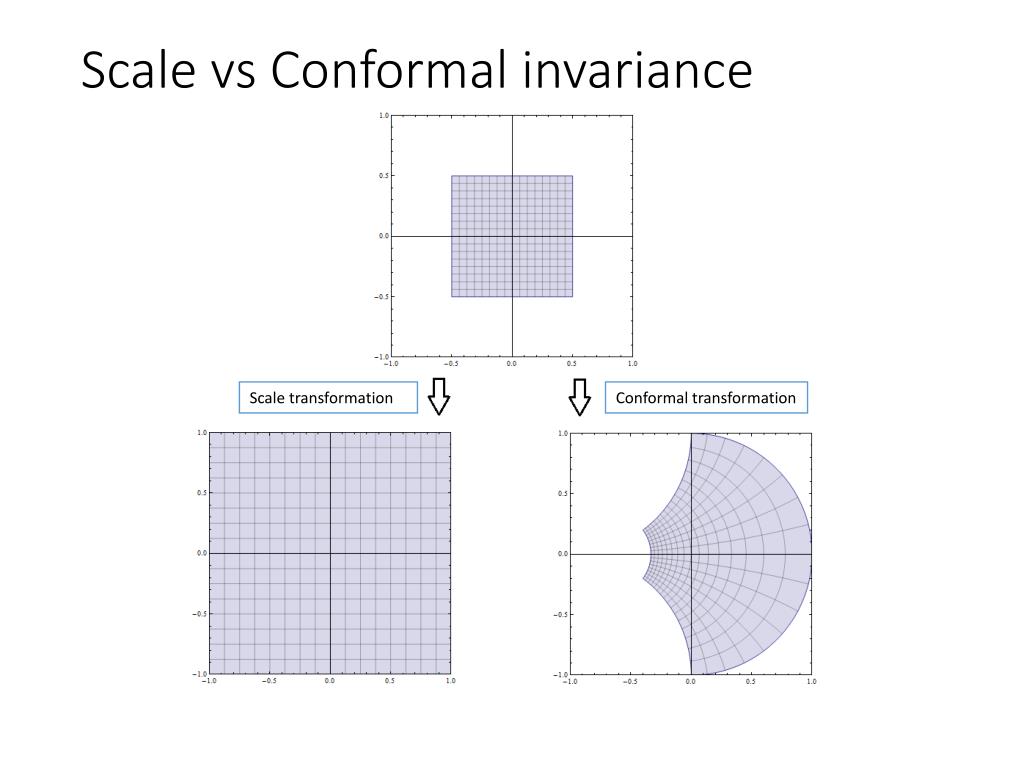
Why should scale invariance imply this larger symmetry? The argument is subtle but powerful and relies on the properties of the stress-energy tensor . Your background in QFT will be helpful here.
- Scale Invariance and the Dilatation Current: In a scale-invariant field theory, there is a conserved current associated with scale transformations (dilatations), called the dilatation current, .
- Conservation and the Stress Tensor Trace: The conservation of this current, , implies (after a short calculation using ) that the trace of the stress-energy tensor must vanish: .
- Traceless Stress Tensor and Conformal Symmetries: For a generic symmetry generated by a vector field , the corresponding current is conserved if (the Killing equation). However, if , the condition for current conservation relaxes to (the conformal Killing equation).
This relaxed condition allows for more solutions than just the Poincaré symmetries and dilatations. It allows for the special conformal transformations (SCTs) we studied in the first module. Thus, in a theory where the stress-energy tensor is traceless, scale invariance naturally leads to full conformal invariance.
While the implication "scale invariance conformal invariance" is not universally guaranteed, it has been proven for unitary, Lorentz-invariant QFTs in dimensions and . In other dimensions, it remains a well-supported conjecture that holds in all known examples.
arXiv:1602.07982v1 [hep-th] 25 Feb 2016
The following excerpt from David Simmons-Duffin's TASI lectures formalizes this argument, showing how a traceless stress tensor is the key link between scale and conformal symmetry.
Please read Section 3, "Conformal Symmetry" (page 12). This short section clearly states that in a conformal theory, T^\mu_\mu=0, and shows how this relaxes the Killing equation to the conformal Killing equation, allowing for the additional symmetries of dilatations and SCTs.
Critical Universality: The Domain of CFT
We've established that the long-distance physics of a system at its critical point is described by a scale-invariant—and typically conformal—field theory. The final piece of the puzzle is the remarkable phenomenon of universality.
It turns out that many microscopically different systems exhibit the exact same behavior at their critical points. For instance:
- Water at its liquid-gas critical point.
- The 3D Ising model (a lattice of classical spins) at its critical temperature.
- A uniaxial magnet at its Curie temperature.
All of these systems, despite their disparate microscopic physics, are described by the same set of critical exponents and, more deeply, by the same Conformal Field Theory at long distances. They are said to belong to the same universality class.
This is the power of our approach. By studying a single CFT (e.g., the "3D Ising CFT"), we are simultaneously studying the universal critical behavior of a vast class of physical systems. The abstract constraints we derive from the conformal bootstrap have direct, measurable consequences in laboratories studying any of these systems.
arXiv:1602.07982v1 [hep-th] 25 Feb 2016
Let's return to the Simmons-Duffin lectures for a clear exposition of critical universality.
Please read Section 1.1, "Landmarks in the Space of QFTs," and Section 1.2, "Critical Universality" (pages 3-4). Pay close attention to Figure 1, which perfectly illustrates how diverse microscopic theories can "flow" to the same IR CFT at their critical points.
Test your understanding!
A condensed matter physicist is studying a newly discovered magnetic material. By carefully tuning the temperature and external magnetic field, they bring the system to a second-order phase transition. At this critical point, they observe that all their measurements are consistent with power-law scaling.
Based on today's lesson, what kind of effective field theory would you propose to describe the long-distance physics of this material at its critical point, and what is the key physical property that justifies this choice? Furthermore, what deeper symmetry would you expect this effective theory to possess beyond simple scale invariance, and what is the field-theoretic reason for this enhancement?
Show answer
The effective field theory describing the long-distance physics would be a Conformal Field Theory (CFT).
The key physical property justifying this is the divergence of the correlation length () at the critical point. This removes any intrinsic length scale from the system, leading to scale invariance, which is manifest in the observed power-law scaling.
Beyond simple scale invariance, one would expect the theory to possess full conformal invariance. The reason for this enhancement stems from the properties of the stress-energy tensor. In a scale-invariant field theory, the conservation of the dilatation current generally leads to a traceless stress-energy tensor (). This condition relaxes the constraints on conserved currents from the Killing equation to the more general conformal Killing equation, which permits the existence of special conformal transformations in addition to Poincaré symmetries and dilatations.
Conclusion
Today, we have built the crucial bridge from the abstract world of CFT to the physical realm of statistical mechanics. We have seen how the seemingly complex and diverse world of critical phenomena simplifies into the elegant and constrained structure of Conformal Field Theory.
Key Takeaways:
- Systems at a continuous (second-order) phase transition are located at a critical point.
- At a critical point, the correlation length diverges, meaning the system loses its intrinsic scale and becomes scale-invariant.
- In many local, unitary quantum field theories, scale invariance implies that the stress-energy tensor is traceless (), which in turn enhances the symmetry to full conformal invariance.
- The phenomenon of universality means that diverse microscopic systems can belong to the same universality class, whose long-distance critical behavior is described by a single, unique CFT.
In our next lesson, we will make this connection even more concrete. We will see how the abstract scaling dimensions of primary operators in a CFT are precisely the critical exponents that characterize the power-law behavior of physical observables near a critical point.