Welcome to the final lesson of our first module, where we'll bring together the core concepts of brand strategy. In our last two lessons, you learned how to define a brand's market positioning and how to use positioning maps to analyze the competitive landscape. Before that, we established that a brand's most foundational element is its purpose—its "why."
Today, our goal is to evaluate the coherence between a brand's stated purpose and its market positioning. This is the ultimate test of a strong brand strategy. A brand that lives its purpose through its market actions is authentic and builds deep, lasting connections. A brand that doesn't is often seen as inconsistent, confusing, or untrustworthy. We will examine this dynamic through a series of case studies that reveal what happens when this alignment is strong, and what happens when it falters.
1. The Framework of Coherence: Connecting "Why" to "How"
Think of a brand's purpose as its internal compass, its fundamental reason for being. Market positioning, on the other hand, is the strategic path it carves out in the world—who it talks to, who it competes against, and how it stands apart. Coherence is the seamless alignment between this internal compass and the external path. Every strategic decision should feel like a natural expression of the brand's core purpose.
To understand this better, let's revisit the idea of purpose as a brand's "navigational code."
Brand purpose: The navigational code for growth
This paper by Markus Kramer, "Brand purpose: The navigational code for growth," provides a strong theoretical basis for why purpose is so critical.
Please read the Introduction, the abstract and keywords, the section "THE WORLD'S AUTHENTIC NEEDS," and the section "Finding and Articulating Purpose." Pay close attention to the "onion principle" which distinguishes the "know-how" from the "know-why." Finally, read the short Conclusion.
The article powerfully argues that purpose is the "know-why" that gives meaning to everything a company does. Profit is the oxygen, but purpose is the reason for living. This "know-why" must be the starting point for all strategy.
The framework below, which you may recall from our second lesson, visualizes this relationship perfectly. The "Brand Heart" (Purpose) is the core from which "Brand Positioning" must logically flow.
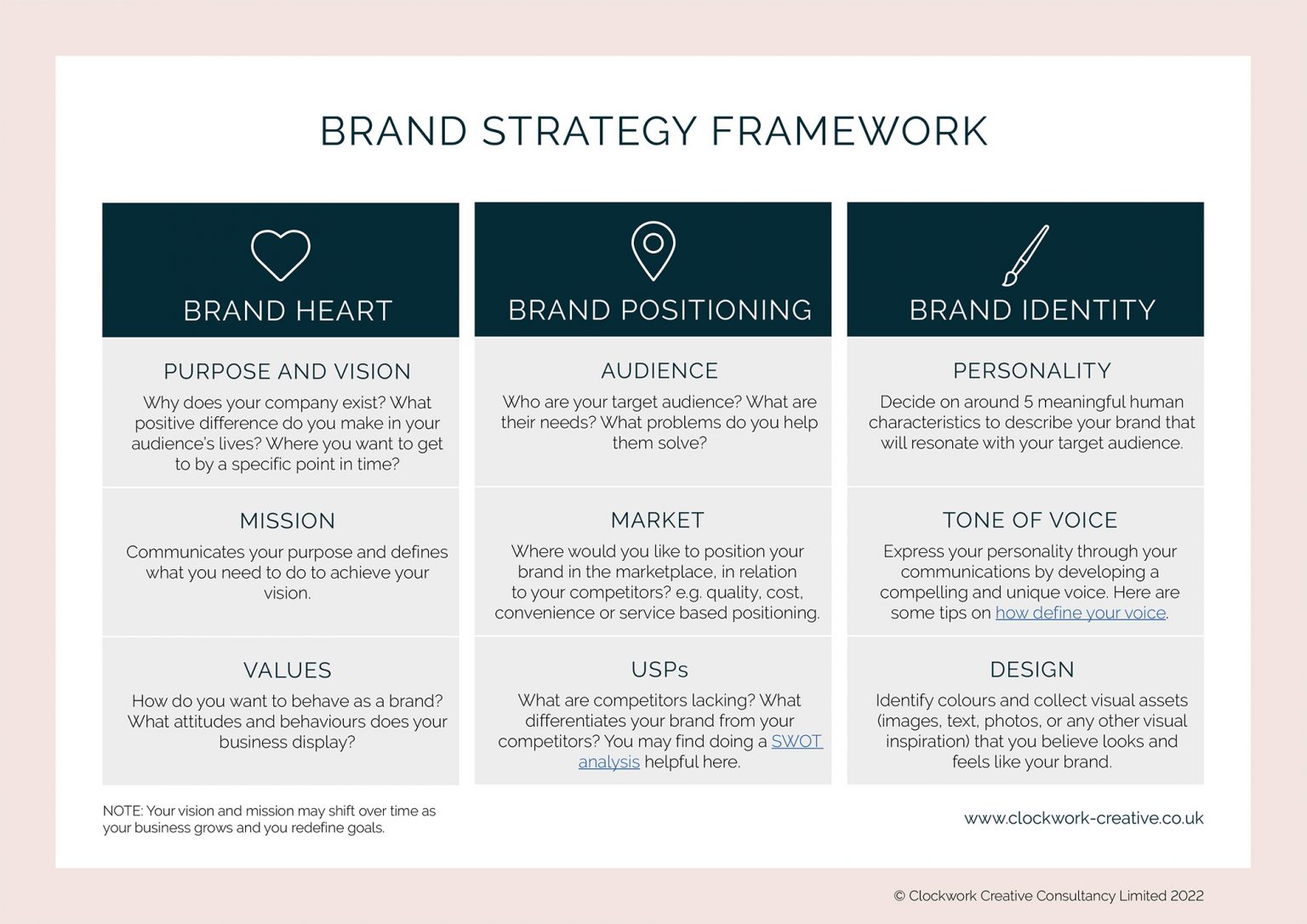
When a brand is coherent:
- Its target audience is naturally drawn to its purpose.
- Its frame of reference is chosen to highlight how its purpose offers a better alternative.
- Its point of differentiation is a unique and compelling expression of that purpose.
Now, let's see how this plays out in the real world.
2. Case Study 1: Patagonia — The Gold Standard of Coherence
Patagonia is perhaps the most frequently cited example of a brand with impeccable coherence between purpose and positioning. Founded by an avid climber, its purpose is deeply rooted in environmentalism.
Let's explore how this purpose is translated into every aspect of its strategy.
Patagonia Business Strategy Explained
The video "Patagonia Business Strategy Explained" from the Business Disruptors channel clearly illustrates the brand's unique approach.
Please watch the following sections: Start with the introduction to Patagonia's philosophy to understand its origins. Continue with the segment on environmental activism, focusing on the "Don't Buy This Jacket" ad. Watch how they handled the 'Midtown Uniform' phenomenon, which is a key test of their coherence. Finally, observe their commitment to radical transparency and ethical practices.
Let's break down the coherence of Patagonia's strategy:
- Stated Purpose: To "use business to inspire and implement solutions to the environmental crisis." More simply, "We're in business to save our home planet."
- Market Positioning:
- Target Audience: Outdoor enthusiasts and, more broadly, conscious consumers who value durability, quality, and environmental responsibility.
- Frame of Reference: The broader apparel industry, particularly fast fashion and conventional outdoor brands that don't prioritize sustainability to the same degree.
- Point of Differentiation: Uncompromising product quality, a lifetime repair guarantee (Worn Wear), and authentic, often radical, environmental activism.
- Evaluation of Coherence:
- The famous "Don't Buy This Jacket" ad is a perfect example of purpose-driven marketing. It directly confronts consumerism, reinforcing their positioning as a brand that values longevity over fleeting sales.
- Their decision to stop adding corporate logos to their vests, even though it meant losing revenue, was a powerful act. It demonstrated that their purpose (reducing waste and avoiding association with industries they don't support) was more important than short-term profit. This action protects the integrity of their brand positioning.
- Their commitment to radical transparency in their supply chain provides tangible proof of their environmental and social claims, making their positioning highly credible.
In every instance, Patagonia's actions are a direct and authentic expression of its purpose. This creates a powerful, unified brand that customers trust and admire.
3. Case Study 2: Burberry — The Challenge of Coherence
Now let's turn to a fashion brand that presents a more complex and challenging picture. Burberry has an incredibly rich heritage, but it has struggled to maintain a coherent identity in the modern market.
[PDF] A Case Study on The Brand Identity of Burberry
This academic paper offers a detailed analysis of Burberry's struggles with brand identity and coherence.
Please read the following sections from the paper: Start with the Abstract to get an overview of the brand's current situation. Read the section titled "Challenges" to understand the specific identity issues the brand has faced. Continue to the "Reasoning" section, focusing on point 1, "Heritage." Next, read point 2, "Instability in Creative Direction." Finally, read the "Conclusion" for a summary of the strategic choices facing the brand.
Let's analyze Burberry's strategy through the lens of coherence:
- Stated Purpose (rooted in heritage): To be a symbol of "Britishness," timeless luxury, craftsmanship, and innovation (e.g., the invention of gabardine for trench coats).
- Market Positioning (often inconsistent):
- Target Audience: This has been a moving target, shifting between traditional luxury consumers, younger fashion-forward customers, and streetwear enthusiasts.
- Frame of Reference: Competes with other heritage luxury houses (like Hermès) but also with more contemporary high-fashion brands (like Gucci or Balenciaga).
- Point of Differentiation: The iconic trench coat and check pattern. However, as the paper notes, these have at times become "over-commercialized and outdated."
- Evaluation of Coherence:
- The paper highlights a significant disconnect. The brand's core purpose is tied to a rich, stable heritage, but its market positioning has been unstable.
- The "instability in creative direction" is a primary source of this incoherence. Each creative director brought a different vision—from Christopher Bailey's digital focus to Riccardo Tisci's streetwear edge to Daniel Lee's return to "Britishness." These rapid shifts confused consumers and made it difficult to understand what Burberry stood for today.
- The dilution of the brand in the past through over-licensing of its iconic check pattern led to a severe crisis of coherence, where the brand's market perception (as "chav" fashion) became dangerously misaligned with its luxury purpose.
- The conclusion of the paper is key: Burberry needs a "clearly articulated strategy" that defines not only what it stands for, but also what it chooses not to be. This is the essence of building a coherent brand.
Burberry's story is a critical lesson for any creative director: a powerful heritage is not enough. The brand's actions in the market must consistently and coherently express that heritage to remain relevant and strong.
4. A Final Example: Aesop — Coherence in Every Detail
To round out our analysis, let's briefly look at a lifestyle brand that, like Patagonia, demonstrates exceptional coherence.
How to Win with Simple Marketing: A branding case study on @Aesop
The video "How to Win with Simple Marketing: A branding case study on @Aesop" by The Art Of The Brand explains how Aesop's purpose drives its unique strategy.
Please watch the section where the narrator explains the meaning of the name 'Aesop' and how it connects to their store philosophy. Then, continue with the analysis of their store design and partnerships.
- Stated Purpose: As the name suggests (Aesop means "storyteller" in Greek), the brand's purpose is to create thoughtful, intelligent, and memorable experiences—to be a storyteller.
- Market Positioning: A premium, minimalist skincare brand for an "intelligent, independent, educated, traveled" consumer who values design, culture, and quality over flashy luxury.
- Evaluation of Coherence: The alignment is perfect. They don't do traditional advertising. Instead, their "storytelling" happens through:
- Product: High-quality, well-formulated products with a distinct aesthetic.
- Placement: Architecturally unique stores designed to reflect their local environment, and partnerships with culturally-aligned hotels and restaurants.
- Packaging: The iconic, uniform amber bottles that create a sense of calm and order.
Aesop proves that when you have a clear purpose, you can build a powerful market position by ensuring every single touchpoint is a coherent expression of that purpose.
Conclusion
This lesson concludes our foundational module on brand strategy. You have moved from understanding a brand as a system of meaning to defining its purpose, formulating its positioning, and now, evaluating the critical link between the two.
Here are your key takeaways from today's lesson:
- Coherence is King: The most successful and resilient brands demonstrate a seamless alignment between their internal purpose ("why") and their external market positioning ("how").
- Purpose Guides Action: A strong purpose acts as a filter for decision-making. As we saw with Patagonia, it can mean saying "no" to profitable opportunities that are not aligned with the brand's values.
- Incoherence Creates Confusion: When a brand's actions (like shifting creative direction or diluting its symbols) are disconnected from its core purpose, it confuses consumers, erodes trust, and weakens its market position, as seen with Burberry's challenges.
- Every Touchpoint Matters: Coherence isn't just about big campaigns; it's expressed in every detail, from store design and packaging (Aesop) to repair policies (Patagonia).
In our next module, "Understanding the Fashion Consumer & Culture," we will shift our focus from the brand to the world it inhabits. We will begin by exploring how to construct a detailed target audience persona, moving beyond simple demographics to understand the psychological and cultural drivers that shape consumer behavior in fashion. This will provide the necessary context for the strategies we've just learned.