Hello! Welcome to your next lesson in our series on functional safety.
In our last lesson, we explored the Memory Protection Unit (MPU), a hardware mechanism that provides spatial isolation to prevent memory corruption between different software components. This is a cornerstone of achieving "freedom from interference" as required by ISO 26262. Today, we build directly on that foundation by shifting our focus from hardware-enforced protection to the software techniques you must implement within your drivers to ensure they are robust and safe.
Your learning outcome for this lesson is to apply key principles from ISO 26262 Part 6 (Software) to driver development, such as defensive programming. We will explore what defensive programming means in a safety-critical context and break it down into concrete, actionable techniques that are frequently discussed in senior engineering interviews.
1. The "Why" Behind Defensive Programming: Systematic Failures
ISO 26262 aims to mitigate two primary types of failures: random hardware failures (e.g., a bit flip in a register due to radiation) and systematic failures. Systematic failures are bugs or flaws introduced during the development process—in requirements, design, or code. Defensive programming is a primary strategy to prevent, detect, and control these systematic failures at the code level.
To understand how ISO 26262 frames this, let's watch a brief introductory clip.
SAEINDIA Functional Safety - Automotive Functional Safety ISO 26262 – Principles & Practices-1
The following clip from a webinar by SAEINDIA provides a clear definition of functional safety and distinguishes between systematic and random hardware failures. This context is essential for understanding why process and design principles like defensive programming are so heavily emphasized by the standard.
Please watch the video from the beginning until 09:27. Pay close attention to: The definition of functional safety as the "absence of unacceptable risk." The clear distinction between systematic failures (which can be fixed by changing the design/process) and random hardware failures (which must be detected and mitigated).
As the video explains, systematic failures are addressed by having a robust development process. Defensive programming is a critical part of that process at the implementation stage. It is a mindset where you, the developer, assume that inputs can be invalid, external components can fail, and the software's internal state can be corrupted. Your code must be written to handle these situations gracefully.
2. Core Techniques of Defensive Programming
ISO 26262 Part 6, Annex E provides guidance on design principles for software unit design and implementation. Many of these directly map to defensive programming techniques. Let's explore the most important ones with practical driver examples.
a) Plausibility and Range Checks on Inputs
This is perhaps the most fundamental principle. Never trust the data passed to your driver's public API. Always validate it before using it to manipulate hardware.
- What: Check that function parameters (especially pointers and numerical values) are valid and within an expected range.
- Why: Prevents callers from providing invalid data that could cause undefined behavior, crash the system, or put hardware into an unsafe state.
- Example: Consider a PWM driver function to set the duty cycle.
Non-Defensive Implementation:
void Pwm_SetDutyCycle(uint8_t channel, uint8_t duty_cycle) {
    // What if duty_cycle is 150? This could overflow or cause unexpected behavior.
    PWM_REGS->CHANNEL[channel].DUTY = duty_cycle;
}
Defensive Implementation:
#include "Det.h" // Development Error Tracer

Std_ReturnType Pwm_SetDutyCycle(uint8_t channel, uint8_t duty_cycle) {
    // 1. Parameter Validation: Range Check
    if (duty_cycle > 100) {
        // Report error (e.g., using AUTOSAR's DET) and return failure.
        Det_ReportError(PWM_MODULE_ID, PWM_INSTANCE_ID, API_ID_SET_DUTY, PWM_E_PARAM_INVALID);
        return E_NOT_OK;
    }

    // 2. Plausibility Check (assuming max channel is 3)
    if (channel >= PWM_MAX_CHANNELS) {
        Det_ReportError(PWM_MODULE_ID, PWM_INSTANCE_ID, API_ID_SET_DUTY, PWM_E_PARAM_INVALID_CHANNEL);
        return E_NOT_OK;
    }

    // Only proceed if checks pass
    PWM_REGS->CHANNEL[channel].DUTY = duty_cycle;
    return E_OK;
}
b) Handling All Logical Paths (else and default)
Your code must account for every possible logical path, not just the "happy path."
- What: Every
if-else ifconstruct should end with a finalelseclause, and everyswitchstatement must have adefaultcase. - Why: This prevents situations where a variable has an unexpected or corrupted value, leading to no code being executed when some action is required. It ensures your logic is complete.
- Example: A state machine in an interrupt-driven I2C driver.
Non-Defensive Implementation:
void I2C_Isr() {
    switch (i2c_driver_state) {
        case I2C_STATE_START_SENT:
            // handle start condition
            break;
        case I2C_STATE_ADDR_SENT:
            // handle address sent
            break;
        // What if i2c_driver_state gets corrupted by a bit flip?
    }
}
Defensive Implementation:
void I2C_Isr() {
    switch (i2c_driver_state) {
        case I2C_STATE_START_SENT:
            // handle start condition
            break;
        case I2C_STATE_ADDR_SENT:
            // handle address sent
            break;
        default:
            // An unexpected state was reached. This indicates a serious error.
            // Transition to a safe state (e.g., reset the I2C peripheral).
            I2C_HandleErrorAndReset();
            Det_ReportError(I2C_MODULE_ID, ...);
            break;
    }
}
c) Restricted Use of Pointers
Your C experience makes you well aware of the dangers of pointers. Defensive programming demands explicit checks.
- What: Always check pointers for
NULLbefore dereferencing them. - Why: A
NULLpointer dereference is a common cause of system crashes (often leading to a HardFault on ARM Cortex-M). - Example: A UART driver function that transmits a block of data.
Non-Defensive Implementation:
void Uart_Transmit(const uint8_t* data, uint32_t length) {
    for (uint32_t i = 0; i < length; i++) {
        // If 'data' is NULL, this will crash on the first iteration.
        UART_REGS->TX_DATA = data[i];
    }
}
Defensive Implementation:
Std_ReturnType Uart_Transmit(const uint8_t* data, uint32_t length) {
    // 1. Check for NULL pointer
    if (data == NULL) {
        Det_ReportError(UART_MODULE_ID, ..., UART_E_PARAM_POINTER);
        return E_NOT_OK;
    }

    // 2. Check for invalid length (plausibility)
    if (length == 0 || length > UART_MAX_BUFFER) {
        Det_ReportError(UART_MODULE_ID, ..., UART_E_PARAM_INVALID_LENGTH);
        return E_NOT_OK;
    }

    for (uint32_t i = 0; i < length; i++) {
        UART_REGS->TX_DATA = data[i];
    }
    return E_OK;
}
These techniques are not just "good practice"; they are methods recommended by ISO 26262 to build predictable and dependable software. The "Best Practice Guideline Software for Safety-Related Automotive Systems" (resource LINK) provides excellent plain-language explanations of these methods in its section 9.6, "Table 6, Design principles for software unit design and implementation".
3. The Link to MISRA C
You've noted experience with MISRA-C/C++. ISO 26262 Part 6 explicitly recommends the "use of language subsets" (Table 1, 1b), and MISRA C is the de facto industry standard for this in the automotive world. Many MISRA C rules directly enforce the defensive programming principles we've just discussed.
Let's see how these two standards are formally connected.
MISRA C in the ISO 26262 Context I #automotive #ESSS21
This video from Embedded Safety & Security explains the direct relationship between ISO 26262 and MISRA C. It highlights how the safety standard explicitly calls out MISRA as a way to fulfill its objectives for programming language guidance.
Please watch the segments from 05:47-08:31 and 11:22-14:31. Focus on how ISO 26262: Directly references MISRA C as an example of a coding guideline (Part 6, Table 1). Has design principles (like defensive implementation) that are covered by MISRA C rules. Connects MISRA rules to specific verification activities like static analysis. Emphasizes defensive techniques like mandatory else and default clauses.
As the video shows, following MISRA C isn't just about code style; it's a concrete way to meet the objectives of ISO 26262 by eliminating large classes of potential bugs and enforcing defensive coding constructs.
Test your understanding!
Imagine you are reviewing a colleague's GPIO driver. You find a function Gpio_SetPinDirection that takes a direction parameter (e.g., INPUT, OUTPUT). The implementation uses an if (direction == INPUT) and an else if (direction == OUTPUT). There is no final else.
What is the risk, and which two defensive programming principles are being violated?
Show answer
The risk is that if the direction variable holds any value other than INPUT or OUTPUT (perhaps due to memory corruption or a caller error), the function will do nothing, leaving the pin's direction in an unknown or incorrect state. This could lead to unpredictable system behavior.
The two violated principles are:
- Plausibility/Range Checks: The function should validate that the
directionparameter is one of the valid enumerations before using it. - Handling all Logical Paths: The
if-else ifstructure is incomplete. It should have a finalelseblock to catch any invalid values and handle the error, for example, by reporting to the DET and not touching the hardware.
4. Defensive Programming in the Software Architecture
Defensive programming isn't just about individual lines of code. The principles extend to the software architecture. ISO 26262 emphasizes creating architectures that are easy to verify and maintain, with characteristics like strong cohesion and loose coupling.
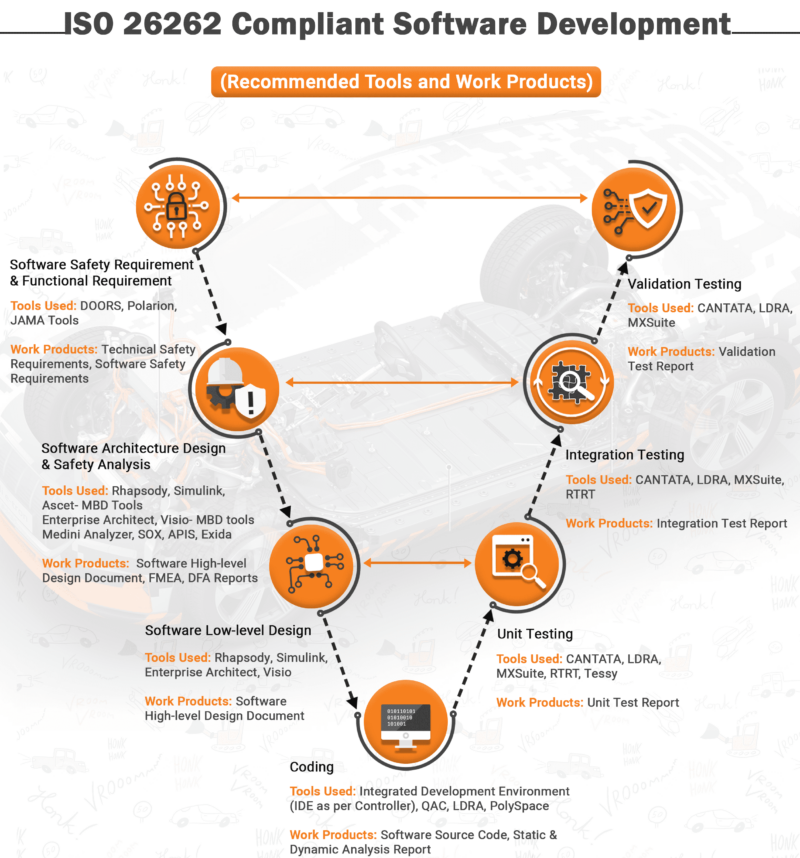
Error detection mechanisms are a key part of this architecture. Let's watch one more clip that places these concepts within the broader software development lifecycle.
SAEINDIA Functional Safety - Automotive Functional Safety ISO 26262 – Principles & Practices-1
Returning to the SAEINDIA webinar, this section discusses software safety requirements and architectural design. It lists several error detection mechanisms that are forms of defensive programming applied at a system level.
Please watch from 01:02:35 to 01:09:25. Focus on the list of "error detection of software level" mechanisms, such as: Plausibility check: Cross-checking related values (e.g., vehicle speed vs. engine speed). External monitoring: The use of a watchdog to monitor program execution. Diversified software design: A powerful technique for high-ASIL systems where redundant components are developed differently to avoid common-cause failures.
This higher-level view shows that defensive programming is a multi-layered strategy, from checking a single function parameter to designing redundant software components to monitor each other.
5. Interview Corner
Q1: What does "defensive programming" mean to you in the context of writing an ISO 26262 compliant driver?
A: It's a proactive approach to software design where you assume failures can and will occur. It's not just about implementing the specified functionality. It means writing code that is robust against invalid inputs, unexpected internal states, and even hardware faults. In practice, this involves implementing software safety mechanisms like validating all API parameters, ensuring complete logical paths with default cases in switches, checking for NULL pointers, and having a defined error handling strategy that transitions the system to a safe state. It is a fundamental method for addressing systematic failures as required by ISO 26262-6.
Q2: You're writing a Can_SetBaudrate function for a CAN driver. Describe the defensive checks you would implement at the function's entry point and explain why.
A: First, I would perform parameter validation. I'd check if the requested baud rate is one of the supported values (e.g., 125kbps, 250kbps, 500kbps, 1Mbps). I would do this with a range or enumeration check. Why: This prevents a caller from attempting to set an impossible baud rate that could cause the CAN controller to fail initialization or not communicate at all. Second, I would check if the CAN controller is in a state where the baud rate can be changed (e.g., it must be in configuration or "stopped" mode, not active on the bus). Why: This is a plausibility check on the system state, preventing a change that would disrupt active communication and violate the CAN protocol. If any check fails, I would return E_NOT_OK and report an error to the DET, without modifying any hardware registers.
Q3 (Advanced): Your last lesson was on using the MPU. How do software-level defensive programming techniques complement the hardware protection offered by an MPU?
A: They are two layers of a defense-in-depth strategy. The MPU provides spatial isolation in hardware. It prevents one software component from illegally accessing another's memory space, which is a very coarse but powerful form of protection against wild pointers or buffer overflows. However, the MPU doesn't understand the logic of the software. Defensive programming provides a finer-grained, logic-aware layer of safety. For example, an MPU can ensure Task A doesn't write to Task B's memory, but it can't stop Task A from passing a logically incorrect value (like a duty cycle of 200%) to a driver API. That's where defensive programming's parameter validation comes in. The MPU protects against illegal access, while defensive programming protects against legal but unsafe operations. Together, they provide robust protection against both memory corruption and logical errors.
Conclusion
Today, we've unpacked the crucial concept of defensive programming as it applies to functional safety and ISO 26262. This mindset is a key differentiator for senior embedded engineers—it shows you think not just about making code work, but about making it fail safely.
Key Takeaways:
- Defensive programming is a core strategy for mitigating systematic failures as required by ISO 26262 Part 6.
- It involves concrete techniques like parameter validation, plausibility checks, ensuring complete logical paths (with
else/default), and safe pointer handling. - These principles are directly supported and often enforced by coding standards like MISRA C, which is explicitly recommended by ISO 26262.
- Defensive programming is a multi-layered approach, applied from individual lines of code up to the software architecture, and works in concert with hardware mechanisms like the MPU.
Next Lesson Preview
In our next lesson, we will get even more practical. We will move from the "what" and "why" to the "how" by focusing on the learning outcome: Implement software safety mechanisms, including parameter validation, range checks, and plausibility checks in a driver API. We'll take the principles from today and apply them to writing a full, safety-conscious driver API from scratch.