Hello and welcome to our new module, Head and Sensory Organ Care.
Introduction
In our last lesson, we consolidated your knowledge of Mukha Shuddhi by designing a complete clinical protocol. You learned to synthesize patient information and classical principles to create a personalized plan, a cornerstone of Ayurvedic practice.
We now move from the oral cavity to the care of the entire head and sensory organs (Urdhvajatru). This lesson focuses on the learning outcome: Explain Pratimarsha Nasya as a daily nasal practice, differentiating it from therapeutic panchakarma procedures.
Nasya Karma, the administration of substances through the nose, is a powerful therapeutic tool in Ayurveda. However, not all forms of Nasya are suitable for daily use. Today, we will clarify the precise definition of Pratimarsha Nasya, understand its role within Dincharya (daily routine), and draw a clear line between this gentle daily practice and the more intensive Nasya procedures used in a clinical Panchakarma setting. This distinction is fundamental to prescribing it safely and effectively.
Understanding Nasya Karma: The Gateway to the Head
The classical texts state, "Nasa hi shiraso dwaram"—the nose is the gateway to the head. This aphorism underscores the significance of the nasal route for administering medicines intended to affect the head, sinuses, and all structures above the clavicle.
As you know from your BAMS studies, Nasya is one of the five primary procedures of Panchakarma, primarily used for its cleansing (Shodhana) and pacifying (Shamana) effects on doshas that accumulate in the head and neck region.
To begin, let's establish the context of Pratimarsha Nasya within the broader category of Nasya.
Conceptual Study Of Pratimarsha Nasya In Swasthavritta
The following resource provides a concise introduction to Nasya Karma and immediately positions Pratimarsha Nasya as the specific type suitable for daily use.
Please read the 'INTRODUCTION' and 'Defination of Nasya' sections. Focus on how the authors introduce Nasya as a Panchakarma procedure but then specify that only Pratimarsha Nasya is included in Dincharya.
As the paper highlights, while Nasya is a major therapeutic procedure, Pratimarsha Nasya is singled out for inclusion in the daily regimen (Dincharya). Its primary purpose is not to cure a severe, established disease but rather to promote health and prevent disease—fulfilling the primary objective of Ayurveda: Swasthasya swasthya rakshanam.
Differentiating Pratimarsha Nasya from Therapeutic Nasya
To truly understand Pratimarsha Nasya's role, we must compare it with its therapeutic counterpart, primarily Marsha Nasya. Marsha Nasya is the main form of oleation Nasya (Snehana Nasya) administered as a Panchakarma therapy under the strict supervision of a physician. The differences between the two are not subtle; they are fundamental and relate to purpose, dosage, procedure, and safety.
The following resource provides an excellent and direct comparison.
A Conceptual Critical Review of the Therapeutic Applications of Pratimarsha Nasya Karma
This research paper includes a table that directly compares Marsha Nasya and Pratimarsha Nasya, which is central to our learning outcome.
Please locate the table titled 'Difference between marsh and pratimarsha nasya' within the 'Nasya Karma Classification' section. Study the comparison points carefully, paying close attention to dosage, mode of action, complications, and patient suitability.
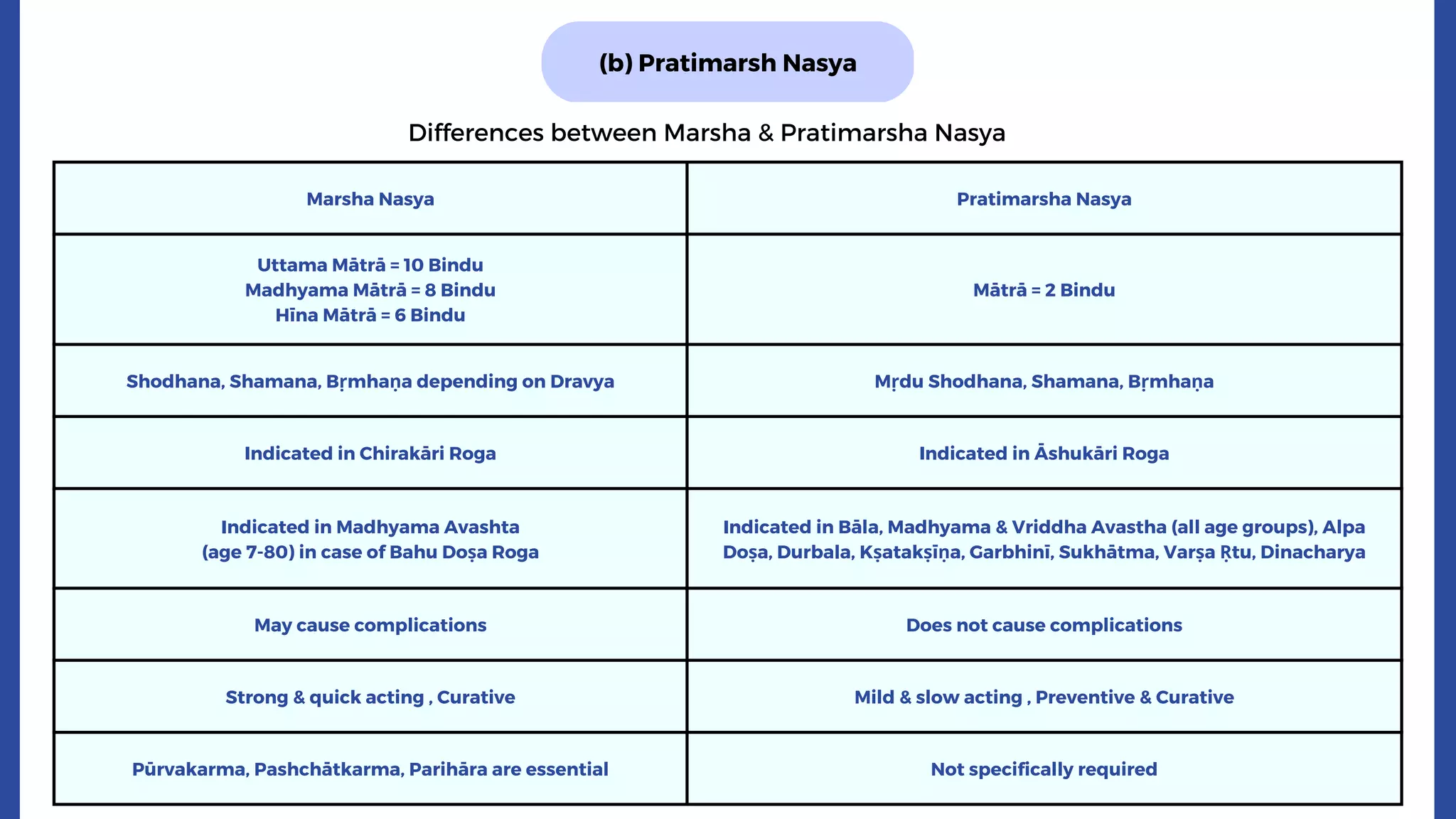
To consolidate this comparison, the table below and the following image summarize the key distinctions you need to know for clinical practice.
| Feature | Marsha Nasya (Therapeutic/Panchakarma) | Pratimarsha Nasya (Daily/Dincharya) |
|---|---|---|
| Primary Purpose | Curative, Shodhana (purification) | Preventative, Shamana (palliative), Brimhana (nourishing) |
| Dosage (Matra) | High dose: 6, 8, or 10 bindu (drops) | Low dose: 2 bindu (drops) only |
| Procedural Steps | Requires formal Purvakarma (facial massage, steam) & Paschatkarma (gargling, medicated smoke) | Minimal to no formal pre/post-procedures required. Can be self-administered. |
| Restrictions (Parihara) | Strict dietary and lifestyle restrictions are mandatory post-procedure. | No specific restrictions are required. |
| Action | Fast-acting (Ashukari) | Slow and sustained action (Chirkari) |
| Complications (Vyapad) | Can cause complications if indications, contraindications, or procedures are not followed correctly. | Considered to have virtually no complications. |
| Indications | Specific disease states in strong patients who can tolerate Shodhana. | Suitable for all ages (child to elderly), weak individuals, and in all seasons. |
Why is Pratimarsha Nasya Safe for Daily Practice?
The safety and suitability of Pratimarsha Nasya for daily use stem directly from the characteristics we've just outlined:
-
Low Dosage (Alpa Matra): The dose of two drops is minute. It is just enough to lubricate and nourish the nasal mucosa and clear the subtle channels (srotas) without being potent enough to aggressively expel doshas or cause vitiation. As described in the resource "A Conceptual Critical Review...", the dose should be enough to reach the throat but not enough to cause excessive secretions or systemic aggravation.
-
Gentle Action (Shamana): Unlike Marsha Nasya, which has a strong Shodhana (purificatory) effect, Pratimarsha has a pacifying (Shamana) and nourishing (Brimhana) action. It soothes Vata dosha locally, lubricates dry tissues, and strengthens the sensory organs without the intensity of a detoxification procedure.
-
Minimal Procedure: The absence of mandatory, elaborate pre- and post-procedural care makes it practical to incorporate into a busy daily schedule. This ease of use is a defining feature of a Dincharya practice.
In essence, you can think of the relationship between Pratimarsha and Marsha Nasya as analogous to daily gentle exercise versus intensive athletic training for a competition. One is for long-term maintenance and well-being, while the other is a targeted, high-intensity intervention for a specific goal.
Test your understanding!
A 45-year-old office worker with a Vata constitution tells you they've heard "Nasya is good for stress and headaches." They want to start doing it every morning before work to combat the dryness from office air-conditioning and prevent sinus issues.
Which type of Nasya would be appropriate for their goal, and how would you explain the key differences from other, more intensive forms of Nasya to ensure they understand the practice correctly?
Show answer
The appropriate recommendation would be Pratimarsha Nasya.
You would explain the choice by highlighting three key differences:
- Purpose: "For your goal of daily prevention and managing dryness, we use Pratimarsha Nasya. This is a gentle, nourishing practice designed for daily well-being. This is different from therapeutic Nasya (like Marsha Nasya), which is a more intensive, supervised treatment for specific diseases and is not done daily."
- Dosage and Safety: "You will only use two drops of oil in each nostril. This very low dose is safe for daily use and has virtually no risk of complications. Therapeutic Nasya uses a much higher dose and requires a physician's supervision because it can cause adverse effects if done improperly."
- Procedure: "You can do Pratimarsha Nasya yourself each morning with minimal preparation. The therapeutic version, however, is a more involved clinical procedure requiring specific preparation and post-procedural care, which is not practical or necessary for a daily routine."
Conclusion
Today's lesson has established a clear and critical distinction. You can now confidently explain Pratimarsha Nasya and its specific role within Ayurveda.
Key Takeaways:
- Nasya Karma is a broad term for nasal administration of medicine, and it is a primary Panchakarma therapy.
- Pratimarsha Nasya is the specific form of Nasya designated for Dincharya (daily routine) due to its preventative, nourishing, and gentle nature.
- It is fundamentally different from therapeutic procedures like Marsha Nasya in its purpose (prevention vs. cure), dosage (low vs. high), procedural complexity, and safety profile.
- This distinction is essential for providing safe and appropriate recommendations to patients for daily self-care.
Now that we have clearly defined what Pratimarsha Nasya is and why it is suitable for daily practice, our next lesson will address the practicalities. We will explore how to select the appropriate oils (sneha dravyas) and understand the correct timing and dosage based on an individual's constitution (prakriti), imbalances (vikriti), and the season (rutu).