Hello! Welcome to the first lesson in our module on Abhyanga, or therapeutic body oiling.
Introduction
In our previous module, we focused on practices for the head and sensory organs, exploring the specific, localized actions of Nasya and Anjana. We are now moving from the head (Urdhvajatru) to the entire body (Sarva Deha) to explore one of the most celebrated practices in Dincharya: Abhyanga.
Your goal is to master the clinical application of Dincharya, which requires a deep understanding of not just what to do, but why it works. Therefore, before we can discuss which oils to use or when to perform Abhyanga, we must first understand its fundamental mechanism of action.
Today's lesson addresses the learning outcome: Explain the physiological mechanisms of sneha (oil) penetration and its effects on dhatus (tissues). We will explore this from both the classical Ayurvedic perspective and the modern physiological viewpoint, integrating these two streams of knowledge to build a robust clinical understanding.
1. The Ayurvedic Model of Sneha Absorption
From an Ayurvedic perspective, Abhyanga is not merely a topical application. It is a profound snehana (oleation) therapy that nourishes the body from the outermost layer to the deepest tissues. The process relies on the unique anatomy and physiology of the Twak (skin) and the properties of the oil itself.
To begin, let's explore the classical explanation for how oil penetrates the skin and begins its journey.
A Conceptual Study on Abhyanga
This research paper, 'A Conceptual Study on Abhyanga,' provides an excellent summary of the classical mode of action as described by Acharya Sushruta and Charaka.
Please read the section titled 'DISCUSSION ON MODE OF ACTION OF ABHYANGA'. Focus on the entry points for the sneha (Romakoopa, Siramukha) and the roles of Bhrajaka Pitta and Vayu.
As you've just read, the classical model involves three key components:
-
The Portals of Entry: Acharya Sushruta describes the skin as a vast network of channels. The sneha enters the body through:
- Romakoopa: The hair follicles.
- Siramukha and Dhamanis: The openings of minute veins and arteries that are connected to the hair follicles.
- Swedovaha Srotas: The channels that carry sweat.
-
The Role of Bhrajaka Pitta: The skin is the seat of Bhrajaka Pitta, a subtype of Pitta Dosha responsible for skin colour, lustre, and absorption. When sneha is applied, Bhrajaka Pitta acts as the local agni (metabolic fire), "digesting" or processing the substance. This metabolic action allows the veerya (active potency) of the oil and any infused herbs to be absorbed and become bioavailable to the body.
-
The Predominance of Vayu: Acharya Charaka highlights that Twak is the primary seat of the Sparshanendriya (sense of touch), which is dominated by Vayu. Since sneha is one of the primary antidotes to the ruksha (dry) and chala (mobile) qualities of Vayu, applying it directly to the seat of Vayu has a potent pacifying effect.

2. The Journey Through the Dhatus
Once absorbed, the essence of the sneha doesn't just stay in the skin. Ayurveda posits that it travels sequentially to nourish all seven dhatus (body tissues). The time it takes to reach each successive dhatu has been meticulously calculated by the acharyas.
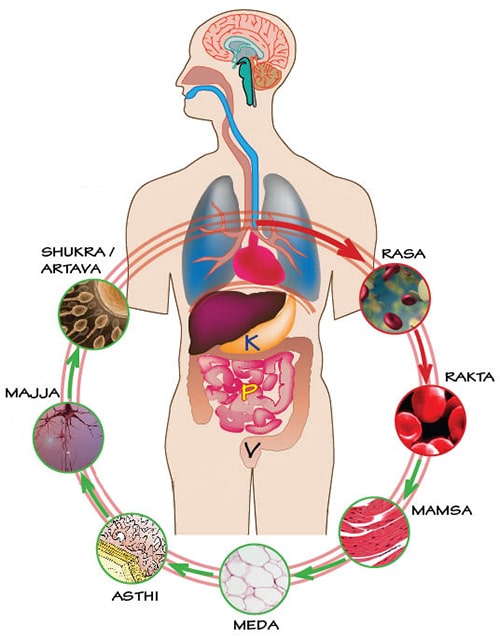
To understand the timeline of this nourishment, let's look at the specific durations mentioned in the texts.
"Fundamentals of Abhyanga" Talk By- Dr. Rajkala P. Patil
This short clip from a lecture by Dr. Rajkala P. Patil provides a concise summary of the time it takes for Abhyanga oil to penetrate the different dhatus.
Watch the segment from 26:13 to 27:19. Dr. Patil lists the time in both 'Matras' (a classical unit of time, roughly one-third of a second) and seconds for the sneha to reach each dhatu.
The timings you just heard are also detailed in several research papers. Here is a clear table consolidating this information, drawn from the resource "A Critical Review of Abhyanga".
a-critical-review-of-abhyanga-with-special-reference-to-its- ...
This paper offers another perspective and includes a helpful table summarizing the penetration time.
Please review 'Table 1: Effect of Abhyanga on Sharir Dhatu' in this document. It clearly lists the tissues and the corresponding time in both Matra and seconds.
Summary of Dhatu Penetration Time:
| Dhatu (Tissue) | Matra | Seconds (approx.) |
|---|---|---|
| Romanta (Hair follicles) | 300 | 95 |
| Tvak (Skin) | 400 | 127 |
| Rakta (Blood) | 500 | 159 |
| Mamsa (Muscle) | 600 | 190 |
| Meda (Fat) | 700 | 220 |
| Asthi (Bone) | 800 | 254 |
| Majja (Bone Marrow/Nervous Tissue) | 900 | 285 |
| Shukra (Reproductive Tissue) | >900 | >285 |
This deep penetration is facilitated by the intrinsic qualities (gunas) of the sneha itself, particularly Taila (oil):
- Sukshma: Subtle, allowing it to enter minute channels.
- Vyavayi: Pervading, enabling it to spread quickly throughout the body.
3. The Modern Physiological Mechanism
Now, let's bridge this classical wisdom with modern physiological understanding. Your background as a BAMS graduate allows you to appreciate both models and see their remarkable parallels.
A Conceptual Study on Abhyanga & a-critical-review-of-abhyanga...
Let's return to the 'A Conceptual Study on Abhyanga' paper and also consult 'A Critical Review of Abhyanga' to explore the modern scientific view.
In the first paper ('A Conceptual Study...'), read the section 'MODREN VIEW Action at physiological level'. This covers the impact on temperature, blood flow, and the nervous system.
a-critical-review-of-abhyanga-with-special-reference-to-its- ...
In this second paper, we'll examine the mechanisms of skin absorption and systemic effects more closely.
Please read the section 'Mode of action of Abhyanga according to Modern view'. Focus on percutaneous absorption, the role of the lymphatic system, and effects on neurotransmitters like serotonin.
Synthesizing these modern perspectives, we can outline the mechanism as follows:
-
Percutaneous Absorption: Modern science confirms that substances can be absorbed through the skin. Lipophilic (fat-loving) substances like oil are particularly effective at crossing the skin's primary barrier, the stratum corneum. The main routes are:
- Intercellular Pathway: The oil seeps through the lipid matrix between the skin cells.
- Transappendageal Pathway: The oil enters through hair follicles and sweat ducts, which is a direct modern correlate to the classical concept of Romakoopa and Swedovaha Srotas.
-
Local Vasodilation: The friction and pressure of the massage increase local skin temperature. This triggers the release of vasoactive substances like histamine and bradykinin, which dilate superficial blood vessels. This increased blood flow (Rakta Dhatu) enhances the delivery of oxygen and nutrients and accelerates the removal of metabolic waste.
-
Neurological Regulation: The stimulation of millions of nerve endings in the skin sends signals to the central nervous system. This promotes a shift toward parasympathetic nervous system dominance (the "rest and digest" state), resulting in:
- Reduced heart rate and blood pressure.
- Decreased production of stress hormones like cortisol.
- Increased production of neurotransmitters like serotonin, which promotes feelings of well-being and calm. This explains the Svapnakara (sleep-inducing) and stress-relieving effects.
-
Lymphatic Drainage: The mechanical action of massage aids the movement of lymph, the fluid that carries waste products away from tissues and back into the bloodstream for elimination. This is a key detoxification mechanism.
4. Integrated Effects on the Dhatus
Finally, let's combine both perspectives to see how Abhyanga specifically nourishes each dhatu.
A Conceptual Study on Abhyanga
The paper 'A Conceptual Study on Abhyanga' provides a dhatu-by-dhatu analysis that integrates these ideas.
Read the section 'MODE OF ACTION ON EFFECTS OF ABHYANGA ON DHATHU'. Pay attention to how it explains the effect on each of the seven dhatus.
Here is a summary of the effects on each tissue:
- Rasa/Tvak (Plasma/Skin): The oil directly moisturizes the skin, reducing rukshata (dryness). The improved circulation nourishes the Rasa Dhatu.
- Rakta (Blood): Vasodilation increases peripheral blood flow, enhancing oxygenation and purification.
- Mamsa (Muscle): Increased blood flow delivers more oxygen to muscles, relieving fatigue, tightness, and spasm. This is the basis for its Shramahara (fatigue-relieving) effect.
- Meda (Fat): As sneha and meda share similar qualities (samana guna), the oil nourishes fatty tissues and helps in their metabolism.
- Asthi (Bone): Vayu has its primary seat (ashraya) in the Asthi Dhatu. By pacifying Vayu, Abhyanga helps prevent degenerative changes in the bones. The pressure may also create a piezoelectric effect, stimulating bone cells (osteoblasts).
- Majja (Marrow/Nervous Tissue): By calming the nervous system (parasympathetic stimulation) and pacifying Vata, Abhyanga directly nourishes and stabilizes the Majja Dhatu.
- Shukra (Reproductive Tissue): Through the principle of sequential nourishment (Kshira Dadhi Nyaya), the health and vitality of all preceding dhatus culminates in the proper nourishment of the final tissue, Shukra Dhatu. A healthy system supports healthy reproductive function.
Test your understanding!
A 60-year-old patient with a Vata constitution presents with dry, rough skin (ruksha twak), disturbed sleep, and generalized body ache, classic signs of Vata aggravation. You recommend daily Abhyanga. From a physiological standpoint, how does this single practice address all three of their complaints? Connect both Ayurvedic and modern principles in your answer.
Show answer
-
Dry, Rough Skin (Ruksha Twak):
- Ayurvedic Principle: The snigdha (oily) and guru (heavy) gunas of the oil directly counteract the ruksha (dry) and laghu (light) gunas of Vata at its main site, the Twak.
- Modern Principle: The oil acts as an emollient, restoring the lipid barrier of the stratum corneum, reducing transepidermal water loss, and moisturizing the skin.
-
Disturbed Sleep (Anidra):
- Ayurvedic Principle: Abhyanga is Svapnakara (sleep-inducing). It pacifies the chala (mobile) and laghu (light) qualities of Vata that disturb the mind and prevent restful sleep.
- Modern Principle: The tactile stimulation of massage promotes parasympathetic nervous system dominance, reducing cortisol and increasing serotonin and melatonin, which are crucial for inducing and maintaining sleep.
-
Generalized Body Ache (Angamarda):
- Ayurvedic Principle: Body ache is a cardinal sign of Vata aggravation. Abhyanga is the foremost Vatahara therapy. It lubricates the tissues (dhatus) and clears obstruction in the srotas (channels), allowing Vata to move freely and without causing pain.
- Modern Principle: The massage increases local blood flow (vasodilation) to sore muscles (Mamsa), delivering oxygen and removing painful metabolic by-products like lactic acid. It also helps block pain signals from reaching the brain via the Gate Control Theory of pain.
Conclusion
In this lesson, we have dissected the complex physiological processes that make Abhyanga a cornerstone of Ayurvedic wellness. You now have a multi-layered understanding of how this practice works, from the classical concepts of Romakoopa and Bhrajaka Pitta to the modern evidence of percutaneous absorption and neuro-hormonal regulation.
Key Takeaways:
- Abhyanga is a transdermal drug delivery system that works through portals like hair follicles and sweat ducts.
- The skin's metabolic fire, Bhrajaka Pitta, is essential for processing the applied oil.
- The effects of Abhyanga are sequential, nourishing all seven dhatus over a period of about 5-15 minutes.
- Modern science validates these effects through mechanisms like vasodilation, parasympathetic stimulation, and lymphatic drainage.
- The practice simultaneously pacifies Vata Dosha, nourishes tissues, and calms the nervous system, making it a holistic therapy.
This foundational knowledge is crucial. In our next lesson, we will build directly upon it to address the learning outcome: Select appropriate tailas (oils) based on prakriti, vikriti, rutu (season), and specific therapeutic goals. Having understood how the oil works, you will be perfectly positioned to learn which oil to choose for maximum therapeutic benefit.