Hello! Welcome to the first lesson in our final module, Evidence-Informed Dincharya Practice.
In our previous module, we focused on the complete clinical management of a Dincharya plan, culminating in how to evaluate long-term outcomes and adapt recommendations to seasonal changes. You now have a robust framework for applying Dincharya as a dynamic therapeutic tool.
This new module will empower you to substantiate your clinical decisions with evidence, blending classical wisdom with modern scientific rigor. The most critical skill in this process, and our focus today, is learning how to ask the right question. We will explore how to formulate a specific clinical question regarding a Dincharya practice for a given patient profile using the PICO framework. This skill is the cornerstone that supports all other aspects of evidence-informed practice.
1. From General Questions to Focused Inquiry
As a clinician, you constantly ask questions. Some are background questions, which deal with general knowledge about a condition or concept. For example:
- "What is Abhyanga?"
- "What are the properties of sesame oil?"
- "What are the symptoms of Vata aggravation?"
Your BAMS education has already provided you with the answers to most background questions.
Evidence-informed practice, however, relies on asking foreground questions. These are specific, targeted questions about managing a particular patient or population. For example:
- "In a patient with Gridhrasi (sciatica), is Abhyanga with Mahanarayana Taila more effective at reducing pain than a placebo oil?"
This shift from broad to specific questions is fundamental. To understand this distinction better, let's watch a short video.
PICO Question tutorial: Understanding and framing clinical research questions made easy!
This video, 'PICO Question tutorial,' by Dr. Eric McCoy, clearly explains the difference between background and foreground questions and introduces the framework used to structure foreground questions.
Please watch from the beginning until 05:18. Focus on how the questions of a novice medical student (background) differ from those of an experienced clinician (foreground). Think about how this applies to your own clinical queries.
As the video explains, foreground questions are essential for making specific decisions about patient care. To ensure these questions are well-defined and answerable, we use a structured format.
2. The PICO Framework: A Tool for Precision
The most common tool for structuring a clinical question is the PICO framework. It helps you break down a clinical problem into four essential components, ensuring your question is clear and focused.
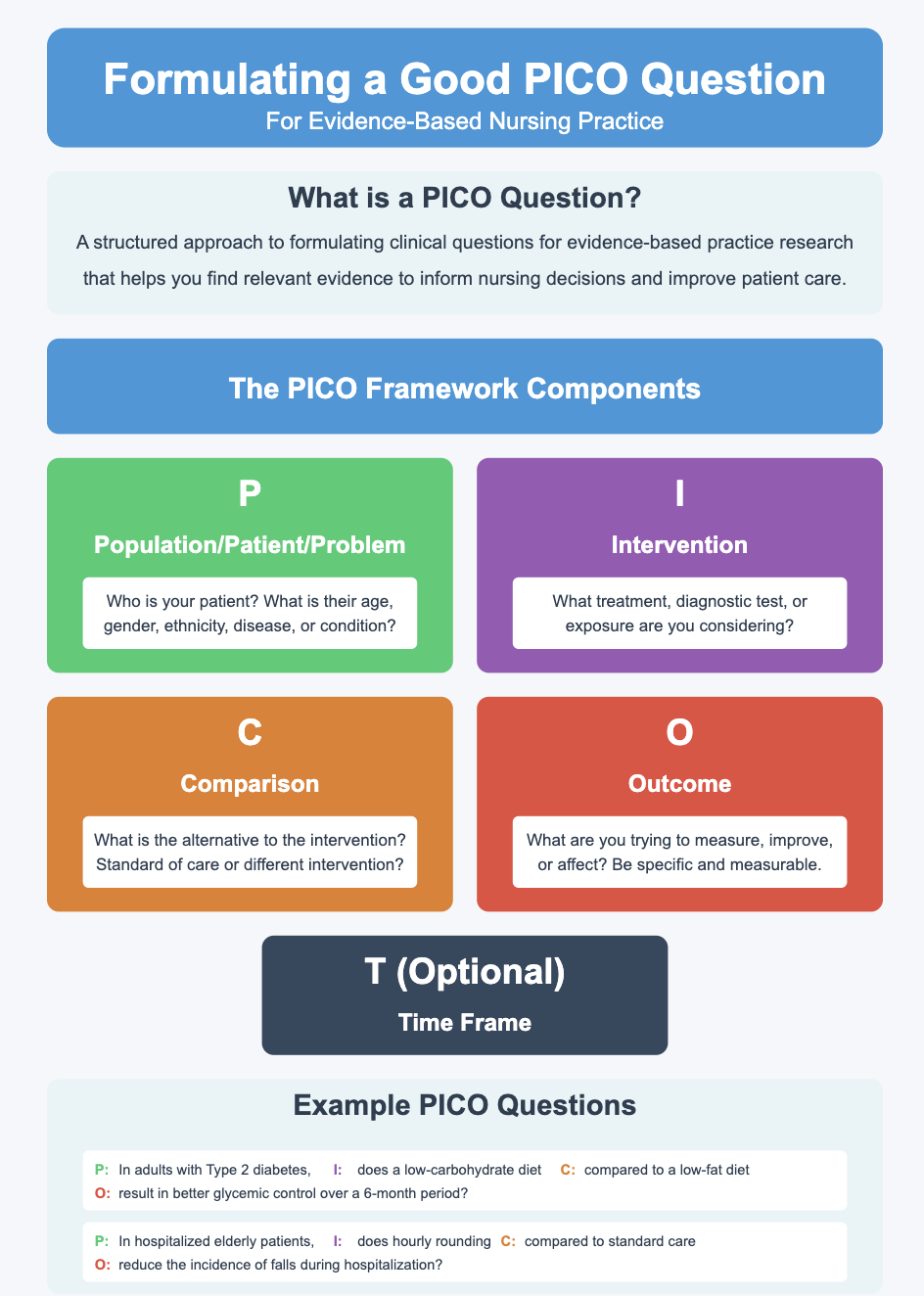
The components are:
- P – Patient, Population, or Problem: Who is your question about? Describe the patient or group as precisely as possible (e.g., by age, gender, diagnosis, prakriti, or specific complaint).
- I – Intervention: What is the main treatment, therapy, or practice you are considering? This could be a specific Dincharya practice (Abhyanga, Nasya), a particular herb, or a dietary change.
- C – Comparison or Control: What are you comparing the intervention to? This could be a different treatment, a placebo, or no intervention at all (i.e., standard care).
- O – Outcome: What are you trying to achieve, measure, or improve? The outcome should be specific and patient-important (e.g., reduction in pain, improved sleep quality, lower blood pressure, reduction in ama lakshanas).
Let's watch the next segment of the same video to see these components explained with examples.
PICO Question tutorial: Understanding and framing clinical research questions made easy!
Continuing with the 'PICO Question tutorial,' this section breaks down each element of the PICO framework.
Please watch from 05:18 to 08:57. Pay close attention to the definition and examples provided for each P-I-C-O component.
3. Applying PICO in an Ayurvedic Context
While the examples in the video are from modern medicine, the PICO framework is perfectly suited for Ayurveda. In fact, it's already being used in high-quality Ayurvedic research.
Let's look at a published clinical trial on Udvartana for Sthoulya (obesity) to see how its research question was built using PICO.
Comparison of Gomaya Mashi and Rodhradi Gana ...
This research paper, 'Comparison of Gomaya Mashi and Rodhradi Gana Udvartana...' provides an excellent, real-world example of PICO applied to an Ayurvedic therapy.
First, briefly read the 'Aims and Objectives' to understand the study's goal. Then, look at the 'Inclusion criteria' to see how the 'Population' (P) was defined. Finally, find the small table at the bottom left of page 474 (it's numbered 1-4). This table explicitly lays out the P, I, C, and O for the entire study.
As you saw in the paper, the researchers framed their study as:
- P: Persons with Obesity (BMI > 25-40 kg/m²).
- I: Udvartana with Gomaya Mashi (cow dung ash).
- C: Udvartana with Rodhradi Gana powder.
- O: Reduction in Body Weight, BMI, anthropometric measurements, and serum lipid profile.
This demonstrates how a complex Ayurvedic study can be distilled into a clear, answerable PICO question. The key is to effectively translate Ayurvedic concepts into the PICO structure. A research paper on literature search strategies in Ayurveda offers profound insights into this translation process.
Literature searches on Ayurveda: An update - PMC
The paper 'Literature searches on Ayurveda: An update' details how to build a PICO question by integrating Ayurvedic terminology. This is a crucial skill for bridging classical knowledge and modern evidence-based practice.
First, read the section 'Search question' and look closely at 'Table 1'. Note how it populates the PICO table with both Ayurvedic terms (like Kusta) and biomedical terms (like psoriasis). Then, read the 'Search strategy' subsection within the 'Discussion' (it starts with 'Well-structured research question...'). This section provides a detailed guide on selecting keywords for each PICO element in an Ayurvedic context.
From this paper, we can extract some key principles for crafting Ayurvedic PICO questions:
- Population (P): Define your patient using both Ayurvedic and modern terms. Include the Sanskrit name of the disease (e.g., Amavata), its biomedical correlate (Rheumatoid Arthritis), the patient's prakriti, age, and other relevant characteristics.
- Intervention (I): Be specific. Instead of "herbal medicine," state the specific herb (e.g., Ashwagandha), formulation (e.g., Triphala Churna), or procedure (e.g., Pratimarsha Nasya with Anu Taila).
- Outcome (O): Define success using both classical and modern parameters. This can include classical Phalashruti (the expected benefits described in texts), reduction of specific lakshanas, as well as modern measures like validated scoring systems (e.g., Psoriasis Area and Severity Index - PASI) or biochemical markers.
4. Crafting Your First Ayurvedic PICO Question
Let's practice building a question together.
Clinical Scenario: A 40-year-old male software engineer with a Vata-Pitta prakriti presents with chronic dry eyes, occasional headaches, and neck stiffness, which he attributes to long hours of screen time. You are considering advising him to start a daily Dincharya practice to alleviate these symptoms.
Let's formulate a PICO question to guide your recommendation for Pratimarsha Nasya.
- P (Patient): In middle-aged adults with a Vata-Pitta constitution experiencing computer-related eye strain and headaches (Urdhvajatrugata Vata vikara)...
- I (Intervention): ...does daily Pratimarsha Nasya with 2 drops of Anu Taila in each nostril...
- C (Comparison): ...compared to no nasal application...
- O (Outcome): ...reduce the self-reported frequency and severity of headaches and eye dryness over a period of one month?
This is a Therapy Question, one of the main types of clinical questions. Other types include questions about Harm, which are equally important for fulfilling your goal of understanding contraindications.
Example of a "Harm" Question:
- P: In individuals diagnosed with Grahani and presenting with active Atisara (diarrhea)...
- I: ...does performing Abhyanga...
- C: ...compared to avoiding Abhyanga...
- O: ...lead to an aggravation of symptoms, such as increased frequency of bowel movements or ama lakshanas?
Test your understanding!
Scenario: A 52-year-old female patient with a Kapha prakriti is in her early post-menopausal stage. She has no major health issues but is concerned about gradual weight gain and wants to establish a healthy routine. You are considering recommending daily Udvartana before her bath.
Formulate a PICO question to investigate the effectiveness of this Dincharya practice for her specific profile and goals.
Show answer
Here is one possible PICO question based on the scenario:
- P (Patient): In healthy, post-menopausal women with a Kapha prakriti experiencing gradual weight gain...
- I (Intervention): ...does daily pre-bath Ruksha Udvartana (dry powder massage) with Kolakulathadi Churnam...
- C (Comparison): ...compared to no Udvartana...
- O (Outcome): ...result in a reduction in body weight and waist circumference over three months?
This question is specific, measurable, and directly addresses the patient's profile and primary concern, making it an excellent starting point for seeking evidence.
Conclusion
In this lesson, you have learned the crucial first step of evidence-informed practice: how to formulate a precise and answerable clinical question. This skill transforms general curiosity into a focused inquiry that can be systematically answered.
Key Takeaways:
- Evidence-informed practice relies on asking specific foreground questions rather than general background questions.
- The PICO framework (Patient, Intervention, Comparison, Outcome) is a powerful tool for structuring clear and focused clinical questions.
- PICO is highly applicable to Ayurveda by thoughtfully integrating Sanskrit terminology, classical concepts (prakriti, lakshana, phalashruti), and relevant biomedical correlates.
- Formulating a clear PICO question is the foundational step that guides your search for evidence and, ultimately, your clinical decision-making.
Preview of the Next Lesson:
Now that you know how to formulate a focused question, the next logical step is to find the answers. In our next lesson, you will locate and summarize evidence from classical texts (Brihattrayi, Laghutrayi) relevant to the clinical question. We will explore methods for efficiently searching these foundational texts to build a strong, classically-supported rationale for your Dincharya recommendations.