Welcome to your next lesson in the Evidence-Informed Dincharya Practice module.
In our previous session, we mastered the art of formulating a precise and answerable clinical question using the PICO framework. This skill provides the focus for our inquiry. Now, we will take the next logical step: learning how to answer that question using Ayurveda's most foundational sources.
Today's lesson is dedicated to the learning outcome: Locate and summarize evidence from classical texts (Brihattrayi, Laghutrayi) relevant to the clinical question. We will develop a systematic approach to navigate these rich, complex texts to find direct support for your clinical recommendations, focusing on the indications, benefits, and contraindications that are central to your learning goals.
1. The Ayurvedic Canon: Your Primary Evidence Sources
When seeking evidence in Ayurveda, our search begins with the foundational classical texts. These are traditionally categorized into two main groups, which you will be familiar with from your BAMS studies.
The Brihattrayi (The Great Trio)
These three texts are the pillars of classical Ayurvedic knowledge, offering comprehensive details on theory, practice, and philosophy.
- Charaka Samhita: The foremost text on Kayachikitsa (Internal Medicine).
- Sushruta Samhita: The definitive text on Shalya Tantra (Surgery).
- Ashtanga Hridaya & Ashtanga Sangraha: Vagbhata's masterful compilations that synthesize the knowledge of the previous two Samhitas.

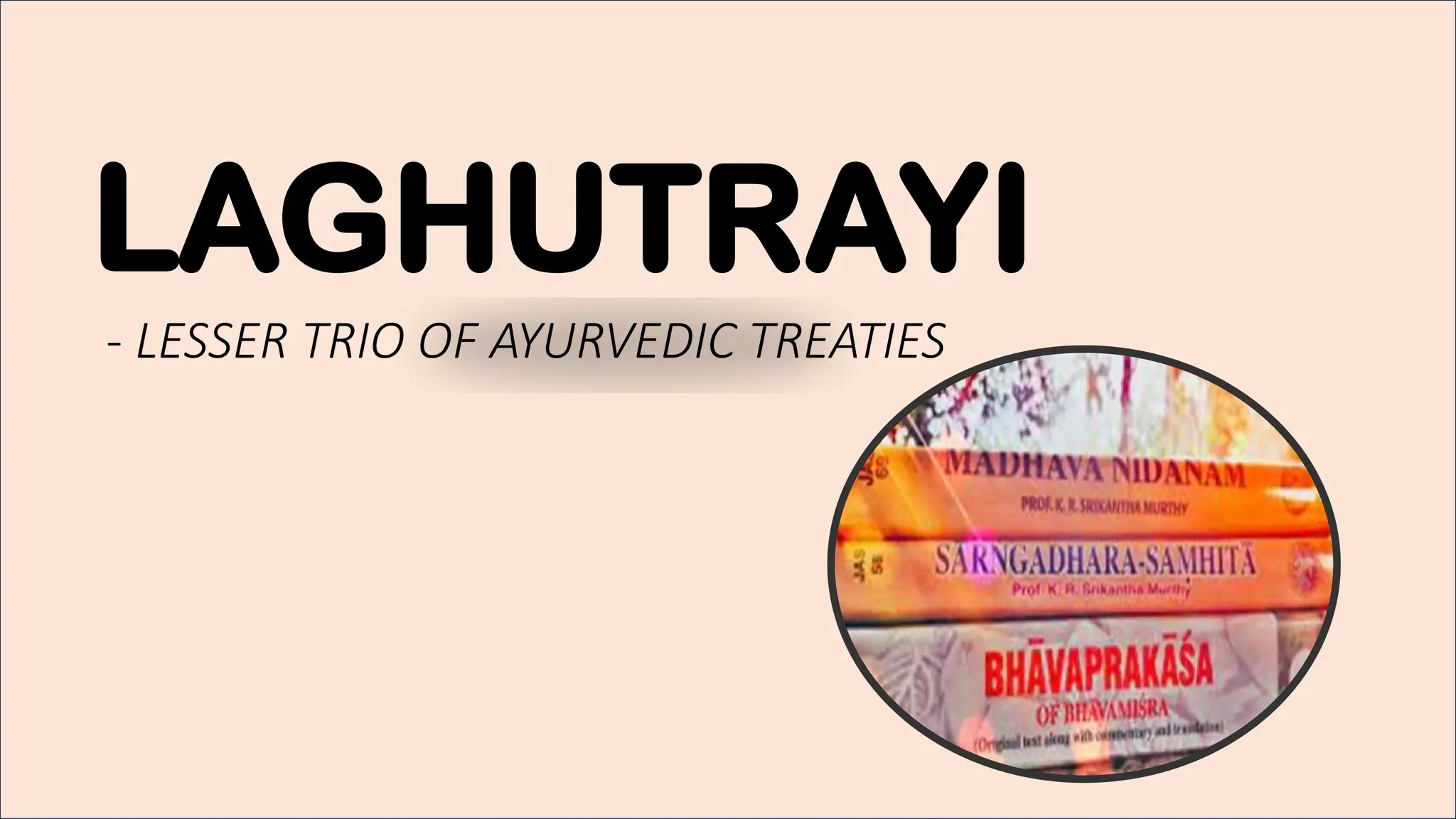
The Laghutrayi (The Lesser Trio)
These texts, composed later, are more concise and practical, often focusing on diagnostics, formulations, and materia medica.
- Madhava Nidanam: Specializes in Nidana (diagnostics and pathology).
- Sharngadhara Samhita: A key text for pharmaceutics and formulations (Bhaishajya Kalpana).
- Bhavaprakasha Samhita: Contains detailed descriptions of drugs (Dravya Guna) and is considered a bridge to modern Ayurvedic practice.
For any clinical question regarding Dincharya, our search will primarily focus on the Sutra Sthana of the Brihattrayi, especially the chapters titled Dinacharya Adhyaya.
2. A Systematic Approach to Textual Search
Having formulated a PICO question, we can now use it to guide our search. This involves a three-step process.
- Deconstruct the PICO question into Ayurvedic keywords.
- Identify the most relevant chapters (adhyayas) and sections within the Samhitas.
- Scan the text for the keywords to locate relevant shlokas and summarize the findings.
Let's walk through this process using the PICO question we developed in the previous lesson's exercise.
Scenario: A 52-year-old female patient with a Kapha prakriti is post-menopausal and concerned about gradual weight gain.
PICO Question: In healthy, post-menopausal women with a Kapha prakriti experiencing gradual weight gain... does daily pre-bath Ruksha Udvartana... compared to no Udvartana... result in a reduction in body weight over three months?
Step 1: Deconstruct into Keywords
- P (Patient): Kapha prakriti, weight gain (Sthoulya, Medo Roga), post-menopausal.
- I (Intervention): Udvartana (specifically Ruksha Udvartana).
- C (Comparison): No Udvartana.
- O (Outcome): Reduction in body weight (Meda Kshaya).
Our primary search terms are Udvartana, Kapha, and Medas/Sthoulya.
Step 2: Identify Relevant Chapters
The most logical place to start is the Dinacharya Adhyaya (Chapter on Daily Routine), as Udvartana is a recommended daily practice. Ashtanga Hridaya, Sutrasthana, Chapter 2 is a perfect example.
Step 3: Locate and Summarize the Evidence
Now, let's search for our keywords within the relevant chapter.
Ashtanga Hrudaya Sutra Sthana Chapter 2: Dinacharya ...
We will use the 'Ashtanga Hrudaya Sutra Sthana Chapter 2: Dinacharya' from EasyAyurveda.com to find the classical reference for Udvartana. This resource is excellent as it provides the original Sanskrit shloka, transliteration, and translation.
Please read the section titled 'Udvartana – Dry powder Massage'. Pay close attention to the Sanskrit shloka and its translation, which lists the primary benefits of this practice.
The text provides the following key shloka from Ashtanga Hridaya (Su. 2:15):
Udvartanaṃ kaphaharaṃ medasaḥ pravilāyanam |
sthirīkaraṇamaṅgānāṃ tvakprasādakaraṃ param ||
Summary of Findings:
The shloka clearly states that Udvartana:
- Is Kaphahara: It pacifies aggravated Kapha dosha.
- Is Medasah pravilayanam: It helps in the liquefaction/dissolution of fat.
- Provides Sthirikaranam Anganam: It brings stability and firmness to the body parts.
- Is Tvak prasadakaram: It improves skin health and complexion.
Connecting Evidence to the PICO Question:
This single shloka directly addresses multiple components of our PICO question.
- It validates the intervention for the Patient profile (Kapha prakriti) by stating it is Kaphahara.
- It supports the desired Outcome (weight reduction) by describing its action as Medasah pravilayanam.
Therefore, based on this primary evidence from Ashtanga Hridaya, we can confidently conclude that Udvartana is a classically indicated practice for this patient.
3. Finding Evidence on Contraindications and Harm
Your goal is not just to know when to recommend a practice, but also when not to. The same search process applies to questions of harm. Let's use the "Harm" PICO question from our last lesson.
PICO Question: In individuals diagnosed with Grahani and presenting with active Atisara (diarrhea)... does performing Abhyanga... compared to avoiding Abhyanga... lead to an aggravation of symptoms?
Step 1: Deconstruct into Keywords
- P (Patient): Grahani, Atisara (diarrhea), Ajirna (indigestion), Ama.
- I (Intervention): Abhyanga (oil massage).
- O (Outcome): Aggravation of symptoms (a negative outcome or harm).
Our primary search terms are Abhyanga and its contraindications (varjya).
Step 2 & 3: Locate Contraindications
We will again look in the Dinacharya Adhyaya of Ashtanga Hridaya, where contraindications are typically listed immediately after the benefits.
Ashtanga Hrudaya Sutra Sthana Chapter 2: Dinacharya ...
Let's return to the same resource on 'Ashtanga Hrudaya Sutra Sthana Chapter 2' to find the contraindications for Abhyanga.
Please read the section 'Abhyanga – Oil Massage' and focus specifically on the subsection 'Abhyanga Contra-indications'.
The text provides the crucial shloka from Ashtanga Hridaya (Su. 2:9):
Varjyo'bhyaṅgaḥ kaphagrastakṛtasaṃśuddhyajīrṇibhiḥ ||
Summary of Findings:
This verse clearly states that Abhyanga should be avoided (varjya) by individuals with:
- Kaphagrasta: Aggravated Kapha conditions (e.g., severe congestion).
- Kritasamshuddhi: Immediately after undergoing Panchakarma purification.
- Ajirnibhih: Those suffering from indigestion (Ajirna).
Connecting Evidence to the PICO Question:
The key term here is Ajirna. From your clinical knowledge, you know that active Atisara (diarrhea) is a cardinal sign of severely impaired agni (digestive fire) and the presence of ama, which is the functional state of Ajirna. Therefore, the contraindication applies directly to our patient.
To further strengthen this, we can look at contraindications for other practices. For instance, the same chapter (A.H. Su. 2:18) explicitly lists Atisara as a contraindication for Snana (bathing), reinforcing the principle that procedures which can disturb doshic balance should be avoided during acute digestive ailments.
Based on this evidence, you can conclude that performing Abhyanga during active diarrhea is classically contraindicated and poses a risk of harm.
Test your understanding!
Scenario: A 35-year-old patient with a Pitta prakriti complains of frequent and painful mouth ulcers (Mukha paka). You want to determine if daily Dantadhavana (tooth brushing with an herbal twig) is appropriate for them.
- What Ayurvedic keywords would you use to search the texts?
- Based on the structure of the Samhitas, which chapter(s) would be the most likely places to find an answer?
Show answer
-
Keywords: Dantadhavana (tooth brushing), Mukha paka or Asya paka (mouth ulcer/stomatitis), varjya (contraindication), aruchi (loss of taste), jwara (fever).
-
Relevant Chapters:
- The primary place would be the Dinacharya Adhyaya (e.g., Ashtanga Hridaya, Sutrasthana Ch. 2), as it details the rules for daily practices.
- You would also consult the Mukharoga Chikitsa Adhyaya (chapter on treating oral diseases) in the Chikitsa Sthana of texts like Sushruta Samhita for more specific therapeutic guidance.
- In fact, Ashtanga Hridaya (Su. 2:4) explicitly lists Asyapaka (ulceration of the mouth) as a contraindication for brushing teeth.
Conclusion
You now have a powerful and systematic method for grounding your clinical decisions in classical Ayurvedic evidence. This process elevates your practice from simply following protocols to deeply understanding the "why" behind each recommendation.
Key Takeaways:
- A well-formed PICO question is your map for navigating the classical texts.
- The search process involves deconstructing the question into keywords and targeting relevant chapters, primarily the Dinacharya Adhyaya in the Sutra Sthana of the Brihattrayi.
- Classical evidence is found not just in descriptions of benefits (phalaśruti) but also in the explicit listing of contraindications (varjya).
- Summarizing the evidence involves synthesizing information from shlokas to build a coherent, logical argument that directly answers your clinical question.
Preview of the Next Lesson:
Classical wisdom provides our foundation, but a truly evidence-informed practice also engages with modern science. In our next lesson, we will move from the library to the laboratory. You will learn how to find and critically appraise a relevant modern clinical study on a Dincharya practice like Abhyanga or Gandoosha. This will equip you to integrate both streams of knowledge for the best possible patient care.