Introduction
Hello! In our last lesson, we established the importance of using Data Transfer Objects (DTOs) to create a clean, secure, and flexible boundary between your application's internal data model (JPA entities) and its public API contract. We practiced implementing this pattern by writing manual mapper classes to convert between entities and DTOs.
While manual mapping is a valid approach, you probably noticed that it involves writing a lot of repetitive, boilerplate code. For every new field, you have to add another setter and getter call. This is not only tedious but also a potential source of bugs. As your application grows, maintaining these manual mappers becomes a significant chore.
This brings us to today's lesson, where we will address this challenge head-on. Our learning outcome is to map between DTOs and JPA entities within the service layer, but this time, we will use an automated, production-grade tool to do the heavy lifting. We will explore MapStruct, a powerful library that generates mapper implementations for you at compile time, eliminating boilerplate while maintaining type safety and high performance.
The Problem with Manual Mapping
Let's quickly revisit the manual mapping process. Imagine you have a User entity and a UserDto.
Entity:
public class User {
    private Long id;
    private String username;
    private String email;
    private LocalDate dateOfBirth;
    // getters/setters...
}
DTO:
public record UserDto(
    Long id,
    String name, // Different field name
    String email,
    String dob // Different field name and type
) {}
A manual mapper would look something like this:
public UserDto toDto(User user) {
    // Manual mapping for each field
    return new UserDto(
        user.getId(),
        user.getUsername(), // Mapping username -> name
        user.getEmail(),
        user.getDateOfBirth().toString() // Mapping LocalDate -> String
    );
}
For every object and every field, you write this conversion logic by hand. Given your background in system design, you can see how this manual process doesn't scale well and violates the DRY (Don't Repeat Yourself) principle.
Introducing MapStruct: Automated, Type-Safe Mapping
MapStruct is a code generator that automates the process of writing mappers. You simply define a Java interface with mapping method signatures, and MapStruct generates the full implementation during the compilation phase. This approach has two key benefits over other methods like reflection:
- High Performance: The generated code is plain Java, just as if you had written it yourself. There is no runtime overhead from reflection.
- Type Safety: The mapping is checked at compile time. If you make a mistake, like trying to map incompatible types without a defined conversion, your code won't compile.
Let's see how to set up and use MapStruct to solve our mapping problem.
MapStruct Explained | Java DTO Conversion & Mapping in Spring Boot
The video 'MapStruct Explained' by The Curious Coder provides an excellent, step-by-step guide to replacing manual boilerplate code with a clean MapStruct mapper.
Please watch from the beginning to 13:38. The video covers: The Boilerplate Problem (00:00 - 05:06): The presenter first demonstrates the manual mapping process, which serves as a great recap and motivation for what follows. MapStruct Setup (05:06 - 06:55): Pay close attention to the pom.xml configuration. Adding the mapstruct dependency and the maven-compiler-plugin with the annotation processor is a critical one-time setup step. Basic Mapper and Field Mapping (06:55 - 13:38): The core of the demonstration. You'll see how to create a mapper interface with @Mapper and use the @Mapping annotation to handle different field names (username to name) and automatic type conversions (LocalDate to String).
After watching that segment, you can see the power of this approach. Instead of a verbose implementation, you have a declarative interface:
@Mapper(componentModel = "spring")
public interface UserMapper {
    @Mapping(source = "username", target = "name")
    @Mapping(source = "dateOfBirth", target = "dob")
    UserDto toDto(User user);
}
MapStruct handles the rest. The componentModel = "spring" attribute tells MapStruct to generate a Spring bean, which we can then inject into our services.
Advanced MapStruct Features
MapStruct is capable of much more than basic field mapping. The library provides a rich set of features for handling complex, real-world scenarios.
MapStruct Explained | Java DTO Conversion & Mapping in Spring Boot
Let's continue with the same video to explore some of these advanced capabilities. These features are what make MapStruct a truly robust solution.
Watch from 13:38 to 30:59. This part of the video covers several useful techniques: Ignoring Fields (ignore = true): How to prevent sensitive data like passwords from being mapped. Default Values (defaultValue): How to handle null values from the source object. Mapping from Multiple Sources: A very powerful feature for creating a DTO from more than one entity (e.g., combining User and Contact info into a single response). Custom Mapping Logic (@Named): How to provide your own implementation for a specific field mapping, such as masking a phone number.
These features give you fine-grained control over the mapping process while still benefiting from automation for the straightforward parts.
Integrating Mappers into the Service Layer
Now, let's address the central part of our learning outcome: using these mappers within the service layer. The service layer acts as the boundary where the raw, internal data model (entities) is transformed into the clean, public data contract (DTOs).
The Art of the DTO: Mastering Data Transfer in Modern Spring Boot
The article 'The Art of the DTO' makes a strong case for why this mapping must happen in the service layer. It's a quick read that reinforces the architectural principles at play.
Please read 'Part 2: The Architecture — Where Does the DTO Belong?'. Focus on the three pitfalls of returning entities from the service layer and the best practice of having the service layer return DTOs.
The article clearly establishes the service layer as the correct boundary. Let's look at the overall architecture.
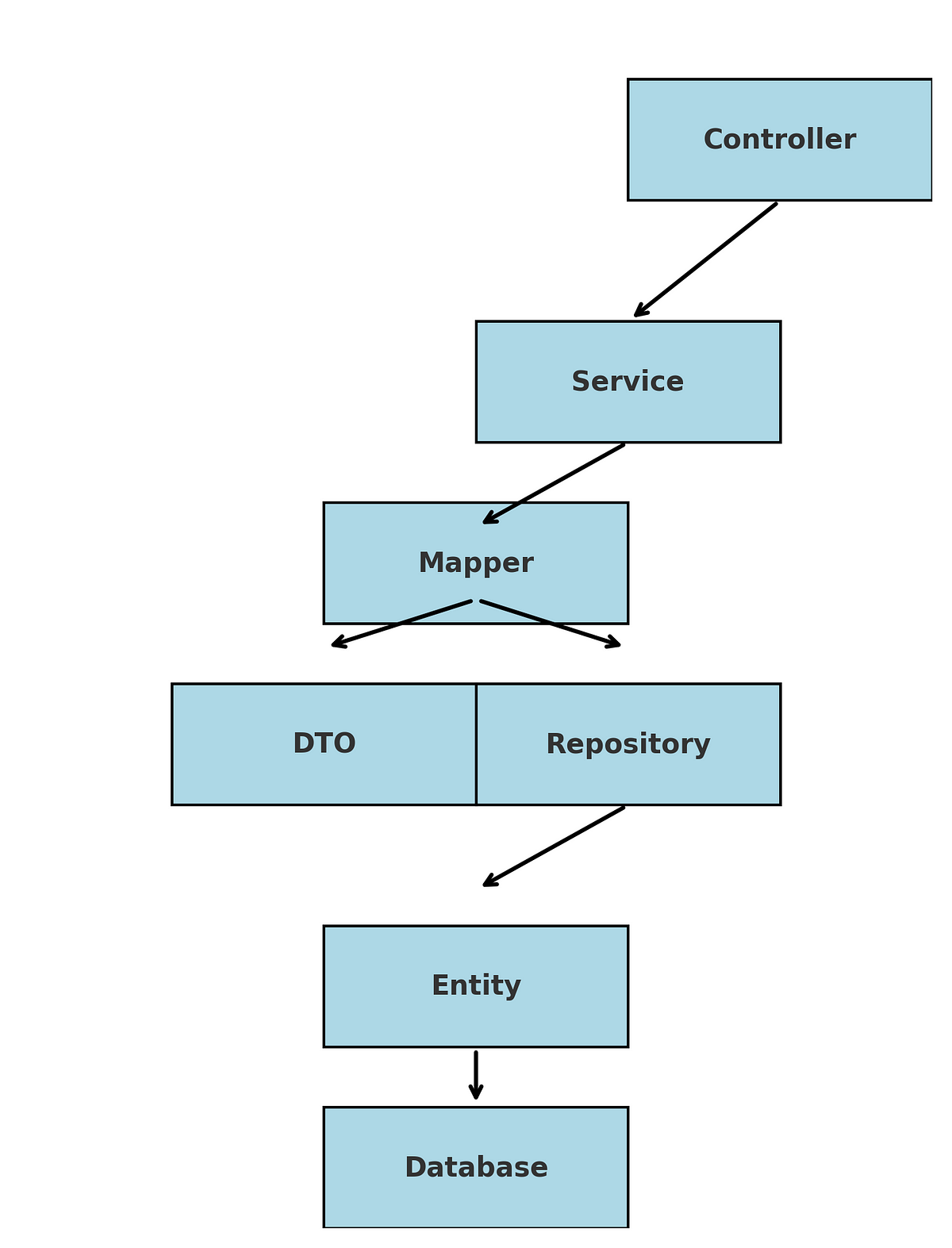
Now for the implementation. Because we specified componentModel = "spring" in our @Mapper annotation, Spring will manage the lifecycle of our mapper implementation. We can simply inject it into our service using standard dependency injection.
How to Use MapStruct for Object Mapping
The OneUptime article 'How to Use MapStruct for Object Mapping' provides a complete code example of a UserService that uses an injected UserMapper.
Please find the section 'Using Mappers in Services' and carefully study the UserService.java code block. Notice how the UserMapper is injected via the constructor (@RequiredArgsConstructor) and then used in the getUserById, createUser, and updateUser methods to seamlessly convert between entities and DTOs.
Here's a condensed example of what that UserService looks like, tying all the concepts together:
// UserService.java
@Service
@RequiredArgsConstructor // Lombok annotation for constructor injection
public class UserService {

    private final UserRepository userRepository;
    private final UserMapper userMapper; // Inject the mapper

    @Transactional(readOnly = true)
    public UserDto getUserById(Long id) {
        // 1. Fetch the entity from the repository
        User user = userRepository.findById(id)
                .orElseThrow(() -> new RuntimeException("User not found"));

        // 2. Use the mapper to convert the entity to a DTO
        return userMapper.toDto(user);
    }

    @Transactional
    public UserDto createUser(UserCreateRequest dto) {
        // 1. Use the mapper to convert the request DTO to an entity
        User user = userMapper.toEntity(dto);

        // 2. Perform business logic (e.g., hash password, set defaults)
        // ...

        // 3. Save the new entity
        User savedUser = userRepository.save(user);

        // 4. Return the new entity converted to a response DTO
        return userMapper.toDto(savedUser);
    }
}
This code demonstrates the clean separation of concerns:
- The Repository deals only with entities.
- The Controller deals only with DTOs.
- The Service orchestrates the process, using the Mapper to translate between the two worlds.
Conclusion
In this lesson, we elevated our DTO implementation from a manual, boilerplate-heavy process to a clean, automated, and type-safe one using MapStruct. This is the standard practice in modern Spring development for creating robust and maintainable applications.
Key Takeaways:
- Automate, Don't Replicate: Manual mapping is tedious and error-prone. Tools like MapStruct eliminate boilerplate code by generating mapper implementations at compile time.
- Declarative Mapping: With MapStruct, you define mappings declaratively in an interface using annotations like
@Mapperand@Mapping, focusing on the "what" rather than the "how." - Performance and Safety: Because MapStruct is a compile-time tool, it offers high performance with no reflection overhead and provides compile-time feedback if mappings are incorrect.
- Service Layer is the Boundary: The service layer is the designated place to perform the mapping. It fetches entities from the repository and returns DTOs to the controller.
- Integration is Seamless: MapStruct mappers can be managed as Spring beans and injected directly into your services, making them easy to use.
In our next lesson, we will delve deeper into the workings of the service layer by exploring Spring's transaction management abstraction. You'll learn how the @Transactional annotation works and how to use it to ensure data consistency and integrity during database operations like the ones we saw in our UserService example.