Hello. In the previous lesson, you used price indexes to express contributions and retirement payments in one year’s purchasing power. That made dollars from different years comparable in terms of what they could buy, but it did not assign a value to when the money was paid. This lesson adds that timing step. You will use supplied discount factors to value contributions and retirement receipts at one reference date, subtract specified taxes on benefits, and keep discounting distinct from inflation adjustment.
A reference date gives every payment a common time
Suppose one amount is paid now and another is paid three years from now. Even if both are stated in dollars with the same purchasing power, their timing may matter: money available sooner can be used sooner. Discounting expresses a later payment’s value at an earlier reference date under an assumed discount rate.
Watch Khan Academy’s Present Value 2 for the calculation that underlies the lesson. Its example is a choice among cash payments, not a model of how Social Security is financed; focus on the treatment of payment dates.
Present Value 2 | Interest and debt | Finance & Capital Markets | Khan Academy
Khan Academy’s “Present Value 2” shows how a future payment is brought back to a reference date and how present values of separate payments are added.
Start with one payment, where the presenter divides a payment received in two years by the annual growth factor twice. Then watch several payments, focusing on why each payment receives its own factor before the results are summed.
For an amount paid years after the chosen date, a supplied discount factor gives:
If the exercise instead supplies an annual rate , the factor for a payment years later is . Here, the factors are supplied, so the main task is to match each factor to the payment’s year. A payment at the reference date has a factor of . A factor for a future payment is generally below when the assumed rate is positive.
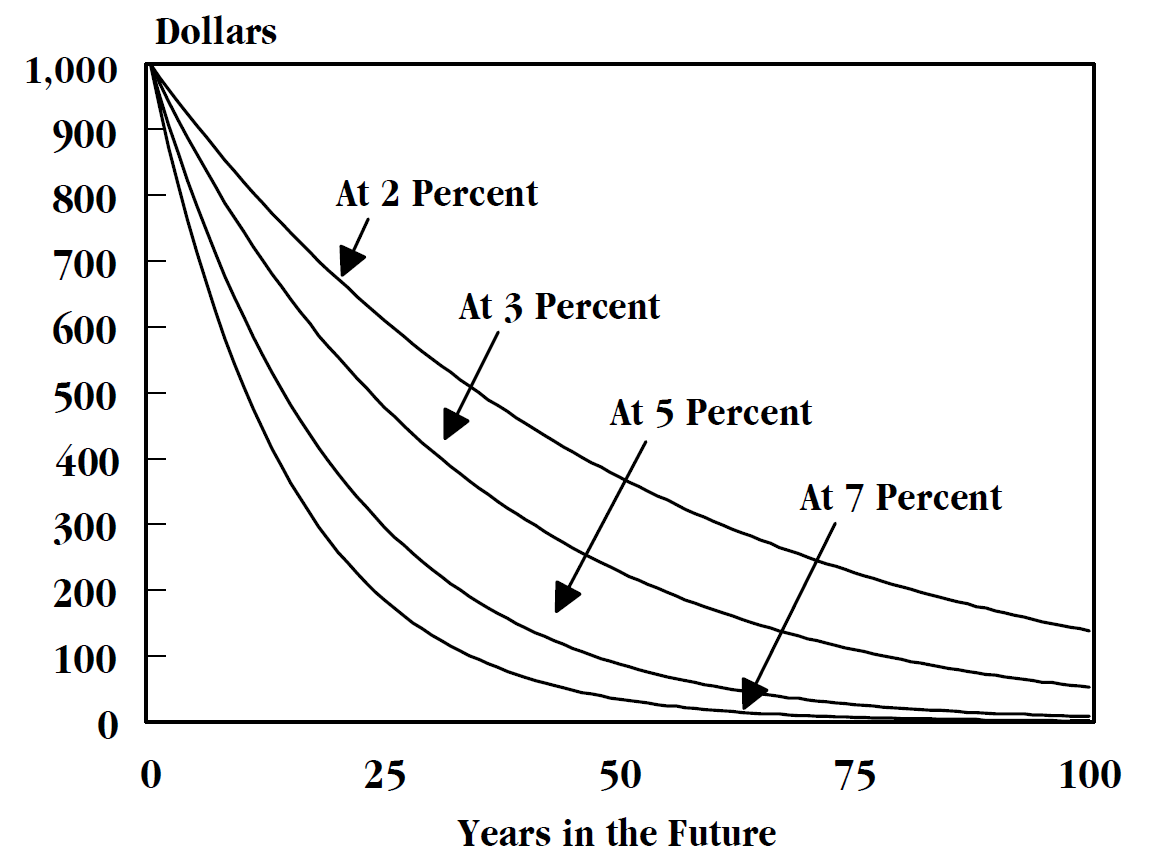
The image makes an important qualification visible: a present value depends on the chosen rate. That rate is an assumption for the comparison, not a return credited to a worker’s Social Security contributions or evidence that the program holds a personal investment account.
Taxes change the receipt before it is valued
For a worker comparing contributions with retirement checks, the relevant receipt may be the amount left after specified income taxes on benefits. First determine the tax attributable to the benefit under the supplied scenario; then value both the receipt and the tax at their payment dates.
The Social Security Administration’s Research: Income Taxes on Social Security Benefits provides context for this step. Read its opening discussion and Table 1 rather than trying to use the table to calculate taxes for the worked example below.
Research: Income Taxes on Social Security Benefits
This Social Security Administration issue paper explains why some benefit income is subject to federal income tax and why the taxable share is not the tax bill itself.
Near the beginning of the paper, read the opening discussion. It begins with the paragraph on the 1983 amendments, includes Table 1 immediately afterward, and ends with the paragraph following the table about thresholds and indexing. Focus on the distinction between a portion of benefits being included in taxable income and the actual tax owed. The paper dates from 2015; use it for that distinction, not as an up-to-date tax calculation for a particular return.
“Up to 85% of benefits are taxable” does not mean an 85% tax on the benefit check. It means that, depending on the applicable income calculation, as much as 85% of benefits may be included in taxable income. The resulting tax depends on other tax rules and income. When a comparison supplies benefit-tax amounts—as ours will—use those amounts rather than treating a taxable percentage as a tax rate.
If a gross benefit and tax attributable to it are both paid in year , the after-tax receipt is . Its value at the reference date is:
Equivalently, you can value the gross benefits and taxes separately and subtract their present-value totals. That equality assumes the benefit and its associated tax are assigned the same payment date. If a scenario specifies that tax is paid in a different year, use the factor for the tax-payment year instead.
A contributions-and-receipts calculation
Consider this short, hypothetical record. It contains selected years, not an entire working life or retirement. We value every amount as of 2020, using the supplied nominal discount factors. For simplicity, all listed cash flows occur at the end of their stated year, and each benefit’s specified tax is paid in that same year. The contribution figures are Social Security payroll taxes only; they exclude Medicare taxes.
| Year | Cash flow | Recorded amount | Supplied factor | Value as of 2020 |
|---|---|---|---|---|
| 2020 | Employee contribution | $1,000 | 1.0000 | $1,000.00 |
| 2020 | Employer contribution | $1,000 | 1.0000 | $1,000.00 |
| 2021 | Employee contribution | $1,100 | 0.9524 | $1,047.64 |
| 2021 | Employer contribution | $1,100 | 0.9524 | $1,047.64 |
| 2022 | Gross retirement payment | $12,000 | 0.9070 | $10,884.00 |
| 2022 | Specified tax on benefit | $600 | 0.9070 | $544.20 |
| 2023 | Gross retirement payment | $13,000 | 0.8638 | $11,229.40 |
| 2023 | Specified tax on benefit | $1,200 | 0.8638 | $1,036.56 |
Work by year, then add. The employee-share contributions have a value of $2,047.64 as of 2020; the employer-share contributions have the same value. Counting both shares gives $4,095.28. Keeping them separate makes it clear which definition of “contributions” a comparison uses.
For retirement receipts, the specified taxes leave $11,400 in 2022 and $11,800 in 2023. Applying each year’s factor gives:
There is a useful check. The gross retirement payments have a value of $22,113.40; the specified benefit taxes have a value of $1,580.76. The difference is again $20,532.64.
Do not compare that receipts total with the contributions total as though the four years constituted a lifetime record. The arithmetic shows how to value cash flows with supplied factors. A lifetime comparison would need the full series of contributions, benefit payments, and applicable taxes, together with factors referenced to the same date. It would also need to state whether the employer share is counted.
Why an inflation adjustment is not an extra discount factor
The previous lesson used a price-index ratio to answer a purchasing-power question. Suppose, solely to illustrate the difference, that the price index is 100 in 2020 and 105 in 2022. The 2022 after-tax receipt of $11,400 expressed in 2020 purchasing power is:
That is not the same as its value using the supplied nominal discount factor:
The first calculation adjusts for the change in the price level. The second uses an assumed time-value factor; a nominal factor can reflect both expected price changes and a valuation of timing beyond those price changes.
Do not apply both the price-index ratio and the nominal discount factor to the same payment. That would count the price-related component twice. There are two consistent routes when the necessary inputs are available:
- Apply nominal discount factors to recorded dollar cash flows, as in the worked example.
- First convert cash flows to constant purchasing-power dollars, then apply corresponding real discount factors.
To see why those routes can agree, the factor corresponding to the illustrative 2022 price conversion would be . Applying it to the already converted $10,857.14 gives approximately $10,339.80. The real factor here is derived only to demonstrate consistency; when factors are supplied, follow their stated nominal or real basis.
The reference date matters too. Our example starts with contributions in 2020, so every later flow uses a factor of or less. In a true lifetime record, many contributions may precede the chosen reference date. Moving a past contribution forward to that date requires an accumulation factor greater than , not the future-payment discount factor from the table. State the date and the supplied factors before adding any flows.
Takeaway
To make a present-value comparison, identify one reference date, assign each contribution and retirement payment its year’s factor, subtract specified benefit taxes from receipts, and add the valued amounts—not the unadjusted payments. Keep employee and employer contributions identifiable. Price-index conversion addresses purchasing power; discounting addresses the valuation of timing under a stated assumption, so their nominal and real versions must not be mixed.
The next lesson examines a further limit of a retirement-check comparison: contributions also support disability, survivor, and lifetime-income insurance protections that the retirement receipts column does not capture.