Hello. In the previous lesson, you put contributions and after-tax retirement payments on a common valuation date. That made the arithmetic more defensible, but it left a question about what is being compared. A worker’s retirement checks are only one possible benefit of Social Security coverage.
This lesson examines the disability, survivor, and lifetime-income protections that a retirement-only tally leaves out. The aim is not to assign each protection a dollar value today. It is to identify what a comparison can—and cannot—conclude from the payments it counts.
A retirement-check tally has a narrow boundary
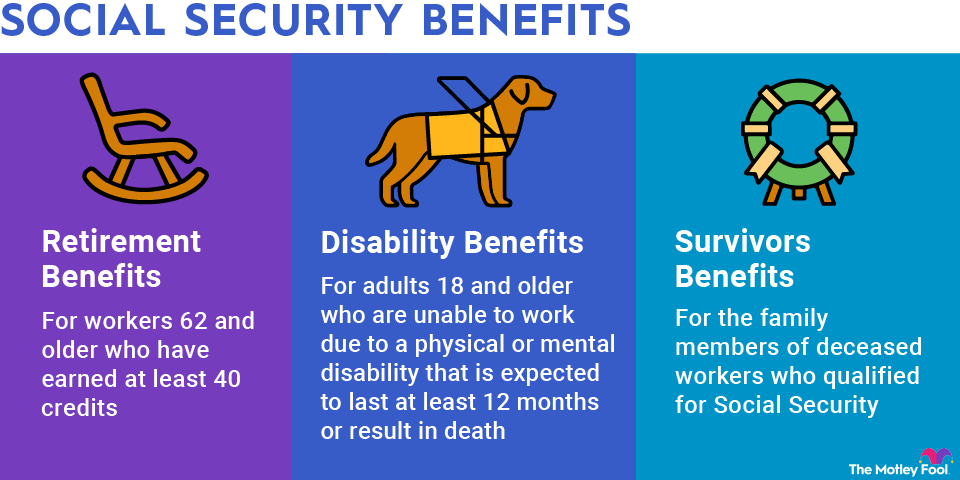
Social Security taxes are not deposits into a personal retirement account. Current tax revenue helps pay current beneficiaries, and a worker’s covered earnings help establish eligibility for benefits under program rules. Those benefits can arise in different circumstances: retirement, a qualifying disability, or a worker’s death leaving eligible survivors.
Read the Social Security Administration’s Understanding the Benefits for the program’s own description of that broader coverage. The two short passages also help distinguish Social Security disability insurance from a different program, Supplemental Security Income (SSI).
Read the Social Security Administration's overview to see who can receive benefits supported by Social Security taxes and what a qualifying disability claim requires.
On p. 2, under "Social Security is more than retirement," read from the paragraph beginning "The current Social Security system works like this" through the overview. Notice that taxes are not held in an account belonging to the worker. Then go to "Disability benefits" on p. 10. Read from the opening description of a physical or mental condition through the disability rules. Finish with the SSI distinction in the final paragraph of that section.
The distinction at the end matters for a contributions-versus-payouts debate. Social Security disability insurance is tied to a worker’s covered work and has medical and work-related eligibility rules. SSI is a separate, needs-based program; it should not be counted as though it were a retirement benefit purchased by Social Security payroll contributions.
Now imagine a comparison that records every year of a worker’s Social Security payroll taxes but records only that worker’s own retirement checks. It may accurately describe those two cash-flow categories. It does not describe the full set of risks the payroll-tax-supported program covers. Much as an insurance policy can provide protection without a claim ever being filed, the absence of a disability payment does not mean disability coverage was absent. Equally, coverage is not a promise that every worker will qualify for or receive every kind of benefit.
Benefits may go to a worker—or to someone else
A qualifying disability can interrupt earnings years before retirement. If a covered worker meets Social Security’s disability requirements, disability benefits may provide income during that period. A spreadsheet containing only retired-worker checks would not show those payments, even though they arose from the worker’s Social Security coverage.
Survivor benefits reveal an even sharper limit. A worker might die before collecting a single retirement check, while an eligible surviving spouse or child receives payments based on that worker’s record. A tally of the deceased worker’s own retirement receipts would show zero; a tally of benefits paid to eligible people on the worker’s record would not.
The same SSA guide describes family benefits while a worker receives retirement or disability benefits, and survivor benefits after a worker’s death.
Continue in the SSA guide to identify whose payments a worker-only comparison misses. Focus on the kinds of eligible recipients, not on memorizing every age rule.
In "Benefits for your family" on pp. 11-12, read from the opening sentence about other family members through the family-benefit discussion. Then, in "Survivors benefits" on pp. 12-13, read from the sentence beginning "When you die" through the survivor examples.
Consider three possible histories for a worker with covered earnings:
| What happens | Why retirement checks alone are incomplete |
|---|---|
| The worker develops a qualifying disability before retirement. | Disability payments may be made during years when the worker receives no retirement checks. |
| The worker dies before claiming retirement, leaving eligible family members. | Survivors may receive payments even though the worker’s own retirement-check total is zero. |
| The worker retires, and an eligible family member also receives a benefit on the worker’s record. | The worker’s own checks omit the family member’s payments. |
These are possible outcomes, not three payments to add to every worker’s record. Eligibility depends on the applicable work, relationship, age, and other rules. Some workers will never receive disability benefits; some will leave no eligible survivors. A careful comparison states whether it follows an individual worker’s receipts or payments to everyone entitled on that worker’s record. It also avoids treating potentially overlapping benefit entitlements as automatically additive.
Retirement benefits also insure against outliving expectations
Even when you count only retirement checks, their value is not fully captured by asking how much a worker has received so far. Social Security retirement benefits, once claimed, are payable monthly for the rest of an eligible worker’s life, with annual cost-of-living adjustments under program rules. The worker does not have to know in advance whether retirement will last ten years or thirty.
The SSA issue paper Social Security Retirement Benefits and Private Annuities: A Comparative Analysis places this lifetime-income feature alongside family benefits. Its private-annuity figures are historical illustrations; for this lesson, focus on which protections a like-for-like comparison must recognize.
Social Security Retirement Benefits and Private Annuities: A Comparative Analysis
Read the SSA issue paper for its explanation of lifetime, inflation-adjusted retirement income and the features a retirement-payment-only comparison can omit.
Under "Benefit Payments," start at the sentence beginning "Once claimed" and read through the benefit scope, stopping before "Benefit Taxation." Later, under "Examples of Private Annuity Premiums to Replicate Social Security Benefits," read the paragraph immediately before Table 1, from its opening sentence through the comparison caveat. You do not need Table 1's historical prices.
A simplified example shows the uncertainty the lifetime promise addresses. Suppose a retirement benefit is $1,800 per month in constant purchasing-power dollars. Ignoring taxes and discounting solely to isolate years of payment, ten years of checks total $216,000; thirty years total $648,000. Both totals could result from the same monthly benefit. The longer-lived retiree receives more because payments continue while that person lives, not because earlier payroll contributions accumulated in a personal account until they were exhausted.
The example does not establish that either retiree received a favorable financial return. A return calculation would need the relevant contributions and receipts on a consistent after-tax, inflation, and present-value basis, as in the preceding lessons. Nor should the $648,000 be treated as a payment every worker is guaranteed to collect. The protection is that income continues if the worker lives longer than expected; the realized total depends on lifespan.
Cost-of-living adjustments are part of that protection, too: they change the nominal benefit over time rather than leaving the original check fixed in dollars. They do not guarantee that every retiree’s personal expenses will rise at exactly the same rate as the adjustment.
How to state a comparison without overstating it
A contributions-versus-payouts claim can be useful if its scope is explicit. For example: “Under these assumptions about earnings, claiming age, lifespan, taxes, and valuation date, this worker’s own retirement checks total a specified amount compared with specified payroll contributions.” That is a narrow cash-flow result.
The stronger claim—“therefore the worker received nothing else for those contributions”—does not follow. It leaves out disability protection while working, possible payments to eligible family members or survivors, and the promise of income for however long retirement lasts. Those protections are not the same as checks already received, so they should not simply be added as invented dollar payments to the cash-flow total. Instead, distinguish:
- Realized receipts: payments actually made, specifying whose payments count.
- Contingent protection: benefits that could be payable if qualifying events occur.
- Lifetime-income protection: continuing retirement payments if the worker lives longer than expected.
That distinction preserves both sides of the analysis. A worker with no eligible survivors should not be assigned hypothetical survivor checks. But a tally restricted to that worker’s retirement checks should not be presented as the complete value or scope of Social Security coverage.
Takeaway
Social Security contributions support more than a worker’s retirement checks. Qualifying disability, eligible family and survivor benefits, and retirement income that continues for life can all matter to the meaning of a contributions-versus-payouts comparison. The defensible approach is to label a retirement-only tally as such, identify protections it excludes, and keep possible insurance benefits distinct from payments actually received.
The next lesson turns to proposed payroll-tax changes. You will compare how a higher tax rate and a higher taxable earnings cap affect workers with different earnings.