Hello! Welcome to the final part of our lesson on security in a Computerized Accounting System (CAS).
In the first part, we established the role of password security as the gatekeeper—it authenticates users and authorizes their access levels, answering the question, "Who are you and what are you allowed to do?". This is crucial because knowing who is performing an action is a prerequisite for the feature we're covering now.
Today, we will address the final learning outcome of our course: to describe the purpose and function of a data audit trail feature in a CAS. We will explore what a data audit trail is, what it does, and why it is a critical feature for ensuring the integrity and accountability of financial records. This topic frequently appears in exam questions about CAS security features.
1. What is a Data Audit Trail?
Imagine a CCTV camera that doesn't record video but instead records every single action performed on your accounting data. That, in essence, is a data audit trail. It's a chronological log that tracks all activities and changes within the accounting software.
For a precise, exam-focused definition, let's consult a past CBSE exam paper.
CBSE Class 12 Accountancy Set 1 Question Paper with Solutions
This PDF contains a solved CBSE question paper. The model answer for a question on security features provides an excellent summary of what a Data Audit is.
Please find question 33(b) in Part B, Option II. Read the second point of the solution, titled 'Data Audit'. This gives a clear and concise explanation.
As the resource explains, a data audit trail:
- Tracks all changes made to financial records.
- Records who made the change, when it was made, and the nature of the change.
- Helps identify errors, fraud, or unauthorized modifications.
Another excellent resource confirms this and explicitly links the term "Data Audit" to "Audit Trail."
Chapter 01 Overview of Computerized Accounting System
This is an online NCERT resource. It reinforces the definition of Data Audit and its role.
Locate the heading 'Security Features of CAS Software' and read the short paragraph under the sub-heading 'Data Audit'. Notice how it emphasizes fixing responsibility.
So, the function of a data audit trail is to create an unchangeable, detailed record of the entire history of a transaction, from its creation to any subsequent modifications or its deletion.
2. The Function: How Does It Work?
A data audit trail works by logging specific pieces of information for every event. Think of it as answering three key questions for every action:
- Who? The specific user who performed the action (e.g., 'RSharma', 'Admin'). This is possible because of the password security we discussed previously.
- What? The nature of the event. Was a new invoice created? Was a payment voucher amount edited? Was a ledger account deleted? It also often records the "before" and "after" values for any modification.
- When? The exact date and timestamp of the action.
This flowchart distinguishes between a general system audit trail (tracking logins, etc.) and a data audit trail, which is our focus. It clearly shows the details captured for data.

To see what this looks like in a real system, let's examine a sample audit trail report.
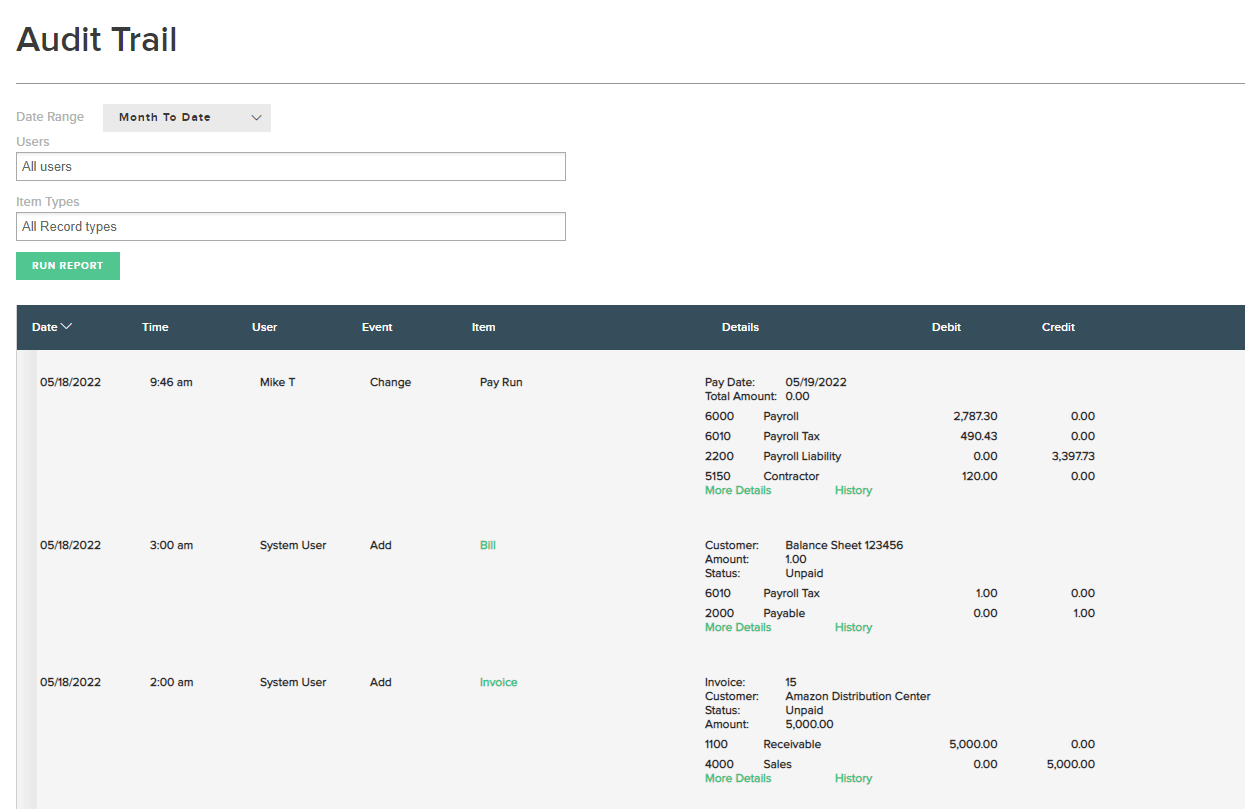
As you can see in the image, the report provides a transparent and detailed history, making it easy to review all activities related to the company's finances.
3. The Purpose: Why is a Data Audit Trail Essential?
Understanding the function of a data audit trail leads directly to its purpose. Why go to the trouble of recording every single action? The reasons are critical for any business and are prime material for exam answers.
The main purposes are:
-
Ensuring Accountability: Because every action is logged against a specific user, it fosters a sense of responsibility. Employees know their actions are being recorded, which makes them more careful and accountable. This directly links back to the concept of fixing responsibility mentioned in the NCERT resource.
-
Detecting Errors and Fraud: The audit trail is the primary tool for investigating discrepancies. If an account balance is incorrect or a transaction seems suspicious, an administrator or auditor can review the trail to pinpoint exactly what happened, who did it, and when. It can reveal unauthorized changes, deletion of records, or attempts to cover up mistakes.
-
Deterring Misconduct: The mere existence of a comprehensive audit trail acts as a powerful deterrent. When employees know that any manipulation of data will be tracked and easily discovered, they are far less likely to attempt fraudulent activities.
-
Supporting Internal and External Audits: For professional auditors, the audit trail is indispensable. It provides objective evidence to verify that the financial statements are accurate and that internal controls are functioning correctly. It allows them to sample transactions and trace them through their entire lifecycle.
-
Regulatory Compliance: Many industries and countries have legal requirements for businesses to maintain secure and complete financial records. A data audit trail helps companies comply with these regulations by providing a verifiable history of their financial data management.
Lesson and Course Conclusion
In this final segment, we have detailed the function and purpose of a data audit trail. You should now be comfortable explaining how it works and why it is a cornerstone of security in any CAS.
Key Takeaways:
- A data audit trail is a chronological log that records all actions (creations, modifications, deletions) performed on accounting data.
- Its function is to capture the "who, what, and when" for every transaction.
- Its primary purposes are to ensure accountability, detect errors and fraud, deter misconduct, and facilitate audits and regulatory compliance.
- Along with password security, the data audit trail forms a robust security framework to protect the integrity and confidentiality of a company's financial information.
This concludes our course on Computerized Accounting for the CBSE Grade 12 exam. We started with the fundamentals of a CAS, moved through the practical application of spreadsheets for accounting tasks, explored data analysis with charts and Pivot Tables, and finished with the critical topics of transaction processing and security.
You have covered all the necessary concepts outlined in the syllabus. Your goal now is to review these lessons and, most importantly, practice with past exam papers. This will help you solidify your understanding and get accustomed to the format and style of the questions.
Thank you for your dedication throughout this course. I wish you the very best of luck on your board examination