Welcome to your first lesson in our Japanese for JLPT N5 course! Your goal is to pass the N5 exam, and our journey begins today with the absolute foundation of the written language. Over the next hour, we will explore the structure of the Japanese writing system.
This lesson will introduce you to the three distinct scripts used in Japanese: Hiragana, Katakana, and Kanji. You will learn what each script looks like, its specific role in a sentence, and why all three are necessary. Understanding this system is the essential first step before we can dive into pronunciation, vocabulary, and grammar.
The Three Scripts of Japanese
Unlike English, which uses a single alphabet, written Japanese is a composite of three different scripts that are often used together within the same sentence.
- Hiragana (ひらがな): A phonetic script for native Japanese words and grammatical elements.
- Katakana (カタカナ): A phonetic script used primarily for foreign words and for emphasis.
- Kanji (漢字): Characters that represent concepts and meanings, adopted from Chinese.
The image below gives a high-level overview of these three systems, their character counts, and their primary functions.
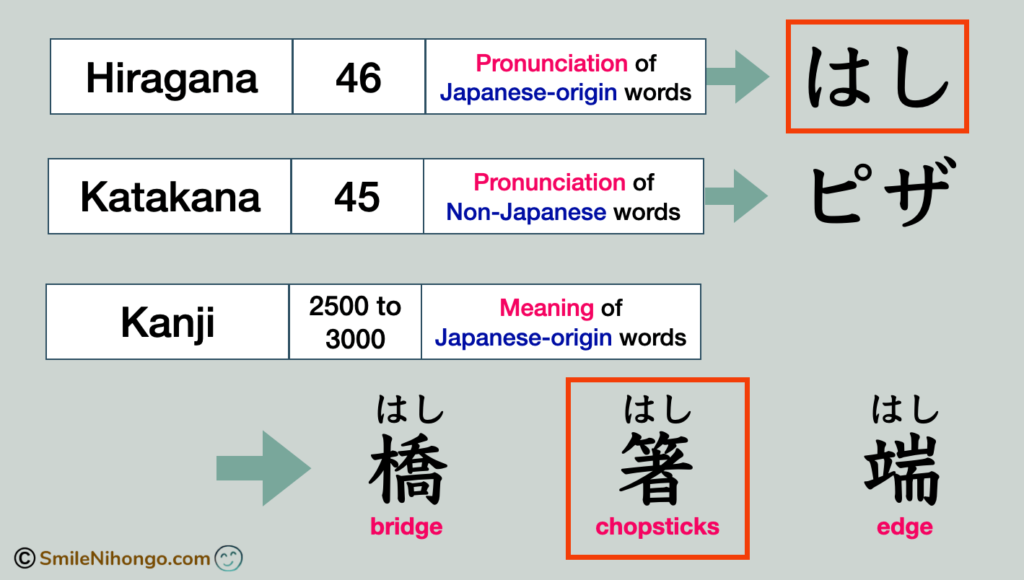
Let's break down each of these scripts one by one.
1. Hiragana (ひらがな): The Foundation
Hiragana is the first script every Japanese child learns, and it will be the first one you master as well. It is a syllabary, which means each character corresponds to a syllable (e.g., ka, ki, ku, ke, ko), not a single consonant or vowel. There are 46 basic hiragana characters. Their defining visual characteristic is their rounded, flowing, and cursive-like strokes.
Hiragana has two main jobs in a sentence:
- Grammatical Functions: It's used for particles (the "glue" that connects words), verb and adjective endings, and other grammatical parts of a sentence.
- Native Words: It's used to write native Japanese words that do not have a kanji, or when the writer chooses not to use the kanji (perhaps because it's rare or for stylistic reasons).
For a more detailed explanation, please read the first section of the following article.
Katakana vs Hiragana vs Kanji: Understanding the Japanese Writing System
This section from a JapanesePod101 blog post provides a clear and comprehensive introduction to Hiragana.
Please read the section titled "1. Hiragana." Focus on understanding its role in handling native words and grammar, and how it functions as okurigana—the endings on verbs and adjectives.
Essentially, Hiragana forms the grammatical backbone of Japanese sentences.
2. Katakana (カタカナ): The Outsider's Script
Like Hiragana, Katakana is also a phonetic syllabary with 46 basic characters that represent the exact same sounds. The difference lies entirely in its appearance and usage. Katakana characters are distinct for their sharp, straight, and angular strokes.
Katakana is used in very specific contexts:
- Foreign Loanwords: This is its most common use. Words borrowed from other languages, like "pizza" or "computer," are written in Katakana.
- Foreign Names: Non-Japanese names are also written using this script.
- Emphasis: It can be used to emphasize a word, similar to how we might use italics or ALL CAPS in English.
- Onomatopoeia: Sound effects, especially common in manga (comics), are often written in Katakana.
To see this in action, watch the following short video from Yuko Sensei. She provides excellent, clear examples that illustrate the different jobs of Hiragana and Katakana.
What is Katakana for? and Kanji? - ひらがな&カタカナ&漢字
This video clearly explains the primary differences between Hiragana and Katakana.
Watch the segment from the beginning until the introduction of Kanji. Pay close attention to her explanation of Hiragana's use for Japanese-origin words, and then how Katakana is used for non-Japanese words like "pizza" and foreign names. She also mentions its use for sounds.
As you saw, if a word like "pizza" (ピザ, piza) were written in Hiragana, it would look incorrect to a native speaker. The choice of script tells the reader about the word's origin.
3. Kanji (漢字): The Script of Meaning
Kanji are fundamentally different from the two kana scripts. They are logographic characters, meaning each symbol represents a concept or an entire word. For example, the single character 木 means "tree," and a single character 食 is the root of the verb "to eat."
Kanji are used for the core content of a sentence: nouns, and the stems of verbs and adjectives. While there are tens of thousands of kanji in existence, literacy in Japanese newspapers requires knowing just over 2,000. For the JLPT N5, you will only need to recognize about 80-100 to start.
So, if Hiragana can spell out any Japanese word phonetically, why bother with the complexity of Kanji? There are two crucial reasons:
- Clarity: Japanese has many homophones—words that are pronounced identically but have different meanings. Kanji eliminate this ambiguity.
- Readability: Japanese text is written without spaces between words. A long stream of Hiragana becomes very difficult to parse. Kanji act as visual anchors, breaking up the sentence and making it much faster to read and comprehend.
The same video from Yuko Sensei explains this perfectly.
What is Katakana for? and Kanji? - ひらがな&カタカナ&漢字
This part of the video explains why Kanji is indispensable in Japanese writing.
Please watch the section explaining Kanji. The video powerfully illustrates the homophone problem with the word hashi (bridge, chopsticks, or edge). Then, watch her demonstrate how a sentence written entirely in Hiragana is confusing, but instantly becomes clear when Kanji is added to provide structure and meaning.
Putting It All Together
A typical Japanese sentence is a seamless blend of all three scripts, each performing its specific job. Let's look at the example from the video:
母は箸で寿司を食べます。
Haha wa hashi de sushi o tabemasu.
(My mother eats sushi with chopsticks.)
Let's break it down:
- Kanji: 母 (mother), 箸 (chopsticks), 寿司 (sushi), 食 (the root of the verb "to eat")
- These characters provide the core meaning of the sentence.
- Hiragana: は (particle), で (particle), を (particle), べます (verb ending)
- These characters provide the grammatical structure.
- Katakana: If we were to say "My mother eats pasta with chopsticks," the sentence would become 母は箸でパスタを食べます, with パスタ (pasuta) written in Katakana because it's a foreign word.

Key Takeaways
This lesson provided the foundational map for your journey into Japanese. Here are the key points to remember:
- Japanese uses three scripts: Hiragana, Katakana, and Kanji.
- Hiragana is a phonetic script with rounded characters, used for native words and grammar. It is the first script you must learn.
- Katakana is a phonetic script with angular characters, used for foreign loanwords, names, and emphasis.
- Kanji are ideographic characters representing meaning. They provide content and clarity, helping distinguish homophones and improve readability.
- All three scripts work together in harmony to create a rich and efficient writing system.
Looking Ahead
Now that you understand the "what" and "why" of the Japanese writing systems, our next lesson will focus on the "how." We will cover the basic sounds of Japanese—the mora—and learn about correct rhythm and pronunciation. This will set the stage for you to begin reading and writing your very first Hiragana characters.