Hello! Welcome back to our study of integrated acid-base homeostasis.
In our last lesson, we focused on the kidney's immense task of conservation: reabsorbing virtually 100% of the ~4320 mmol of bicarbonate filtered each day. We established that this process is vital for preventing the loss of our primary buffer, but it only maintains the status quo. It does not address the ~70 mmol of non-volatile acid (like sulfuric and phosphoric acid) produced daily through metabolism.
Today's lesson tackles the next crucial step. Your learning outcome is to explain the mechanisms of net acid excretion by the kidneys, including the formation of titratable acid and ammonia. We will explore how the kidneys not only dispose of this daily acid load but also generate new bicarbonate in the process, ensuring long-term pH stability.
1. The Challenge: Excreting Protons
You might wonder why the kidney can't just pump free hydrogen ions () directly into the urine. While the distal nephron is capable of creating a significant proton gradient, there's a strict limit. The urine pH can drop no lower than about 4.5.
- Blood pH is ~7.4 ().
- Minimum urine pH is ~4.5 ().
While this represents an almost 1000-fold concentration gradient for , the total amount of free H⁺ even in this highly acidic urine is minuscule. To excrete the entire daily load of 70 mmol of acid as free protons, you would need to produce thousands of liters of urine at this minimum pH. This is clearly not feasible.
The solution is to buffer the secreted protons within the tubular fluid, "packaging" them for excretion. The kidney uses two primary packaging systems: titratable acids and the ammonium/ammonia system.
2. Mechanism 1: Formation of Titratable Acid
The first mechanism involves binding secreted protons to filtered non-bicarbonate buffers. These are collectively known as titratable acids. The name comes from the laboratory method of measuring them: the amount of sodium hydroxide (NaOH) required to titrate the urine pH back to the pH of plasma (7.4) represents the amount of H⁺ buffered by these substances.
The Phosphate Buffer System
The most important urinary buffer is phosphate.
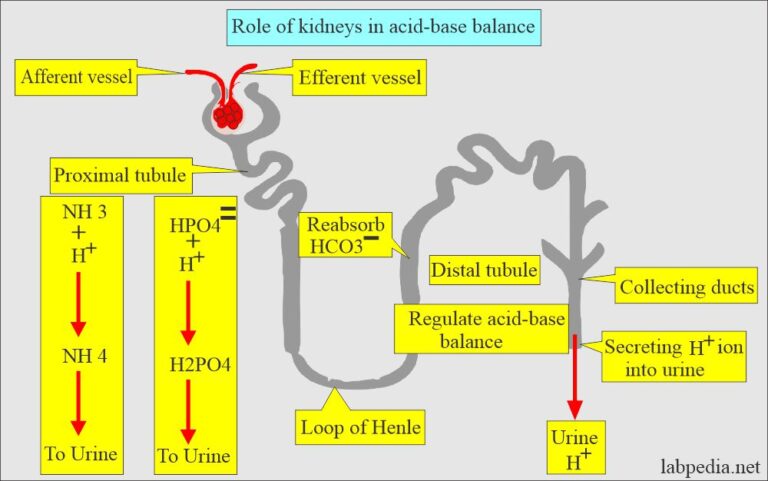
- Phosphate is filtered at the glomerulus and enters the tubular fluid primarily as monohydrogen phosphate ().
- In the lumen of the proximal and distal tubules, H⁺ ions are actively secreted by the tubular cells.
- These secreted protons combine with to form dihydrogen phosphate ().
- The crucial point is that while is partially reabsorbed, is poorly reabsorbed and is thus "trapped" in the tubule to be excreted in the urine.
Each molecule of excreted represents one proton eliminated from the body. Simultaneously, for every H⁺ secreted into the lumen, a "new" is generated inside the tubule cell and transported into the blood, replenishing the body's buffer stores.
Phosphate is an ideal buffer in the tubular fluid because its pKa is 6.8. This means that at the pH range found in the tubular lumen (which can range from 7.4 down to below 6.0), both the proton-accepting form () and the proton-donating form () are present in significant quantities, allowing it to effectively buffer changes in H⁺ concentration.
Other minor contributors to titratable acid include creatinine (pKa ≈ 4.9) and urate (pKa ≈ 5.7), which become more effective buffers at the very low pH levels seen in severe acidosis.
The following reading elaborates on the concept of titratable acids and the central role of phosphate.
Renal regulation of acid-base balance
The article 'Renal regulation of acid-base balance' from derangedphysiology.com offers a detailed look at this mechanism.
Please read the section titled 'Excretion of "titratable acids" in the renal tubule', down to (but not including) the heading 'Production and excretion of ammonia'. Focus on why this process is necessary and how the properties of phosphate make it the primary player.
3. Mechanism 2: The Ammonium System
While titratable acid excretion is important, its capacity is limited by the amount of phosphate filtered, which doesn't change significantly in acidosis. The kidney's most powerful and adaptable mechanism for excreting acid is the ammonium () system. This system can increase its capacity tenfold in response to chronic acidosis.
The process is a two-part story involving production in the proximal tubule and secretion in the collecting duct, linked by a clever recycling mechanism.
Part 1: Production in the Proximal Tubule
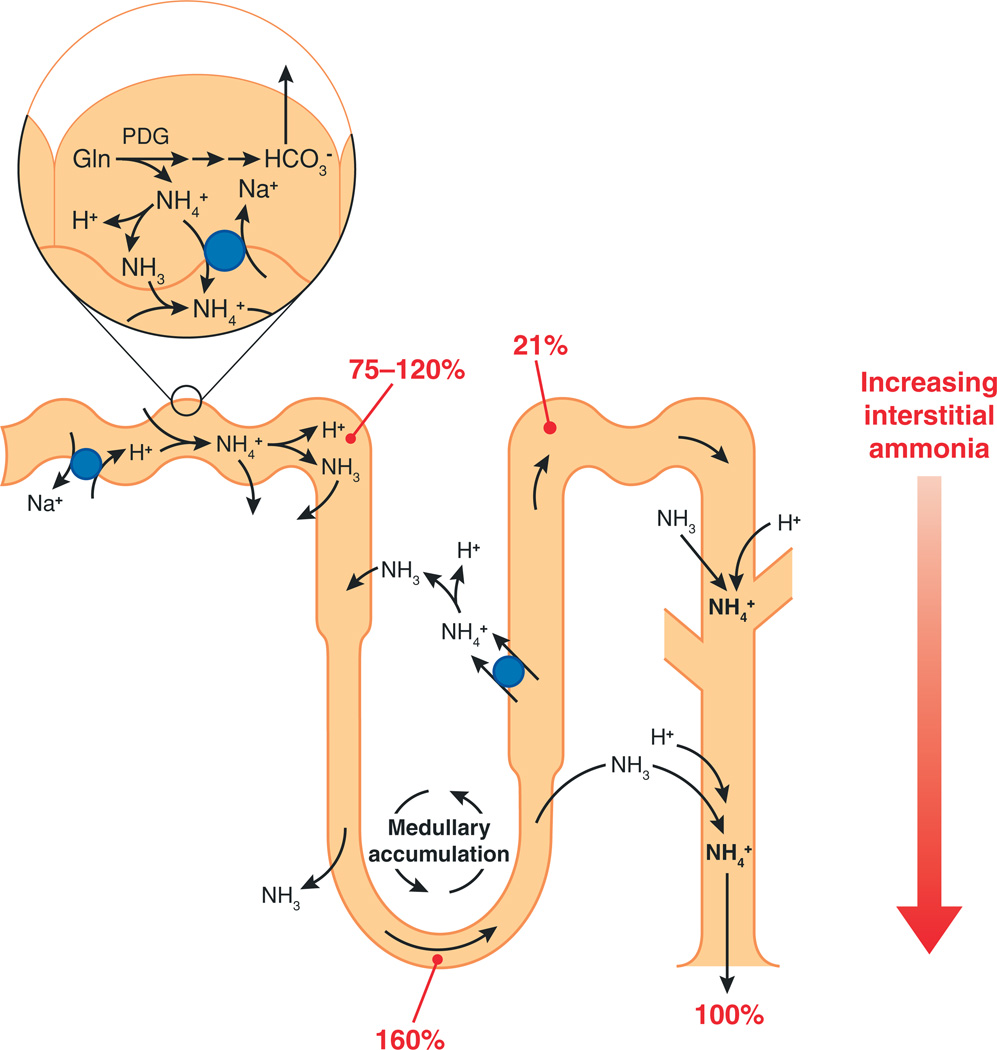
The process begins in the cells of the proximal tubule, which take up the amino acid glutamine from both the blood and the filtrate. Inside the cell, glutamine is metabolized in a two-step process:
- Glutamine → Glutamate + (catalyzed by glutaminase)
- Glutamate → -ketoglutarate + (catalyzed by glutamate dehydrogenase)
This pathway yields two key products for every one molecule of glutamine:
- Two ammonium ions (): These are actively secreted into the tubular lumen, often by substituting for on the Na⁺/H⁺ exchanger (NHE3).
- One -ketoglutarate molecule: This molecule is further metabolized within the cell, and the net result of its consumption is the generation of two new bicarbonate () ions. These bicarbonate ions are then transported across the basolateral membrane into the blood.
So, the proximal tubule accomplishes two things at once: it packages protons for future excretion as and it generates new bicarbonate to replenish the body's buffer supply.
Part 2: Diffusion Trapping and Excretion
The secreted in the proximal tubule travels down the nephron. A significant portion is reabsorbed in the thick ascending limb of the loop of Henle, leading to a high concentration of ammonium in the medullary interstitium. This sets the stage for the final step in the collecting duct.
Ammonium exists in equilibrium with ammonia: .
- (ammonium) is a charged ion and cannot easily cross cell membranes.
- (ammonia) is a neutral, lipid-soluble gas and diffuses freely.
The high concentration of in the medullary interstitium creates a high partial pressure of . This diffuses from the interstitium into the cells of the collecting duct and then into the acidic tubular fluid.
Once in the acidic lumen, the immediately combines with a secreted (from the H⁺-ATPase in intercalated cells) to reform .
Because is an ion, it cannot diffuse back out. It is "trapped" in the lumen and excreted in the urine. This process of "diffusion trapping" is a highly efficient way to move acid into the final urine.
The following readings provide a deeper look into the quantitative importance and regulatory aspects of this system.
Renal regulation of acid-base balance
This first reading details the production of ammonia from glutamine and the concept of diffusion trapping.
In the same article, 'Renal regulation of acid-base balance', please read the sections 'Production and excretion of ammonia in the proximal tubule' and 'Ammonium elimination by the distal nephron'. Focus on how ammonia is generated and the mechanism that concentrates it in the final urine.
2.4 Renal Regulation of Acid-Base Balance -continued
This second reading defines Net Acid Excretion and explains why the ammonium system is the primary regulatory component.
Please read section '1. Titratable Acidity' and '2. Addition of Ammonium'. Then find the bolded heading 'Net acid excretion' and read that short paragraph. Finally, read the summary at the very end of the page under the heading 'As pH falls, the 3 factors involved in increased H+ excretion are:'. This will neatly tie the concepts together.
Test your understanding!
During prolonged starvation, the body produces ketoacids (a type of metabolic acid). The kidney's response involves a dramatic increase in the excretion of one of the two main acid-packaging products. Which one is it, and why is this mechanism more suitable for handling a large, sustained acid load than the other?
Show answer
The kidney dramatically increases the excretion of ammonium (). While titratable acid excretion also increases (as keto-anions can act as buffers), its capacity is limited. The ammonium system is far more adaptable because the synthesis of enzymes involved in glutamine metabolism is upregulated in response to chronic acidosis. This allows the proximal tubule to produce significantly more and new , making it the primary and most powerful mechanism for compensating for large, sustained acid loads.
4. Putting It All Together: Net Acid Excretion
We can now define Net Acid Excretion (NAE) with a simple equation. It is the total amount of acid excreted, which is the sum of the two mechanisms we've discussed, minus any bicarbonate that might have escaped reabsorption.
Under normal physiological conditions and during acidosis, the kidneys are so efficient at reabsorbing bicarbonate that urinary is essentially zero. Therefore, the equation simplifies to:
To maintain acid-base balance, the daily NAE must equal the daily production of non-volatile acid (~70 mmol/day).
Conclusion
In this lesson, we have moved beyond simple conservation and explored the active, dynamic role the kidney plays in eliminating metabolic acid.
Key Takeaways:
- To maintain acid-base balance, the kidneys must excrete the daily metabolic acid load (~70 mmol/day).
- Direct excretion of free H⁺ is not feasible; protons must be buffered in the urine.
- Titratable acid, primarily buffered by the phosphate system (), accounts for about one-third of acid excretion.
- The ammonium system is the most important and adaptable mechanism, accounting for about two-thirds of acid excretion.
- Glutamine metabolism in the proximal tubule generates for excretion and new which is reabsorbed into the blood.
- Net Acid Excretion (NAE) is the sum of excreted titratable acid and ammonium, and it equals the amount of new bicarbonate generated by the kidneys.
Preview of the Next Lesson:
We have now fully covered the renal side of the acid-base equation: conserving the existing bicarbonate pool and generating new bicarbonate while excreting acid. With this foundation, we are perfectly positioned to analyze what happens when these systems are overwhelmed or fail. In the next lesson, we will begin to differentiate the four primary acid-base disorders (respiratory/metabolic acidosis/alkalosis) based on changes in pH, , and bicarbonate.