Hello! Welcome back to our module on Integrated Acid-Base Homeostasis.
In our last lesson, we established the fundamental role of the Henderson-Hasselbalch equation in understanding acid-base balance. We saw that blood pH is critically dependent on the ratio of bicarbonate to the partial pressure of carbon dioxide , a ratio tightly controlled by the kidneys and lungs, respectively. Today, we will delve into the kidney's first and most monumental task in this process.
Your learning outcome for this lesson is to explain the renal mechanism for reabsorbing filtered bicarbonate. We will uncover why this process is so vital and dissect the elegant, indirect mechanism the nephron uses to reclaim this essential buffer, ensuring the stability of your body's pH.
1. The Scale of the Challenge: Why Reabsorption is Critical
Every day, your glomeruli filter approximately 180 liters of plasma. With a normal plasma bicarbonate concentration of about 24 mmol/L, a simple calculation reveals the staggering amount of bicarbonate that enters the nephron tubules daily:
This is over 4 moles of bicarbonate. If even a small fraction of this filtered bicarbonate were lost in the urine, it would rapidly deplete the body's primary buffer, leading to a severe and life-threatening metabolic acidosis. Therefore, to maintain acid-base homeostasis, the kidneys must reabsorb virtually 100% of the bicarbonate they filter. Let's explore how they accomplish this feat.
2. The Proximal Tubule: The Workhorse of Bicarbonate Reabsorption
The vast majority—about 80-85%—of filtered bicarbonate is reabsorbed in the proximal convoluted tubule (PT). The key to understanding this process is to realize that the apical (luminal) membrane of the PT cell is essentially impermeable to the bicarbonate ion () itself. The kidney solves this problem with an ingenious indirect strategy: it converts the luminal bicarbonate into a molecule that can cross the membrane easily—carbon dioxide ().
This process is a beautiful example of cellular machinery, involving specific transporters and enzymes working in concert.

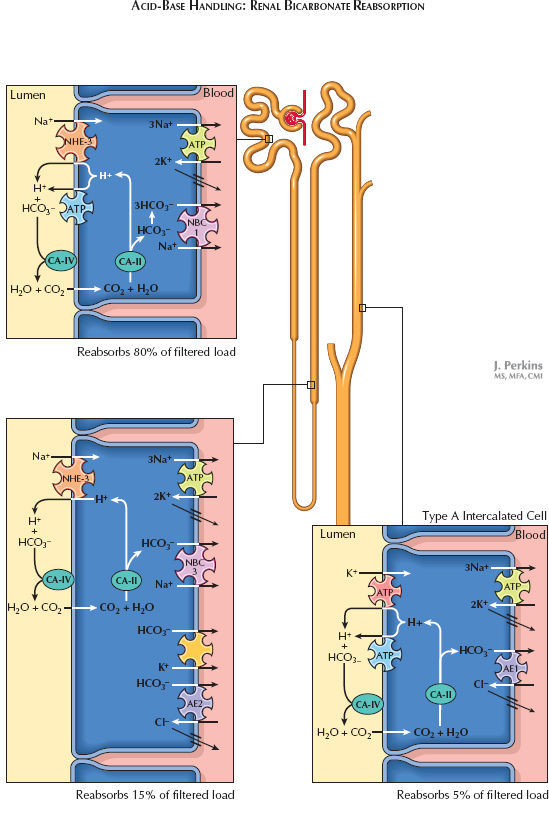
Let's break down the mechanism shown in the diagram step-by-step:
-
H⁺ Secretion: The process begins with the secretion of hydrogen ions () from the tubule cell into the lumen. This is primarily accomplished by the Na⁺/H⁺ exchanger (NHE3), which uses the favorable gradient for Na⁺ entry to drive H⁺ out. A smaller contribution comes from an H⁺-ATPase pump.
-
Luminal Reaction: In the tubular fluid, the secreted combines with a filtered ion to form carbonic acid ().
-
CO₂ Formation: The newly formed carbonic acid is unstable. An enzyme called carbonic anhydrase (Type IV), located on the apical brush border of the PT cell, rapidly catalyzes the decomposition of into carbon dioxide () and water ().
-
CO₂ Diffusion: is a small, lipid-soluble gas. It diffuses freely across the apical membrane and into the tubule cell, moving down its concentration gradient.
-
Intracellular Reaction: Once inside the cell, the process reverses. The cell has a high concentration of a different isoenzyme, carbonic anhydrase (Type II). This enzyme rapidly combines the diffused with water to form carbonic acid, which then spontaneously dissociates into and .
-
Basolateral Transport & H⁺ Recycling:
- The "new" generated inside the cell is transported out of the cell across the basolateral membrane and into the blood. This occurs mainly via a Na⁺/HCO₃⁻ cotransporter (NBC1), with a smaller role for a Cl⁻/HCO₃⁻ exchanger.
- The generated inside the cell is "recycled" back to Step 1, being secreted into the lumen by the NHE3 and H⁺-ATPase.
The net effect is that for every molecule of that disappears from the tubule lumen, one molecule of appears in the blood. Although the specific bicarbonate ion that enters the blood is not the same one that was filtered, the process results in the net reclamation of one bicarbonate ion from the filtrate.
To solidify your understanding of this core mechanism, the following reading provides a detailed narrative of the process.
Renal regulation of acid-base balance
The article 'Renal regulation of acid-base balance' from derangedphysiology.com provides a thorough, step-by-step description of this entire sequence.
Please read the section titled 'Bicarbonate handling in the proximal tubule'. Focus on the logical flow from H+ secretion to the eventual exit of bicarbonate from the basolateral side of the cell. This reinforces the steps we just outlined.
Test your understanding!
A class of diuretic drugs called carbonic anhydrase inhibitors (e.g., acetazolamide) block the action of both apical and intracellular carbonic anhydrase. Based on the mechanism we just discussed, what effect would this have on plasma bicarbonate concentration and blood pH?
Show answer
Inhibiting carbonic anhydrase would severely slow down both the conversion of to in the lumen and the conversion of back to inside the cell. This drastically reduces the rate of bicarbonate reabsorption. As a result, large amounts of would remain in the tubule and be excreted in the urine. This loss of base from the body leads to a decrease in plasma and causes a metabolic acidosis (a drop in blood pH).
3. Reabsorption in the Loop of Henle and Collecting Duct
While the proximal tubule does the heavy lifting, the remaining 15-20% of filtered bicarbonate must still be reabsorbed to achieve near-total reclamation.
- Thick Ascending Limb (TAL) of the Loop of Henle: Reabsorbs about 10-15% of the filtered bicarbonate.
- Collecting Duct (CD): The intercalated cells of the collecting duct reabsorb the final ~5%.
The fundamental mechanism in these segments is identical to that in the proximal tubule: H⁺ secretion leads to the conversion of luminal to , which diffuses into the cell and is converted back to for transport into the blood. The same key players—NHE3, H⁺-ATPases, and carbonic anhydrase—are involved.
The following diagram provides a comprehensive overview, comparing the mechanisms in the PT, TAL, and Type A intercalated cells of the collecting duct. Notice the core similarities across all three segments.
Conclusion
In this lesson, we have dissected the crucial physiological process of renal bicarbonate reabsorption. We've seen how the kidney employs a sophisticated, multi-step mechanism to conserve the body's most important buffer.
Key Takeaways:
- The kidneys must reabsorb nearly 100% of the massive amount of bicarbonate filtered daily ( mmol/day) to prevent metabolic acidosis.
- This reabsorption occurs along the nephron: 80-85% in the proximal tubule, 10-15% in the thick ascending limb, and the final ~5% in the collecting duct.
- The mechanism is indirect: is not directly transported. Instead, secreted converts luminal to .
- diffuses into the tubule cell, where it is converted back into and then transported into the blood.
- Carbonic anhydrase (both at the apical membrane and intracellularly) is essential for this process to occur at a sufficient rate.
- Key transporters involved are the apical NHE3 and H⁺-ATPase for H⁺ secretion, and the basolateral NBC1 for transport.
Preview of the Next Lesson:
Reclaiming all the filtered bicarbonate is a vital act of conservation, but it only prevents the loss of existing buffer. It does not neutralize the mmol of non-volatile acid produced daily by metabolism. To maintain balance, the kidneys must also excrete this acid load and, in the process, generate new bicarbonate. In our next lesson, we will explore the mechanisms of net acid excretion, focusing on the formation of titratable acid and the critical role of ammonia.