Hello! Welcome back to our course on the foundations of physiology.
In our last lesson, we deconstructed the action potential, exploring the precise sequence of depolarization, repolarization, and hyperpolarization. We identified the culprits: the rapid opening and subsequent inactivation of voltage-gated Na⁺ channels, and the slower, delayed opening of voltage-gated K⁺ channels. We concluded by introducing the concepts of absolute and relative refractory periods as direct consequences of these channel dynamics.
Today, we will build directly on that foundation. Our goal is to apply the concepts of absolute and relative refractory periods to neuronal excitability. This means we'll move beyond simply defining these periods to understanding their profound functional consequences. You will learn how these brief moments of unresponsiveness are not a design flaw, but are in fact essential features that dictate how neurons encode and transmit information.
1. The Molecular Basis of Refractoriness: A Deeper Look
Let's begin by solidifying our understanding of what causes the refractory periods. As we covered, it all comes down to the conformational states of the voltage-gated ion channels.
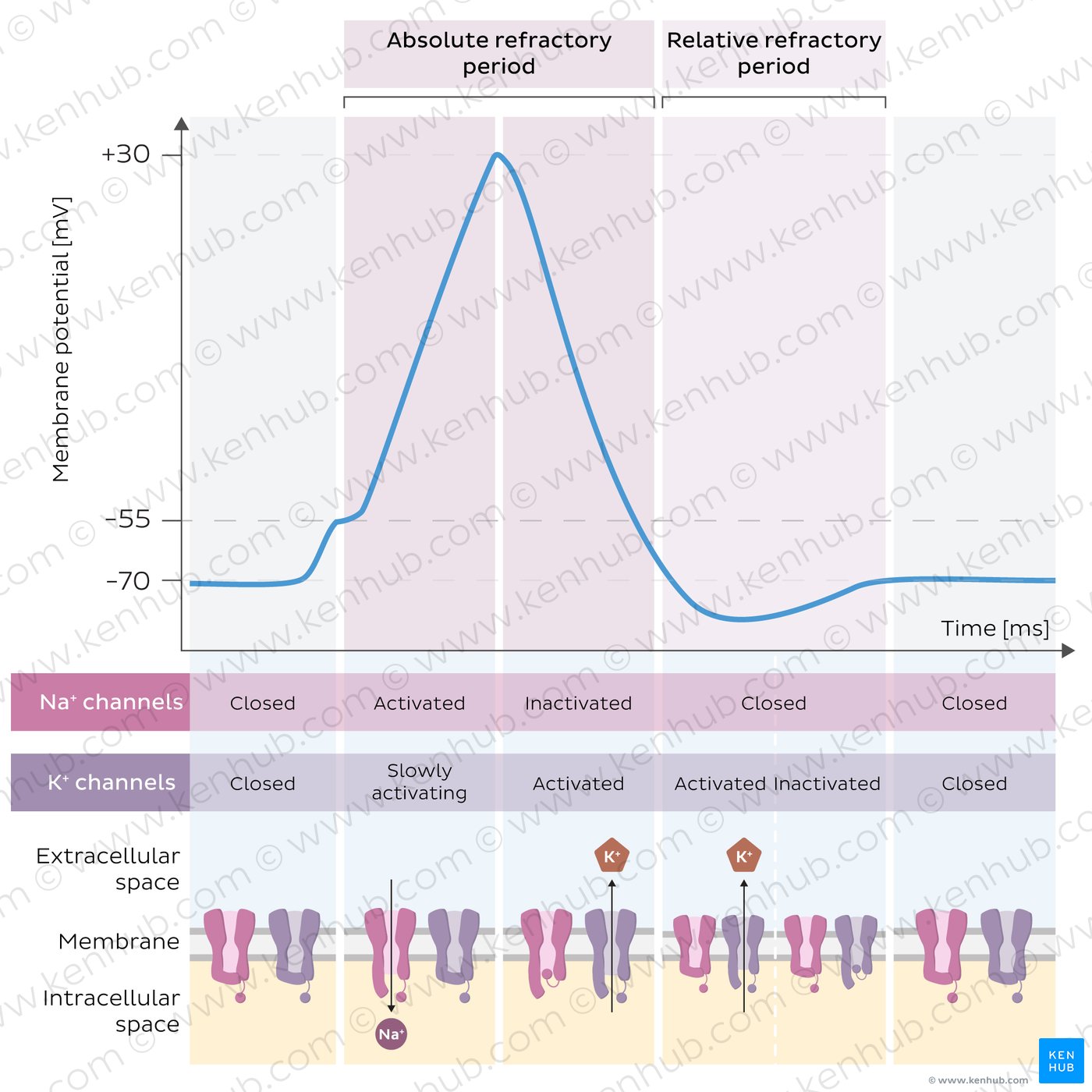
- The Absolute Refractory Period (ARP) occurs because the voltage-gated Na⁺ channels are in their inactivated state. In this state, the channel's inactivation gate is blocking the pore, and it cannot be opened by depolarization, no matter how strong the stimulus. The neuron is temporarily inexcitable.
- The Relative Refractory Period (RRP) follows the ARP. During this time, most Na⁺ channels have recovered from inactivation and returned to their closed, resting state. However, the membrane is hyperpolarized (more negative than resting potential) due to the slow closure of voltage-gated K⁺ channels. Therefore, a stronger-than-normal stimulus is required to depolarize the membrane to the threshold.
The image below provides an excellent summary, linking the phases of the action potential to the state of the channels and the resulting refractory periods.
To see these mechanisms explained in a dynamic way, let's watch a short, focused video.
Why the Membrane Becomes Un-Responsive || Absolute & Relative Refractory Period
This video from Nonstop Neuron provides a clear and concise explanation of both the absolute and relative refractory periods, focusing entirely on their definitions and the underlying channel-based mechanisms.
Please watch from 01:51 to 04:51. Pay close attention to: The reason why a second action potential is impossible during the absolute refractory period. The two reasons given for why a stronger stimulus is needed during the relative refractory period.
For a supplementary text-based explanation, you can refer to the resource "Chapter 2. Ionic Mechanisms of Action Potentials" (LINK). Section 2.9, "Absolute and Relative Refractory Periods," clearly defines both periods and explains them in the context of Na⁺ channel inactivation dynamics and the hyperpolarizing afterpotential.
Test your understanding!
Based on the video and text, what are the two primary reasons a neuron is less excitable during the relative refractory period?
Show answer
- Membrane Hyperpolarization: The membrane potential is more negative than the resting potential (e.g., -80 mV instead of -70 mV), meaning it is further away from the threshold potential (e.g., -55 mV). A larger depolarization is therefore needed to reach the threshold.
- Elevated K⁺ Conductance: Some voltage-gated K⁺ channels are still open, causing a continued efflux of positive K⁺ ions. This outward current opposes the depolarizing effect of any incoming positive charge from a stimulus.
2. Functional Consequences of Refractory Periods
Now that we have solidified the "why," let's explore the "so what." How do these periods of reduced excitability actually impact the function of a neuron?
Application 1: Limiting the Maximum Firing Rate
A neuron cannot fire action potentials indefinitely at an infinite frequency. The absolute refractory period imposes a strict upper limit on how often a neuron can fire.
Imagine the absolute refractory period lasts for 2 milliseconds. This means that after one action potential is fired, the neuron is completely unable to fire another one for at least 2 ms. This creates a mandatory "cooldown" time.
The maximum theoretical firing frequency can be calculated simply:
Max Frequency (Hz) = 1 / Absolute Refractory Period (in seconds)
For an ARP of 2 ms (0.002 s), the maximum frequency is 1 / 0.002 s = 500 Hz.
This limit is crucial for neural coding. It means that neurons encode the intensity of a stimulus not by changing the size of their action potentials (which are all-or-none), but by changing their frequency of firing, up to this maximum limit.
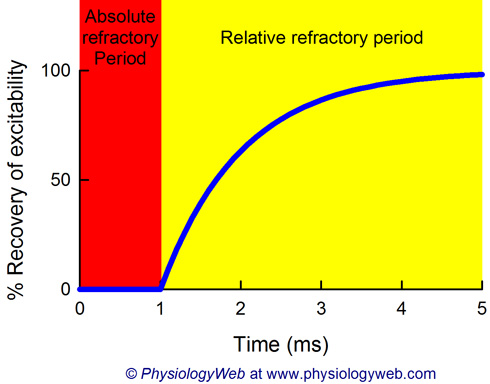
The following reading elaborates on the functional significance of refractory periods, including their role in limiting firing rates.
Refractory Period - an overview
Let's read a short section from a ScienceDirect overview that directly addresses the functional significance of the refractory period.
Please read the first paragraph of the section titled '4. Functional Significance of the Refractory Period in Neural Circuitry and Information Processing'. Focus on how the refractory period constrains firing rates and ensures unidirectional propagation (which we will cover next).
Application 2: Ensuring Unidirectional Propagation
Perhaps the most critical function of the absolute refractory period is to ensure that action potentials propagate in only one direction: from the axon hillock down to the axon terminal.
When an action potential occurs at one point on the axon, it creates a local current that depolarizes the adjacent membrane segments in both directions (forward and backward).
Let's consider three adjacent segments of an axon: A → B → C.
- An action potential is initiated at the axon hillock and arrives at segment B.
- The depolarization at B creates local currents that spread forward to C and backward to A.
- The forward-spreading current depolarizes segment C to its threshold, triggering an action potential there. The wave moves forward.
- Why doesn't the backward-spreading current trigger an action potential at segment A? Because segment A has just finished firing its own action potential. Its voltage-gated Na⁺ channels are in the inactivated state, making it absolutely refractory.
The refractory period acts as a barrier, preventing the action potential from propagating backward and creating a chaotic echo. It ensures the clean, one-way transmission of the nerve impulse.
Conclusion
Today, we explored the crucial applications of refractory periods in shaping neuronal function. By understanding the behavior of ion channels, you can now explain not just what these periods are, but why they are physiologically indispensable.
Key Takeaways:
- The absolute refractory period, caused by Na⁺ channel inactivation, makes a patch of membrane completely inexcitable.
- The relative refractory period, caused by membrane hyperpolarization and lingering K⁺ efflux, requires a stronger stimulus to trigger an action potential.
- Application 1: The absolute refractory period sets a hard upper limit on a neuron's maximum firing frequency, which is fundamental to how stimulus intensity is encoded.
- Application 2: The absolute refractory period ensures the unidirectional propagation of action potentials down an axon by preventing the signal from traveling backward.
Preview of the Next Lesson:
We have now completed our deep dive into the electrical properties of the cell membrane. In the next lesson, we will shift our focus to another critical aspect of cellular homeostasis: cell volume regulation. We will explore the mechanisms cells use to maintain their volume when faced with changes in the osmolarity of their environment.