Hello! Welcome to your sixth lesson on the foundations of cellular physiology.
In our last lesson, we mastered the Goldman-Hodgkin-Katz (GHK) equation. We established that the resting membrane potential is a weighted average of the equilibrium potentials for several ions, with the weighting factor for each ion being its relative membrane permeability. You learned that at rest, the high permeability to potassium () makes the membrane potential sit close to potassium's equilibrium potential ().
Today, we'll see what happens when those permeabilities change dramatically. This lesson explains the central event in neuronal communication: the action potential. Our learning outcome is to explain the ionic basis and phases of the neuronal action potential, including the roles of voltage-gated Na⁺ and K⁺ channels. We will dissect this rapid, transient change in membrane voltage, revealing the elegant molecular machinery that makes it possible.
1. From Resting Potential to Threshold: The "All-or-None" Trigger
An action potential isn't a graded response; it's a stereotyped, all-or-none event. This means that if a neuron is stimulated, it either fires a full-blown action potential or it doesn't fire at all. There is no "half" action potential.
The deciding factor is whether the stimulus is strong enough to depolarize the neuron's membrane to a critical voltage known as the threshold potential (typically around -55 mV).
- Subthreshold stimuli: Small depolarizations that do not reach the threshold potential will simply die out, and the membrane will return to its resting potential.
- Suprathreshold stimuli: Any stimulus that reaches or exceeds the threshold will trigger an action potential of a fixed size and shape.
This all-or-none principle is fundamental to how neurons encode information reliably.
Generation of Action Potential | How Action Potential is Generated in neurons, muscles etc?
This brief clip from Nonstop Neuron concisely explains the all-or-none phenomenon and the importance of the threshold.
Please watch the segment from 03:11 to 03:58. Focus on the distinction between what happens when a stimulus reaches threshold versus when it does not.
Reaching threshold is the trigger because it's the voltage at which a special class of proteins—voltage-gated ion channels—begin to open en masse.
2. The Phases of an Action Potential
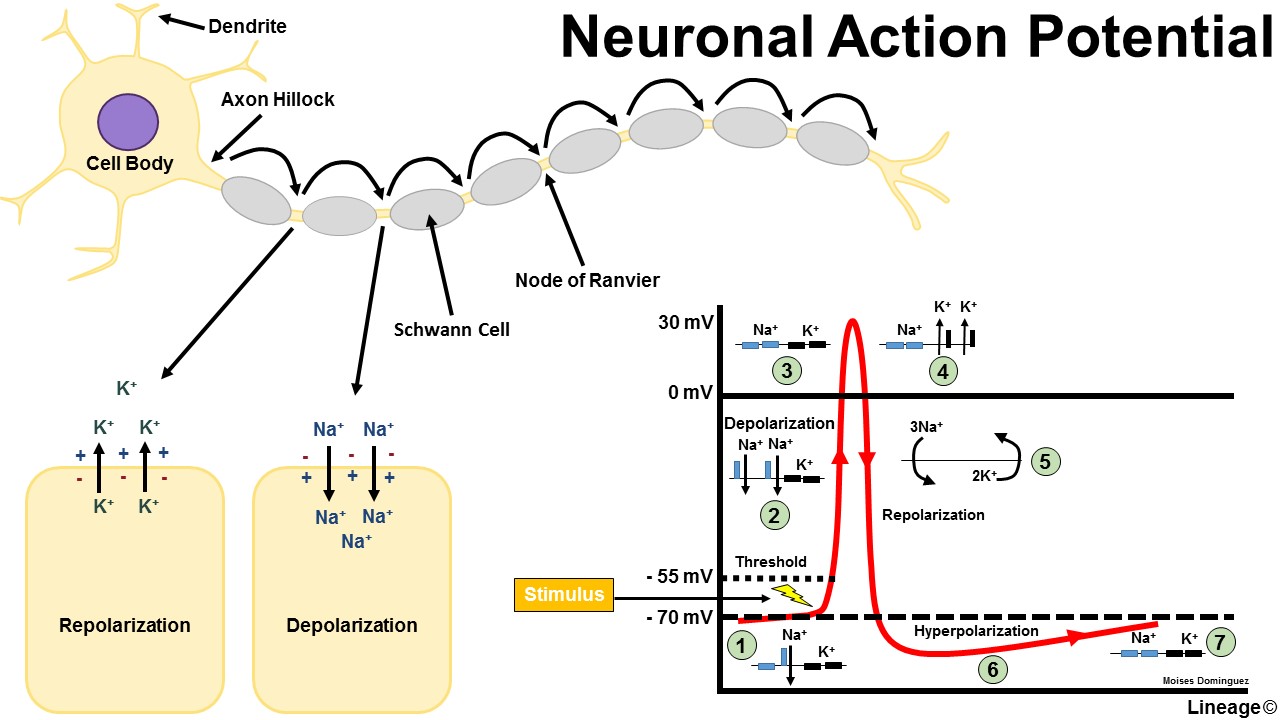
The action potential is a sequence of stereotyped changes in membrane potential that occur over about 2-3 milliseconds. Let's walk through the process, phase by phase. The image below provides a complete overview, which we will dissect in detail.
Phase 1: Depolarization (The Rising Phase)
Once the threshold is reached, voltage-gated Na⁺ channels snap open. Based on what you know about ion gradients and the Nernst potential for Na⁺ ( ≈ +60 mV), a massive electrochemical force drives Na⁺ ions to rush into the cell.
This influx of positive charge causes the membrane potential to rapidly shoot upward, from -55 mV towards the sodium equilibrium potential. This process is self-reinforcing, creating a positive feedback loop:
Depolarization → More voltage-gated Na⁺ channels open → More Na⁺ influx → More depolarization.
This regenerative cycle is responsible for the explosive, all-or-none nature of the action potential's rising phase.
This section from the StatPearls review article provides a concise, high-yield summary of the depolarization and repolarization phases, directly addressing the core concepts.
Please read the section titled 'Function'. Pay close attention to the description of the positive-feedback loop involving voltage-gated sodium channels (Nav).
Phase 2: Repolarization (The Falling Phase)
The membrane doesn't stay depolarized for long. Two key events, which are also initiated by the depolarization at threshold, work to bring the potential back down:
-
Inactivation of Voltage-Gated Na⁺ Channels: After being open for less than a millisecond, the voltage-gated Na⁺ channels automatically shut. This is not the same as closing; they enter an inactivated state where they cannot be immediately reopened. This process breaks the positive feedback loop and stops the influx of Na⁺.
-
Activation of Voltage-Gated K⁺ Channels: The depolarization also triggers the opening of voltage-gated K⁺ channels. However, these channels are much slower to respond. They begin to open significantly just as the Na⁺ channels are inactivating.
With Na⁺ influx halted and K⁺ channels now open, the dominant permeability switches decisively back to potassium. K⁺ ions rush out of the cell, driven by their electrochemical gradient, carrying positive charge out and making the inside of the cell negative again.
Phase 3: Hyperpolarization (The "Undershoot")
The slow kinetics of the voltage-gated K⁺ channels have one more effect. Just as they were slow to open, they are also slow to close. They remain open for a short time even after the membrane potential has returned to its resting level.
During this time, the total potassium permeability of the membrane ( from leak channels + voltage-gated channels) is temporarily higher than it is at rest. This causes the membrane potential to dip slightly below the resting potential, approaching the K⁺ equilibrium potential () even more closely. This brief dip is called the hyperpolarizing afterpotential, or undershoot.
Finally, as the voltage-gated K⁺ channels close, the membrane potential returns to the steady-state resting level maintained by the leak channels and the Na⁺/K⁺-ATPase pump.
Neurology | Resting Membrane, Graded, Action Potentials
The Ninja Nerd video provides an excellent, detailed walkthrough of all these phases, illustrating the ion movements and corresponding voltage changes.
Please watch from 32:31 to 47:45. This is a longer segment, but it provides a comprehensive narrative of the entire process. 32:31 - 36:41: Focus on how the opening of Na⁺ channels at the axon hillock causes the depolarizing wave. 39:14 - 45:38: Pay attention to the dual roles of Na⁺ channel inactivation and K⁺ channel opening in causing repolarization and hyperpolarization. 45:38 - 47:45: This section provides a graphical summary that ties all the phases together.
3. The Molecular Machinery: A Closer Look at the Channels
To truly understand the action potential, we must examine the structure and function of the voltage-gated channels themselves.
The Voltage-Gated Na⁺ Channel: Three Key States
The behavior of the voltage-gated Na⁺ channel is the main star of the show. It can exist in three distinct conformational states, which dictates the flow of the action potential.

- Closed (Resting): At the resting membrane potential, the channel is closed but capable of opening. The "activation gate" is shut, while the "inactivation gate" is open.
- Open (Activated): When the membrane depolarizes to threshold, the activation gate swings open rapidly, allowing Na⁺ ions to flood through.
- Inactivated: A fraction of a millisecond after opening, the inactivation gate (often visualized as a "ball and chain") swings up to block the pore from the inside. The channel is now inactivated and cannot pass Na⁺, even though the activation gate may still be open. It cannot be stimulated to open again until it returns to the closed state.
The transition from the inactivated state back to the closed state only happens once the membrane repolarizes back near the resting potential. This property is the key to understanding refractory periods, which we will discuss next.
The Voltage-Gated K⁺ Channel: The Slower Partner
The voltage-gated K⁺ channel is simpler. It has two states: closed and open. The key feature is its slower kinetics. It responds to the same depolarization that opens the Na⁺ channels, but it takes longer to do so. This timing difference is crucial: it ensures that the K⁺ efflux (repolarization) begins only after the Na⁺ influx (depolarization) has occurred.
Test your understanding!
Two famous toxins are used in neurophysiology research: Tetrodotoxin (TTX) blocks voltage-gated Na⁺ channels, and Tetraethylammonium (TEA) blocks voltage-gated K⁺ channels.
- What would happen to the action potential if you applied TTX to a neuron and then provided a strong, suprathreshold stimulus?
- What would the action potential waveform look like if you applied TEA?
Show answer
- With TTX blocking the voltage-gated Na⁺ channels, there would be no action potential. The depolarizing positive feedback loop cannot be initiated, so the rising phase is completely prevented. The membrane potential would remain at rest.
- With TEA blocking the voltage-gated K⁺ channels, the action potential would be significantly prolonged. The rising phase (depolarization) would be normal. However, repolarization would be much slower, relying only on the gradual inactivation of Na⁺ channels. Furthermore, the hyperpolarizing undershoot, which is caused by the slow closing of K⁺ channels, would be absent.
To see this explained, you can read the short section 'Pharmacology of the Voltage-Dependent Membrane Channels' in the textbook resource from UT Houston (resource ID LINK, found after the section on 'Sequence of Conductance Changes').
4. Refractory Periods: The Consequence of Channel States
The properties of the voltage-gated channels impose critical limits on neuron firing. These limits are known as refractory periods.
-
Absolute Refractory Period: This is a period during which it is impossible to fire another action potential, no matter how strong the stimulus. It coincides with the time when the voltage-gated Na⁺ channels are either already open or are in the inactivated state. Because inactivated channels cannot be opened, a new action potential cannot be initiated.
-
Relative Refractory Period: This is a period during which it is possible to fire another action potential, but only with a stronger-than-normal stimulus. It coincides with the hyperpolarization phase. During this time, most Na⁺ channels have returned to their closed/resting state, but:
- The membrane is hyperpolarized, meaning it's further away from the threshold.
- Some voltage-gated K⁺ channels are still open, opposing depolarization.
More excitatory input is therefore needed to overcome these factors and reach threshold.
Neurology | Resting Membrane, Graded, Action Potentials
This segment of the Ninja Nerd video connects the channel states directly to the absolute and relative refractory periods.
Please watch from 47:45 to 55:54. 47:45 - 51:27: This gives a very clear visual explanation of the three states of the Na⁺ channel gates. 52:53 - 55:54: This part explicitly links the inactivated state of Na⁺ channels to the absolute refractory period and the hyperpolarized state of the membrane to the relative refractory period.
Conclusion
Today you have dissected one of the most fundamental processes in physiology. We saw how the principles of ion gradients and permeability, which we established in previous lessons, come together in a dynamic, precisely timed sequence to create the nerve impulse.
Key Takeaways:
- The action potential is an all-or-none electrical signal triggered when a stimulus depolarizes the membrane to a threshold voltage.
- Depolarization is caused by the rapid opening of voltage-gated Na⁺ channels and the resulting influx of Na⁺, driven by a powerful positive feedback loop.
- Repolarization is caused by the inactivation of Na⁺ channels and the slower opening of voltage-gated K⁺ channels, which allows K⁺ to flow out of the cell.
- Hyperpolarization (the undershoot) occurs because the voltage-gated K⁺ channels are slow to close, temporarily making the membrane even more permeable to K⁺ than at rest.
- The three states of the voltage-gated Na⁺ channel (closed, open, inactivated) are crucial for the shape and properties of the action potential, including the absolute refractory period.
Preview of the Next Lesson:
We have now defined the absolute and relative refractory periods. In our next lesson, we will explore their profound functional consequences. We will apply these concepts to explain key aspects of neuronal excitability, such as why action potentials travel in only one direction and how refractory periods set the maximum firing rate of a neuron.