Hello! Welcome to your next lesson in the "Vascular Physiology and Hemodynamics" module.
In our previous lesson, we defined and calculated cardiac output (CO), which represents the total volume of blood flow generated by the heart per minute. We established that this flow is the ultimate output of the cardiac pump. Now, we will explore the principles that govern this flow as it travels through the thousands of miles of blood vessels in your body.
Today's learning outcome is to apply Ohm's law and Poiseuille's law to describe the relationship between pressure, flow, and resistance in the vascular system. This lesson will provide the fundamental physical framework for understanding how blood is distributed and regulated throughout the circulation.
1. The Fundamental Relationship: Pressure, Flow, and Resistance
The movement of any fluid, including blood, is governed by a simple but powerful relationship: flow is driven by a pressure difference and is opposed by resistance. This concept is beautifully captured by an analogy to electrical circuits, a principle known as Ohm's Law.
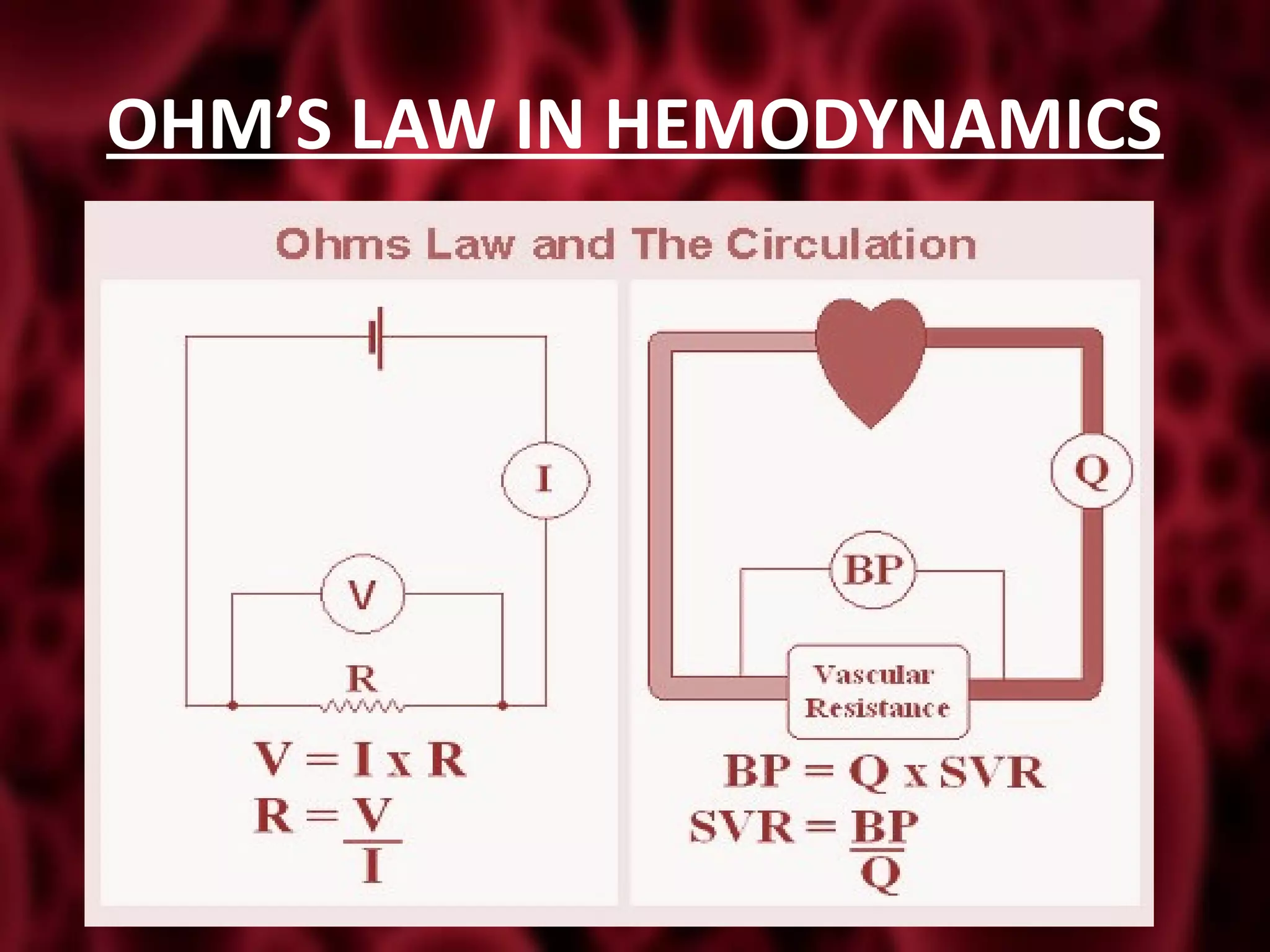
Let's formalize this for the cardiovascular system.
Physiology, Cardiovascular Hemodynamics
To begin, let's explore the core equation that relates pressure, flow, and resistance. The StatPearls article on Cardiovascular Hemodynamics provides a clear, concise introduction to this concept, which they call 'Ohm’s law of fluid flow.'
Please read the section starting with 'This governing principle is quantified by Ohm’s law...' until the end of the paragraph that describes resistance in series and parallel. Focus on the equation for Ohm's law and the analogy provided.
As the resource explains, the relationship for fluid flow is expressed as:
Where:
- Q is the Flow of blood. For the entire systemic circulation, this is the Cardiac Output (CO) we discussed in the last lesson, typically measured in L/min.
- is the Pressure Gradient. This is the difference in pressure between the beginning and the end of the circuit. For the systemic circulation, it's the Mean Arterial Pressure (MAP) minus the Central Venous Pressure (CVP). This pressure gradient is the driving force for blood flow.
- R is the Resistance to flow. For the whole system, this is called Systemic Vascular Resistance (SVR) or Total Peripheral Resistance (TPR).
This simple equation is the cornerstone of hemodynamics. It tells us that flow can be increased by either increasing the pressure gradient (i.e., the heart pumps harder) or by decreasing the resistance in the vessels (i.e., vasodilation).
To deepen our understanding of resistance, let's look at another resource.
Factors which affect peripheral vascular resistance
The article from Deranged Physiology provides a more detailed definition of vascular resistance and discusses the interesting theoretical distinction between resistance and its reciprocal, conductance.
Please read the sections titled 'Definition of systemic (peripheral? Total?) vascular resistance' and 'Vascular resistance versus vascular conductance.' These sections will reinforce the Ohm's law analogy and introduce a nuanced perspective on why we focus on resistance.
As you read, note the concept of conductance (C = Q/ΔP), which is the reciprocal of resistance. While resistance is the conventional term, thinking about conductance can be useful. Conductance measures how easily blood flows for a given pressure, which is often what happens physiologically: the body changes vessel diameter (and thus conductance) to alter flow, while the pressure gradient (MAP) is kept relatively stable.
2. The Determinants of Resistance: Poiseuille's Law
Ohm's law tells us that resistance exists, but it doesn't explain what physical factors create it. To understand that, we turn to another principle from fluid dynamics: Poiseuille's Law (often called the Hagen-Poiseuille equation).
This law describes the factors that determine the resistance of a fluid flowing through a cylindrical tube.
Factors which affect peripheral vascular resistance
The Deranged Physiology article provides an excellent breakdown of Poiseuille's Law and its variables. It also critically evaluates how this idealized physics equation applies to the complex reality of the circulatory system.
Please read the sections starting from 'Factors which affect peripheral vascular resistance' through to the end of 'Radius of the vessel.' As you read, focus on the equation itself and how the article discusses the physiological relevance of each variable: length (l), viscosity (η), and especially radius (r).
The equation for resistance derived from Poiseuille's law is:
Where:
- R is Resistance.
- (eta) is the viscosity of the fluid (i.e., blood).
- l is the length of the tube (i.e., the blood vessel).
- r is the radius of the tube.
- is a constant of proportionality.
Let's break down the physiological importance of each variable:
-
Length (l): While resistance is directly proportional to vessel length, the overall length of the vascular tree in an adult is fixed. Therefore, length is not a variable that the body manipulates to regulate blood flow.
-
Viscosity (): Blood viscosity is mainly determined by the hematocrit (the percentage of blood volume occupied by red blood cells). While viscosity can change (e.g., in polycythemia or anemia), these are not rapid, moment-to-moment changes used for flow regulation. It's an important factor, but not a primary regulatory one. An interesting point from the reading is the Fahraeus–Lindquist effect, where blood's apparent viscosity actually decreases in very small vessels, which helps facilitate flow in the microcirculation.
-
Radius (r): This is the most critical and powerful variable in the equation. Resistance is inversely proportional to the radius raised to the fourth power. This means that even a tiny change in vessel radius has a massive impact on resistance and flow.
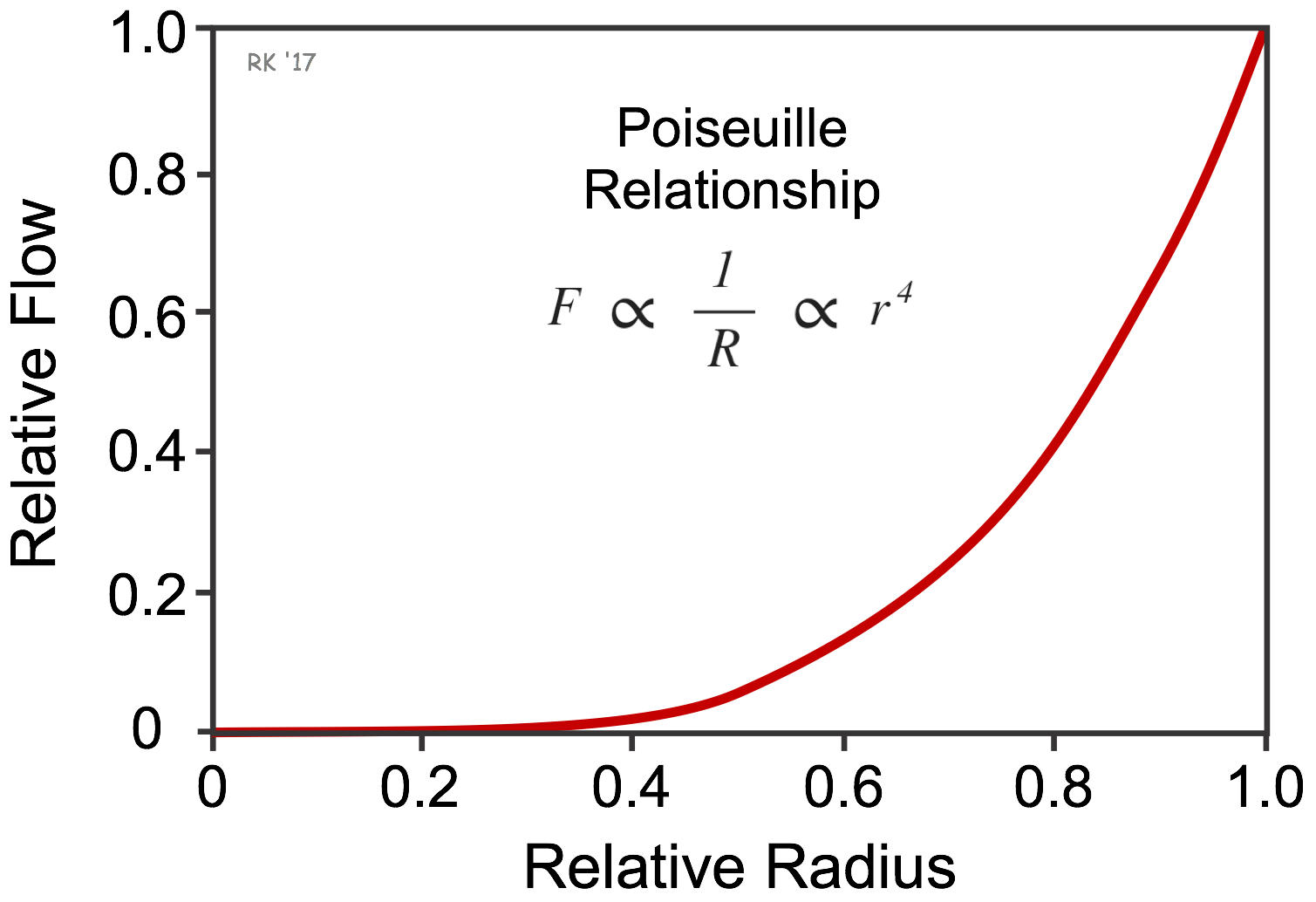
For instance, if you halve the radius of a vessel (r → r/2), the resistance will increase by a factor of 16 (1 / (1/2)⁴ = 16). This immense sensitivity is why the muscular arterioles, whose radii can be actively and rapidly changed, are the primary sites for regulating both systemic vascular resistance and local blood flow to tissues.
Test your understanding!
An arteriole constricts, reducing its diameter by 50%. Assuming pressure and viscosity remain constant, how does this change affect the flow (Q) through that vessel?
Show answer
-
Relate Flow to Resistance: From Ohm's Law, . Since is constant, flow is inversely proportional to resistance: .
-
Relate Resistance to Radius: From Poiseuille's Law, .
-
Combine the relationships: . Flow is directly proportional to the radius to the fourth power.
-
Calculate the effect:
- Reducing the diameter by 50% means reducing the radius by 50%. The new radius, , is .
- The new flow, , will be proportional to .
- .
- Therefore, the new flow is only 6.25% of the original flow. A 50% reduction in radius causes a ~94% reduction in blood flow.
3. Resistance in Series and Parallel
The final piece of the puzzle is understanding how to combine resistances in a complex network like the circulatory system. Just like electrical resistors, blood vessels can be arranged in series (one after another) or in parallel (branching paths).
-
Series Resistance: When vessels are in series (e.g., aorta → large artery → small artery), the total resistance is the sum of the individual resistances.
This means that adding a resistor in series always increases the total resistance. -
Parallel Resistance: When vessels are in parallel (e.g., the branching capillary beds supplying an organ), the reciprocal of the total resistance is the sum of the reciprocals of the individual resistances.
This is a crucial concept: for a parallel arrangement, the total resistance is less than the resistance of any single path. Adding more resistors in parallel decreases the total resistance.
This explains a seeming paradox: individual capillaries have a tiny radius and thus very high resistance. However, because the body contains billions of capillaries arranged in parallel, the total resistance of all capillary beds combined is very low. The primary site of vascular resistance is not the capillaries, but the arterioles that feed into them. These arterioles act as control valves, arranged in series before the parallel capillary networks, regulating how much blood enters each network.
Conclusion
In this lesson, we established the core physical principles governing blood flow. By understanding and applying Ohm's and Poiseuille's laws, we can appreciate the elegant system the body uses to control circulation.
Key Takeaways:
- The relationship between blood flow (Q), pressure gradient (), and resistance (R) is described by Ohm's Law: .
- The physical factors determining resistance are described by Poiseuille's Law: .
- Vessel radius (r) is the most potent determinant of resistance due to the fourth-power relationship. The body dynamically regulates arteriolar radius to control blood flow.
- The parallel arrangement of blood vessels, particularly capillaries, allows for a massive surface area for exchange while keeping the total resistance of that segment surprisingly low.
Preview of the Next Lesson:
Now that we have the laws of flow and resistance, we can trace the consequences of these principles throughout the vascular tree. In the next lesson, we will describe the distribution of blood pressure and volume throughout the systemic circulation. We will see how and why pressure drops as it moves through different vessel types and how the physical characteristics of vessels determine where most of our blood volume is located at any given moment.