Hello! Welcome to the first lesson in our new module, "Vascular Physiology and Hemodynamics."
In our last module, we concluded by analyzing how the heart's mechanical performance is governed by three key determinants: preload, afterload, and contractility. We saw how these factors alter the pressure-volume loop and, consequently, the amount of blood the ventricle ejects with each beat—the stroke volume.
Today, we will build directly on that foundation. The learning outcome for this lesson is to define and calculate cardiac output, stroke volume, and ejection fraction. We will formalize the definitions of these critical parameters, which are used to quantify the heart's overall pumping function. This lesson acts as a bridge, connecting the mechanics of a single heartbeat to the continuous flow of blood throughout the entire circulatory system.
Let's begin with the most direct link to our previous discussion: stroke volume.
1. Stroke Volume (SV)
In the last lesson, we frequently referred to the volume of blood ejected by the ventricle. This has a formal name: Stroke Volume. It is the most direct measure of the mechanical output of a single cardiac contraction.
To start, let's get a precise definition of stroke volume and its calculation. The following resource from StatPearls provides a clear and concise explanation.
Please read the first paragraph in the 'Mechanism' section. Focus on how Stroke Volume (SV) is defined and how it is calculated from end-diastolic and end-systolic volumes.
As the text explains, stroke volume is the volume of blood ejected from a ventricle during one contraction (systole). It's not the total amount of blood in the ventricle, but rather the difference between the volume at the end of filling and the volume at the end of ejection.
The formula is:
Where:
- SV is Stroke Volume.
- EDV is End-Diastolic Volume (the volume of blood in the ventricle just before contraction, representing the preload).
- ESV is End-Systolic Volume (the volume of blood remaining in the ventricle just after contraction).
For a typical resting adult, the EDV might be around 120-130 mL and the ESV around 50-60 mL, resulting in a stroke volume of approximately 70 mL per beat.
As we explored in depth previously, this value is dynamically determined by the interplay of preload (EDV), afterload, and contractility.
2. Cardiac Output (CO)
While stroke volume tells us about a single beat, it doesn't describe the heart's overall ability to supply blood to the body over time. For that, we use Cardiac Output. It is arguably the single most important measure of the heart's function as a pump.
Components and determinants of cardiac output
The following article from Deranged Physiology provides an excellent definition of cardiac output and explores some important theoretical nuances.
Please read the following sections: 'Definition and normal value range of cardiac output': Focus on the definition, typical units, and the concept of 'cardiac index'. 'Factors which affect cardiac output': Note the primary formula. 'Heart rate as a determinant of cardiac output': Pay attention to why the relationship isn't perfectly linear.
Definition and Calculation
Cardiac Output (CO) is the volume of blood pumped by a ventricle per minute. It connects the single-beat performance (SV) with the rate at which the heart beats (HR).
The fundamental formula is:
Where:
- CO is Cardiac Output (typically in Liters/minute).
- HR is Heart Rate (in beats/minute).
- SV is Stroke Volume (typically in mL/beat, which you must convert to L/beat for the final CO unit).
For example, using our typical resting values:
- HR = 70 beats/min
- SV = 70 mL/beat = 0.070 L/beat
- CO = 70 beats/min × 0.070 L/beat = 4.9 L/min
This value of ~5 L/min is a standard resting cardiac output for an average adult. During strenuous exercise, this can increase dramatically to 20-25 L/min, and even up to 40 L/min in elite athletes.
Cardiac Index (CI)
A 5 L/min cardiac output would be excessive for a small child but inadequate for a very large adult. To standardize this measurement across individuals of different sizes, we use the Cardiac Index (CI).
The cardiac index provides a measure of cardiac performance relative to body size, making it a more comparable value. It is typically expressed in L/min/m².
The Nuanced Role of Heart Rate
It might seem that simply increasing heart rate would always increase cardiac output. However, as the resource points out, the relationship is more complex. Remember that stroke volume depends on preload, which requires time for the ventricle to fill during diastole.
- At very high heart rates, the diastolic filling time is reduced.
- This leads to a lower end-diastolic volume (EDV), which reduces preload.
- According to the Frank-Starling mechanism, this reduced preload leads to a lower stroke volume.
Therefore, at extreme heart rates, the decrease in SV can be so significant that it overrides the increase in HR, causing the overall cardiac output to fall. For every individual, there is an optimal heart rate at which cardiac output is maximal.
3. Ejection Fraction (EF)
Our final parameter, Ejection Fraction (EF), does not measure a volume but rather the efficiency of the ventricle. It describes what fraction, or percentage, of the blood that fills the ventricle is actually pumped out with each beat.
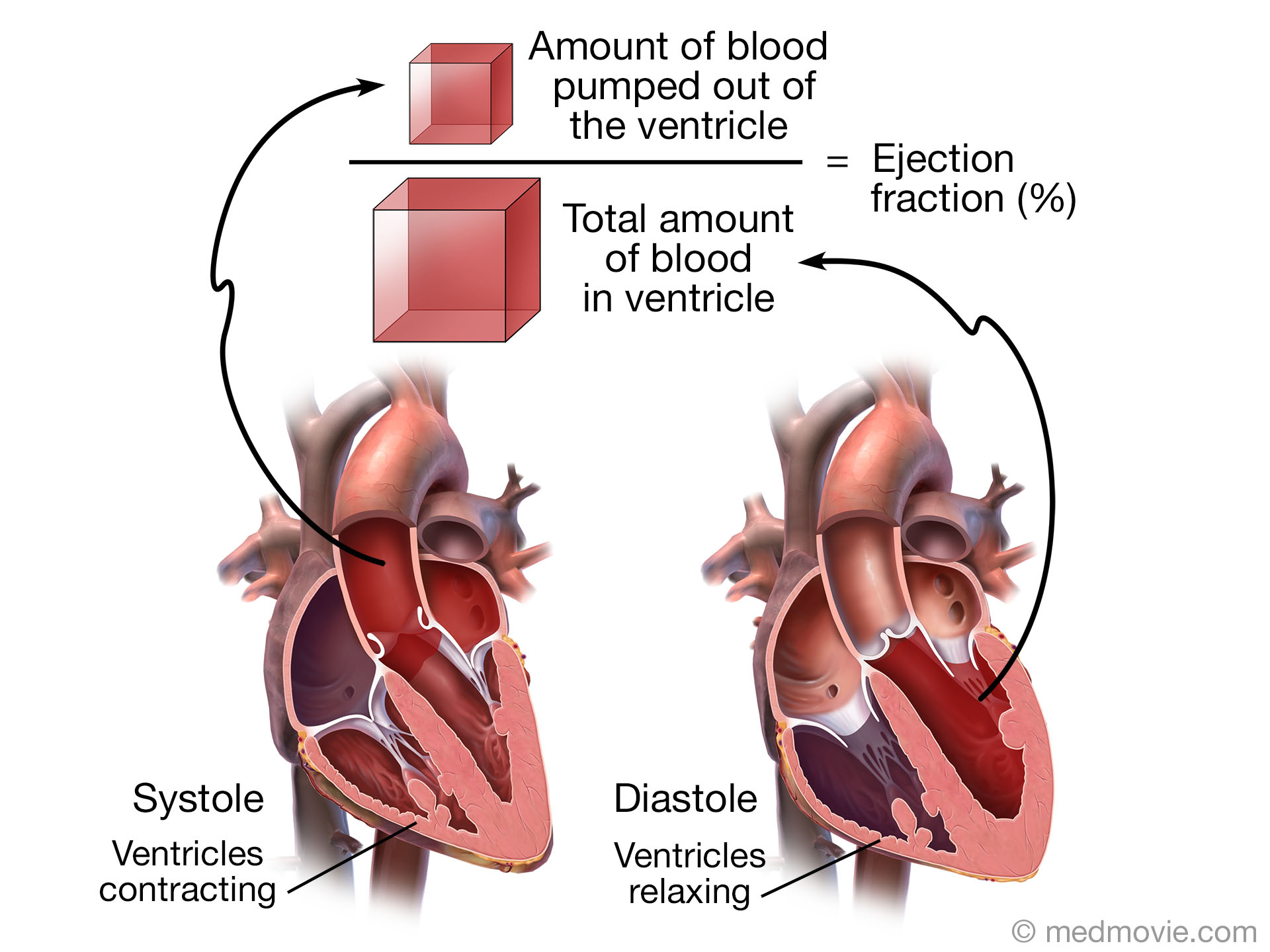
The formula for Ejection Fraction is:
Since we know SV = EDV - ESV, we can also write this as:
This value is an excellent index of ventricular contractility. For example, a failing heart might have a very large EDV (high preload) but still have a poor stroke volume because it can't contract effectively. The resulting EF would be low, signaling poor pump function.
Let's read a brief passage to establish the normal range for this important value.
The StatPearls article provides the standard clinical definition and normal values for ejection fraction.
Please read the first three sentences of the 'Clinical Significance' section. Focus on the definition of ejection fraction and the normal range provided.
As stated in the resource, a normal ejection fraction is typically in the range of 55% to 65%. This means that a healthy heart pumps out a little over half of the blood it contains with each beat. It's important to note that the EF is never 100%; a residual volume (the ESV) always remains in the ventricle.
Test your understanding!
A patient's left ventricle is measured to have an end-diastolic volume (EDV) of 140 mL and an end-systolic volume (ESV) of 63 mL. Their heart rate is 80 beats per minute.
Calculate the following:
- Stroke Volume (SV)
- Ejection Fraction (EF)
- Cardiac Output (CO)
Is the ejection fraction within the normal physiological range?
Show answer
-
Stroke Volume (SV):
-
Ejection Fraction (EF):
-
Cardiac Output (CO):
The calculated ejection fraction is 55%, which is at the lower end of the normal range (55-65%).
Conclusion
In this lesson, we have defined and learned to calculate the three most fundamental parameters of cardiac performance. These metrics allow us to quantify the heart's function and understand how it adapts to the body's demands.
Key Takeaways:
- Stroke Volume (SV) is the volume of blood pumped per beat, calculated as SV = EDV - ESV. It is the direct result of the interplay between preload, afterload, and contractility.
- Cardiac Output (CO) is the total volume of blood pumped per minute, calculated as CO = HR × SV. It represents the total blood flow to the systemic circulation.
- Ejection Fraction (EF) is the percentage of end-diastolic volume ejected per beat, calculated as EF = (SV / EDV) × 100%. It is a key indicator of ventricular efficiency and contractility.
Preview of the Next Lesson:
We have now established a clear definition for cardiac output, which represents blood flow from the heart. The next logical question is: what governs this flow as blood moves through the vast network of arteries, capillaries, and veins? In our next lesson, we will apply fundamental physical principles to the vascular system, using Ohm's law and Poiseuille's law to describe the relationship between pressure, flow, and resistance. This will complete our picture of how the heart's output is translated into blood circulation throughout the body.