Hello! Welcome to the first lesson of our "Modern C++" module.
In our previous lessons on object-oriented programming, we frequently used new to allocate objects on the heap and were responsible for manually calling delete to free them. As the preview to this lesson noted, this manual approach is a significant source of bugs in C and older C++ code. Forgetting to call delete leads to memory leaks, and using a pointer after it's been deleted (a dangling pointer) often leads to crashes. This problem becomes even harder to solve correctly when functions have multiple exit points or can throw exceptions.
Today, you will learn to explain the RAII (Resource Acquisition Is Initialization) principle. This is arguably the most important and foundational concept in modern C++. It provides an elegant, robust, and systematic way to manage not just memory, but any kind of "resource" your program uses. Understanding RAII is the key to writing safe and clean C++ code.
1. What Are Resources and Why Are They Hard to Manage?
First, let's broaden our definition of a "resource." It's not just memory. A resource is anything that you must acquire before you can use it and must release when you are done.
Common examples include:
- Dynamic Memory: Acquired with
new, released withdelete. - File Handles: Acquired with
fopen(), released withfclose(). - Mutex Locks: Acquired with
lock(), released withunlock(). - Network Sockets: Acquired by opening a connection, released by closing it.
- Database Connections: Acquired by connecting, released by disconnecting.
Managing these manually is fraught with peril.
To understand why, let's watch a short segment that introduces the core problem.
Back to Basics: RAII in C++ - Andre Kostur - CppCon 2022
This clip from a CppCon talk by Andre Kostur clearly defines what a 'resource' is in this context and outlines the classic problems associated with managing them.
Watch the segment from 00:28 to 03:29. Pay attention to the definition of a resource as an 'acquire and release pair' and the three main problems he identifies: resource leaks, use-after-disposal, and double disposal.
The video then provides a fantastic example of how manual resource management quickly breaks down. He uses a mutex lock, which is a great case study because failing to release it causes a deadlock—a situation where your program grinds to a halt.
Back to Basics: RAII in C++ - Andre Kostur - CppCon 2022
Now, let's see a concrete example of how manual resource management can go wrong, especially when dealing with multiple return paths or exceptions. The video continues by demonstrating this with a mutex lock and then shows how an RAII-based class, std::lock_guard, elegantly solves the problem.
Continue watching from 03:29 to 10:36. Observe how the manual unlock() calls become a maintenance nightmare. Then, see how using the std::lock_guard object simplifies the code and makes it robust by automatically handling the unlock when the lock_guard object goes out of scope.
This example perfectly illustrates the power of RAII. The code using std::lock_guard is simpler, cleaner, and, most importantly, correct by construction. There is no code path, including one caused by an exception, that can forget to release the lock.
2. The RAII Principle Explained
So, how does this work? The name itself is the definition: Resource Acquisition Is Initialization.
Let's break that down:
- Resource Acquisition...: The act of getting the resource (e.g., calling
new,fopen, ormutex.lock()) is performed. - ...Is Initialization: This acquisition happens inside the constructor of an object. The sole purpose of this object is to manage the resource.
This binds the lifetime of the resource to the lifetime of the object.
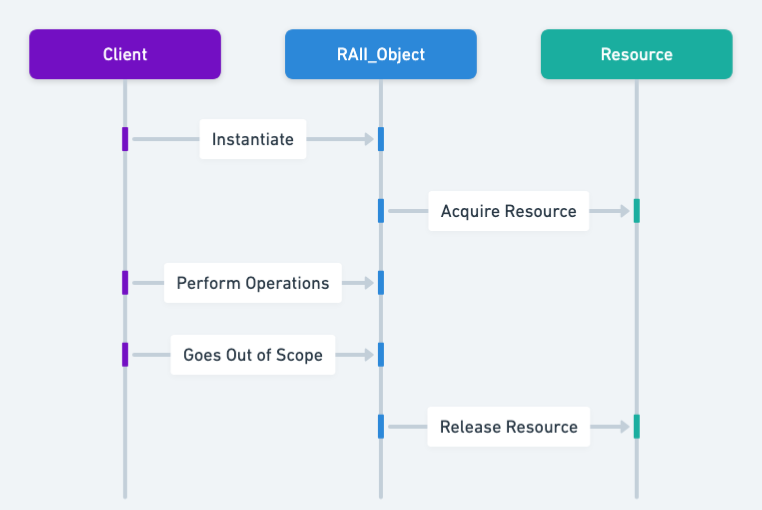
And here's the crucial second part of the idiom: Resource release happens in the object's destructor.
C++ guarantees that for any object created on the stack (a local variable), its destructor will be called automatically when the object goes out of scope. This happens whether the function returns normally, or if an exception is thrown, causing the stack to "unwind." RAII leverages this language feature to ensure resources are always released.
This diagram visualizes the lifecycle:
Exception Safety: The Superpower of RAII
One of the most powerful aspects of RAII is that it makes your code "exception-safe" without extra effort. In languages like Java, you use try...finally blocks to ensure cleanup code runs. In C++, RAII handles this for you.
Let's watch a quick demonstration that proves destructors are called even when an exception occurs.
Classes part 9 - Resource Acquisition is Initialization (RAII) Ep. 45
Mike Shah provides an excellent demonstration of RAII's role in exception safety. He'll create a simple RAII class for memory and show that its destructor is called even when an exception interrupts the normal flow of the program.
Watch from 08:32 to 11:24. Notice how even when an exception is thrown, the destructor for the custom collection object is still called. This process is called 'stack unwinding', and it's the foundation of exception safety in C++.
3. A Core C++ Idiom
Given your background in multiple languages, you might be wondering how RAII compares to concepts like garbage collection or finally blocks. RAII is C++'s unique and powerful answer to resource management.
The following reading from a popular Stack Overflow discussion addresses this directly. It explains why the name is what it is and contrasts RAII with patterns in other languages.
c++ - Understanding the meaning of the term and the concept - RAII ...
The name 'Resource Acquisition Is Initialization' can be a mouthful. This highly-rated Stack Overflow answer does a great job of explaining what it really means and why RAII is so central to C++.
Read the top two answers (by users 'peterchen' and 'paercebal'). Focus on these points: The Name: Why it's not just 'using the stack to trigger cleanup'. The key is acquiring the resource in the constructor. The FileHandle example: It shows how RAII handles complex cases like partial construction failures cleanly. Comparison to Java/C#: The second answer draws a direct parallel to synchronized blocks and explains why C++ doesn't need a finally clause, which should resonate with your background.
4. Applying RAII to Different Resources
The C++ standard library provides several ready-to-use RAII classes for common resources:
- Memory:
std::unique_ptrandstd::shared_ptr(which we'll study next). - Files:
std::ifstream,std::ofstream,std::fstream. When a file stream object is destroyed, the file is automatically closed. - Locks:
std::lock_guard,std::unique_lock,std::scoped_lock.
For resources not covered by the standard library (like a database connection or a C-style API for hardware), you can easily write your own RAII wrapper class, just like the simple collection class in Mike Shah's video. This is a common practice when working on desktop applications or with embedded systems that interface with C libraries.
Resource Acquisition Is Initialization (RAII) in C++ – A Complete Guide
To reinforce the concept, this article provides a good summary of RAII's application across various resource types.
Skim through the sections 'RAII for Memory Safety', 'RAII and File Handling', 'Mutex Locks and Thread Safety with RAII', and 'Custom RAII Wrappers for Specialized Resources'. This will solidify how the same principle is applied to different kinds of resources.
Conclusion
You have now learned about the single most important principle for writing modern, safe C++ code. Moving away from manual resource management and embracing RAII is a huge step forward.
Key Takeaways:
- RAII stands for Resource Acquisition Is Initialization.
- It's a C++ programming idiom that binds the life cycle of a resource to the life cycle of an object.
- A resource is acquired in an object's constructor and released in its destructor.
- RAII leverages C++'s automatic destructor calls for stack-based objects to guarantee that resources are released, even when errors or exceptions occur.
- This makes code significantly safer, cleaner, and easier to reason about, eliminating entire classes of bugs like resource leaks and deadlocks.
- The C++ standard library provides RAII wrappers for common resources like memory (
std::unique_ptr), files (std::fstream), and locks (std::lock_guard).
Next Up
We started this lesson by highlighting the dangers of manual new and delete. Now that you understand the RAII principle, our next lesson will introduce the primary tool for applying it to dynamic memory: std::unique_ptr. You'll learn how to use it for exclusive, automatic resource management, which will almost entirely replace manual new and delete in your code.