Hello! Welcome back to our module on modern C++ resource management.
In our last lesson, we explored the Resource Acquisition Is Initialization (RAII) principle. We learned how binding a resource's lifetime to an object's scope provides a powerful, automatic, and exception-safe way to manage resources like files and locks.
Today, we will apply this fundamental principle to its most common use case: managing dynamically allocated memory. You will learn to use std::unique_ptr for exclusive, automatic resource management. By the end of this lesson, you will be able to replace most of your manual new and delete calls with a safer, cleaner, and more robust alternative. This is a critical step towards writing modern, professional C++ code.
1. The Dangers of Manual Memory Management
As a quick refresher, manual memory management using raw pointers (new and delete) is a major source of bugs in C and older C++ programs.
- Memory Leaks: Forgetting to
deleteallocated memory. - Double Deletion: Calling
deletemore than once on the same pointer. - Dangling Pointers: Using a pointer after the memory it points to has been deleted.
These issues become especially difficult to manage correctly when a function has multiple exit points or can throw an exception, as we saw with RAII.
Let's watch a short video that brilliantly illustrates how quickly a seemingly simple program using raw pointers can become error-prone.
unique_ptr: C++'s simplest smart pointer
The mCoding channel provides a concise example using a vector of widget pointers to demonstrate the various pitfalls of manual memory management. Pay close attention to the different ways the code can fail.
Watch from 00:39 to 02:40. The video shows how easily memory can be leaked or deleted twice in a typical workflow involving dynamic allocation.
The video clearly shows that tracking who is responsible for calling delete—the concept of "ownership"—is the core of the problem. This is exactly what std::unique_ptr is designed to solve.
2. std::unique_ptr: RAII for Exclusive Ownership
std::unique_ptr is a smart pointer provided by the C++ standard library (in the <memory> header) that applies the RAII principle to a dynamically allocated object. It models exclusive ownership: at any given time, exactly one unique_ptr can own and be responsible for deleting the managed object.
This is the most common and simplest form of ownership. Think of it as a car title: only one person owns the car and is responsible for it.
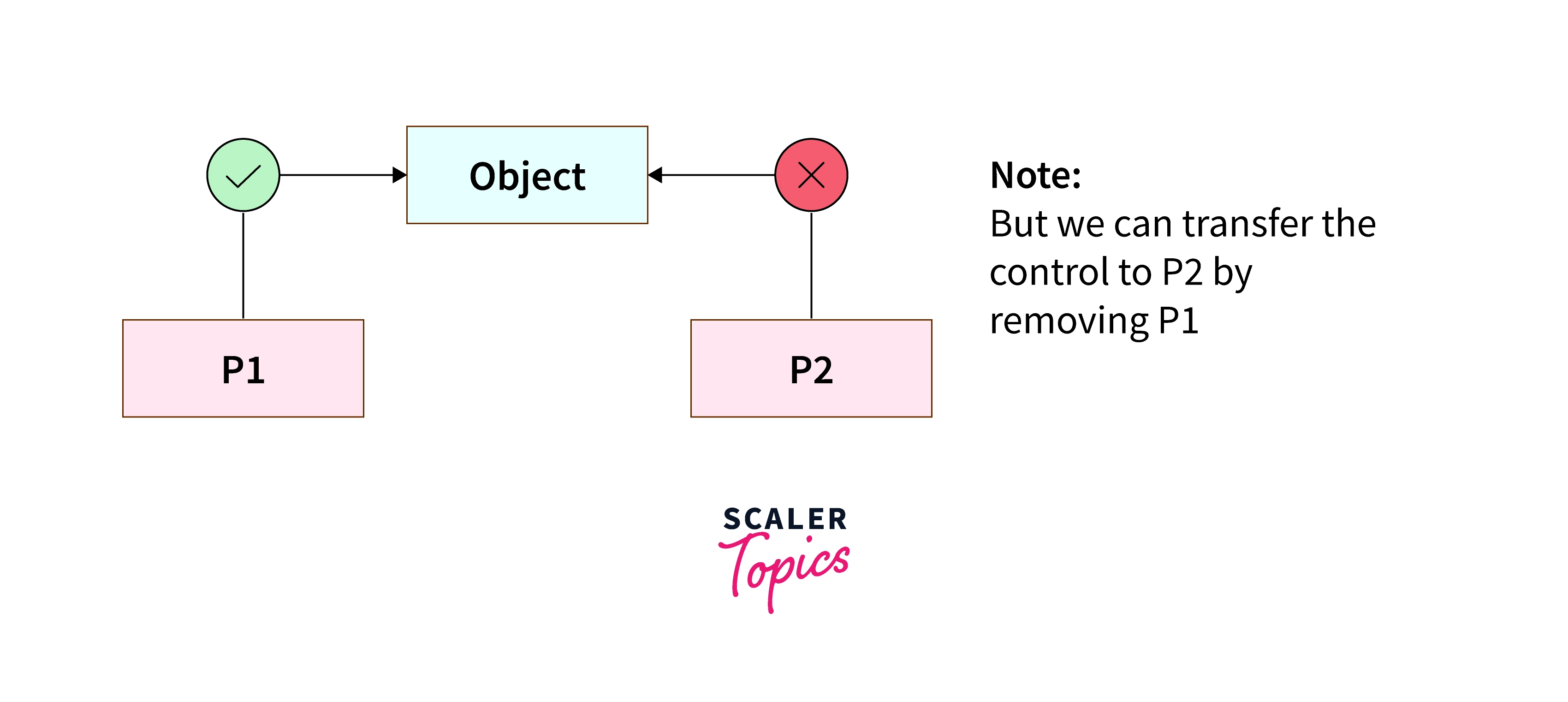
Now, let's see how std::unique_ptr elegantly solves the problems from the previous example.
unique_ptr: C++'s simplest smart pointer
Continuing with the same example, the video now refactors the code to use std::unique_ptr. This demonstrates how smart pointers automate cleanup and prevent common errors.
Watch from 02:40 to 05:15. Notice how the manual delete calls disappear and how the compiler helps prevent bugs by enforcing ownership rules.
As you saw, the code becomes simpler and, more importantly, safer. Let's formalize the key concepts.
Creating std::unique_ptr with std::make_unique
The recommended way to create a std::unique_ptr is with the std::make_unique helper function (introduced in C++14).
#include <iostream>
#include <memory> // Required for std::unique_ptr and std::make_unique

class MyData {
public:
    MyData() { std::cout << "MyData object created.\n"; }
    ~MyData() { std::cout << "MyData object destroyed.\n"; }
    void do_work() { std::cout << "Doing work.\n"; }
};

int main() {
    // Create a unique_ptr that owns a new MyData object.
    // Use `auto` for cleaner code.
    auto ptr = std::make_unique<MyData>();

    // Use the pointer just like a raw pointer.
    ptr->do_work();

} // `ptr` goes out of scope here. Its destructor is called,
  // which automatically calls `delete` on the MyData object.
Why prefer std::make_unique over new?
- Simplicity: It's more concise. You don't have to type the type name twice.
- Exception Safety: It prevents a subtle type of memory leak that can occur in complex expressions.
Accessing the Managed Object
You can interact with the object managed by a std::unique_ptr just as you would with a raw pointer, using the * (dereference) and -> (member access) operators.
Since a unique_ptr can be empty (or nullptr), it's good practice to check if it actually owns an object before trying to use it. A unique_ptr can be implicitly converted to bool for this check.
std::unique_ptr<MyData> ptr; // Creates an empty (null) unique_ptr

if (ptr) {
    ptr->do_work(); // This code won't run
} else {
    std::cout << "Pointer is null.\n";
}
For a detailed walkthrough of these basics, the following reading is an excellent resource.
The popular tutorial site LearnCpp.com has a very clear article on std::unique_ptr. These sections cover the core concepts of creation and access.
Read the introductory section, the section 'Accessing the managed object', and the section on 'std::make_unique'. This will solidify your understanding of the basic syntax and best practices.
3. Transferring Ownership: Move, Don't Copy
The "unique" in unique_ptr is enforced by the type system. A unique_ptr cannot be copied. If you could copy it, you would have two pointers thinking they owned the same object, leading to a double-delete error.
auto ptr1 = std::make_unique<MyData>();
// auto ptr2 = ptr1; // COMPILE ERROR! Cannot copy a unique_ptr.
Instead, ownership must be explicitly moved. When you move from one unique_ptr to another, the source pointer gives up ownership and becomes nullptr. This is where the move semantics we've discussed come into play.
auto ptr1 = std::make_unique<MyData>();
auto ptr2 = std::move(ptr1); // Ownership is transferred to ptr2.

std::cout << "ptr1 is now " << (ptr1 ? "not null" : "null") << '\n'; // Prints "null"
ptr2->do_work(); // ptr2 now owns the object.
This move-only behavior is fundamental to how unique_ptr works in functions.
- Returning a
unique_ptrfrom a function: A factory function that creates an object can safely return aunique_ptrby value. The compiler will automatically use move semantics to transfer ownership to the caller. This is a very common and powerful pattern. - Passing a
unique_ptrto a function:- To transfer ownership to a function, pass the
unique_ptrby value (and the caller must usestd::move). The function now owns the object. - To let a function use the object without taking ownership, pass a raw pointer or a reference. You can get the raw pointer by calling the
.get()method.
- To transfer ownership to a function, pass the
The following reading explains these crucial ownership transfer rules in detail.
Let's return to the LearnCpp.com article to see how move semantics enable safe ownership transfer.
Read the sections explaining move semantics, 'Returning std::unique_ptr from a function', and 'Passing std::unique_ptr to a function'. Focus on the difference between transferring ownership and providing temporary access.
4. Under the Hood (Optional)
You've expressed interest in how things work behind the scenes. std::unique_ptr is a perfect example of a "zero-cost abstraction"—it adds safety at compile time without any runtime performance penalty compared to a raw pointer.
It's actually just a simple class template. Understanding its basic implementation can demystify it completely.
unique_ptr: C++'s simplest smart pointer
The same mCoding video has an outstanding section where the author implements a simplified unique_ptr from scratch. This is a great way to see how the RAII principles are put into practice.
I highly recommend watching this segment from 05:15 to 10:50. He walks through creating the class, adding the destructor to call delete, deleting the copy operations, and implementing the move operations. This will give you a solid mental model of what std::unique_ptr is actually doing.
5. Summary of Best Practices
To effectively use std::unique_ptr, follow these guidelines:
- Use
std::unique_ptrfor exclusive ownership: When you dynamically allocate an object that should have a single, clear owner, usestd::unique_ptr. This is your default choice for smart pointers. - Prefer
std::make_unique: Always preferstd::make_uniqueover a directnewcall to create aunique_ptr. - Transfer ownership via move: Use
std::moveto transfer ownership to anotherunique_ptror to pass it to a function that will take ownership. Returnunique_ptrby value from factory functions. - Use raw pointers for non-owning access: When a function just needs to observe or use the object, pass a raw pointer (
ptr.get()) or a reference (*ptr). - Never manage the same raw pointer with multiple
unique_ptrs: This defeats the purpose of unique ownership and will lead to a crash. Usingstd::make_uniquehelps prevent this mistake. - Don't manually
deletea managed pointer: Never calldelete ptr.get(). Theunique_ptrwill handle this automatically.
Conclusion
You have now learned how to use std::unique_ptr, the workhorse of modern C++ resource management. By embracing it, you can eliminate a whole class of memory-related bugs from your code, making it safer and easier to maintain.
Key Takeaways:
std::unique_ptris an RAII wrapper that enforces exclusive ownership of a dynamically allocated resource.- It automatically deletes the managed object when it goes out of scope, preventing memory leaks.
- It is a move-only type. Ownership is transferred using move semantics (
std::move), not by copying. - Always prefer
std::make_uniquefor creation due to simplicity and exception safety. std::unique_ptris a zero-cost abstraction, meaning it has the same size and performance as a raw pointer.
Next Up
Exclusive ownership is the most common and simplest model, but what happens when a resource needs to be kept alive as long as any one of several objects is still using it? This is a case for shared ownership. In our next lesson, we will explore std::shared_ptr, the C++ tool for managing resources with multiple co-owners.