Welcome back. Last lesson separated an on-ad disclaimer from a public campaign-finance report. Both can identify an organization involved in an ad, but neither necessarily reveals everyone who funded that organization.
This lesson follows one hypothetical donation through a nonprofit intermediary to a super PAC. The central distinction is between the immediate donor named in a report and an earlier source of funds. It will help you read a claim about “dark money” precisely, without assuming either that all political donations are hidden or that all donations are unlimited.
Why the kind of recipient matters
A super PAC is a political committee that makes independent expenditures. It publicly reports its reportable receipts and spending to the Federal Election Commission (FEC). A politically active tax-exempt organization, such as a 501(c)(4) social-welfare group, is not automatically subject to the same political-committee donor-reporting requirements simply because it raises money and sometimes engages in election advocacy. Other reporting requirements can apply to particular activities.
The short video below supplies the basic distinction. Treat it as an overview of federal elections, not as a complete statement of every donor-disclosure rule.
How Do Political Donations Work? | Civics Made Easy
Watch “How Do Political Donations Work?” from PBS for its explanation of super PACs and 501(c) groups.
In the section beginning around 08:32, watch the comparison. Focus on the contrast between a super PAC’s public reporting and a 501(c) group’s different donor-disclosure obligations. The video simplifies those obligations; the readings below provide the qualifications needed for this lesson.
The Congressional Research Service (CRS) explains why that contrast exists. Read its account of which entities fall under campaign-finance reporting rules, then locate its specific example of a 501(c) group giving to a super PAC.
Donor Disclosure: 501(c) Groups and Campaign Spending
Read this CRS account to distinguish a political committee’s reporting duties from those of a 501(c) organization, and to see the intermediary route described explicitly.
In “Disclosing Donors,” start with the paragraph beginning “Most FECA provisions apply to political committees.” Read the committee description, then the paragraph beginning “Crossroads GPS is not a political committee.” Read the group comparison. In “Shift Spending to Other Communications,” find the paragraph beginning “Even if a politically active 501(c) group chose to forgo making IEs as planned”; read its first option. “IE” means independent expenditure.
The CRS discussion does not mean that a 501(c) group can never have a disclosure obligation. It means that its receipt of a donation is not, by itself, the same event as a political committee’s receipt of a reportable contribution. To see why this matters, follow the transactions separately.
Follow a donation, one transaction at a time
Suppose an eligible domestic corporation gives $100,000 to a 501(c)(4) organization. The organization later gives $60,000 to a super PAC. The super PAC pays $40,000 for an independent ad supporting a federal candidate. Assume the contributions are lawful, the ad is genuinely independent, and the relevant reporting requirements are met.
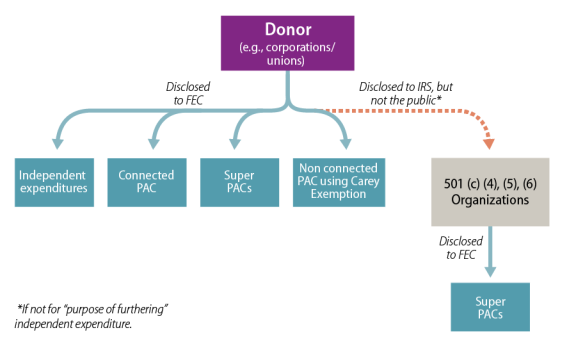
The image below depicts several possible paths for political money. Concentrate on the path at the right: a donor gives to a 501(c) organization, which then gives to a super PAC. It is a 2016 illustration, useful for understanding the route rather than for determining every current filing requirement.
Now view the hypothetical from three places where a member of the public might look:
| Where you look | What this hypothetical can show | What it does not establish by itself |
|---|---|---|
| The ad’s disclaimer | The super PAC paid for the ad and it was not authorized by a candidate or candidate’s committee. | Who funded the super PAC or its donors. |
| The super PAC’s FEC report | The reportable $60,000 receipt from the 501(c)(4) organization, alongside its reportable spending. | That the original corporation will also be listed as the super PAC’s donor. |
| Information about the 501(c)(4) | Information required by any rules applicable to that organization and its activities. | A guaranteed public, transaction-by-transaction list linking every incoming donor to every outgoing contribution. |
The super PAC received money from the 501(c)(4). Reporting that receipt truthfully identifies its immediate, or proximate, donor. It does not automatically identify the corporation that gave to the 501(c)(4). Compare a direct $60,000 contribution from the eligible corporation to the super PAC: on that simpler path, the corporation itself would be the immediate donor in the super PAC’s report.
There is another reason to avoid overreading the numbers. The 501(c)(4) might have received funds from many sources and paid many expenses. Even knowing that it received $100,000 from the corporation and later gave $60,000 to the super PAC would not, without more information, prove that particular dollars from the corporation funded that contribution. A path of possible financial support is not always a trace of earmarked dollars.
This is the precise disclosure gap the example illustrates: a publicly reported transaction at the last link does not necessarily make every earlier link public. It does not establish that a hidden donor exists in every case, that a filing is false, or that using an intermediary excuses an otherwise prohibited contribution.
What federal regulators have—and have not—said about tracing
A 2024 Federal Register notice presents the issue in unusually direct terms. It recounts a petition asking the FEC to require disclosure of the original source of election-related funds through intermediary organizations, rather than stopping at a political committee’s proximate source. Importantly, the petition’s claims are the petitioners’ argument; the notice then gives the Commission’s response.
Federal Register :: Contributions From Corporations and Other Organizations to Political Committees
Read this Federal Register notice to separate a proposal for comprehensive source tracing from the FEC’s account of its existing authority.
Under “SUPPLEMENTARY INFORMATION,” find the paragraph beginning “The Petition argued that for disclosure requirements to be effective.” Within it, read the petitioners’ claim about intermediary corporations. Then find the later paragraph beginning “First, and most significantly, the Commission lacks the statutory authority.” Read from “Nor does the Act require such entities to disclose” through the FEC’s conclusion. Notice the difference between describing a disclosure gap and claiming that the FEC can close it by regulation alone.
The FEC declined that proposed rulemaking, saying it lacked statutory authority to impose the petition’s sweeping requirement to trace all such funds through all intermediary entities to a natural person. That is narrower than saying “no disclosure applies to nonprofits.” Particular spending, contributions, or circumstances can trigger their own rules. Nor does a public-reporting gap authorize a prohibited source to route money indirectly into federal elections.
The lesson’s hypothetical therefore has a careful answer. The super PAC’s report can disclose its $60,000 contribution from the 501(c)(4) while leaving a reader unable to identify from that report alone the corporation that earlier funded the 501(c)(4). Whether other records reveal more depends on the facts and the applicable rules.
What to carry forward
When tracing election money, identify each recipient and each transaction before deciding what a disclosure reveals. An ad disclaimer identifies the ad’s payor; a super PAC report identifies its reportable immediate contributors; neither automatically supplies the complete history of money received by an intermediary. At the same time, “not visible in this report” is not the same as “unregulated” or “never disclosed.”
The next lesson turns from what a disclosure rule reveals to whether a proposed rule requiring more information is constitutional. It will examine the scrutiny courts apply and why a desire for more tracing does not, on its own, settle the First Amendment question.