Hello! Welcome to the third and final lesson in our first module on Core Concepts for AI in Sales.
In our previous lessons, we covered the foundational economics of AI models and the strategic trade-offs between using open-source and closed-source systems. You now have a framework for deciding which type of model an enterprise might choose. Today, we'll explore how these models are put to work to automate business processes.
Our learning outcome is to differentiate between deterministic AI workflows and autonomous AI agents with sales-specific examples. This distinction is fundamental. It's the difference between giving an AI a rigid script to follow and giving it a goal to achieve on its own. Understanding this will be critical as you begin to design and deploy AI-powered solutions to enhance your sales effectiveness.
1. Two Flavors of Automation: The Script vs. The Strategist
At its core, all automation involves getting a machine to perform a task. However, the way AI approaches this can differ dramatically. To set the stage, let's look at a simple visual distinction.
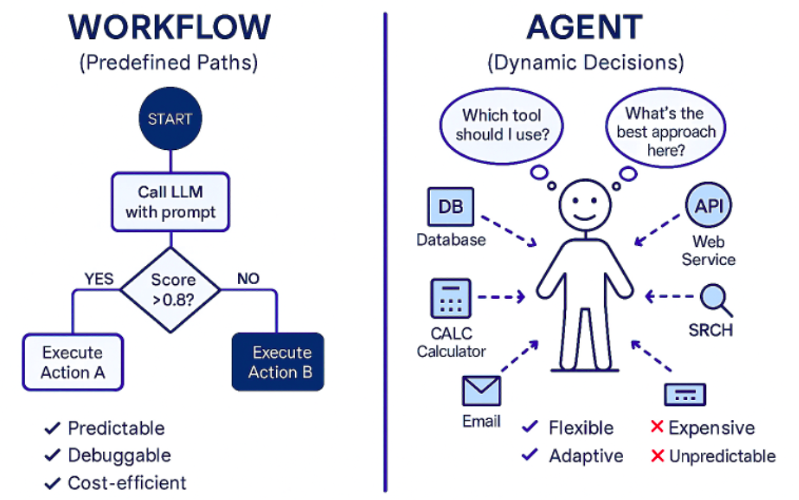
On one side, you have the AI Workflow: a predictable, step-by-step process, like following a recipe. The path is predefined. On the other side, you have the AI Agent: a dynamic system that acts more like a chef. It has a goal (e.g., "make a delicious meal"), access to ingredients and tools (a pantry and kitchen), and it decides the steps for itself.
Let's dive deeper into what this means in a business context.
Most Companies Are Choosing the Wrong AI Agent
To formalize this distinction, please read this short introductory section from the article 'Most Companies Are Choosing the Wrong AI Agent'. It clearly frames the spectrum from deterministic to autonomous systems.
Read the section titled 'The Question Nobody’s Asking'. Focus on the definitions of deterministic and autonomous agents.
Now, let's break down each of these concepts with examples directly relevant to your work as an Account Executive.
2. Deterministic AI Workflows: The Reliable Assembly Line
A deterministic AI workflow executes a predefined sequence of steps. You might also hear this called "workflow automation" or, in older contexts, "Robotic Process Automation (RPA)". The key feature is predictability: the same input will always produce the same output, following the exact same path.
Most Companies Are Choosing the Wrong AI Agent
The same article, 'Most Companies Are Choosing the Wrong AI Agent', has an excellent section that highlights the value and characteristics of these systems. It's important to see them not as a lesser form of AI, but as the right tool for many jobs.
Now, read the section 'Deterministic Agents: The Unsung Heroes of Real-World AI'. Note the characteristics and the types of tasks where these workflows excel.
As the article notes, these workflows are the backbone of most real-world AI deployments today because they are reliable, auditable, and safer for high-stakes, low-variability tasks.
Sales Example: The AI Research Assistant
Imagine you have an important meeting tomorrow. You need a briefing document. A deterministic workflow would be perfect for this.
To see this in action, let's look at Microsoft's "Sales Chat" agent. While they call it an "agent," its function in this context is a classic deterministic workflow.
Microsoft’s New AI Sales Agents Explained
This video from Lisa Crosbie explains two new Microsoft tools. We'll focus on the first one, 'Sales Chat', which exemplifies a deterministic workflow.
Watch from 0:54 to 04:21. Notice how the user gives a specific command ('show me an account summary' or 'help me prepare for a meeting'), and the system follows a fixed set of steps to gather information from the CRM, documents, and emails to produce a structured output.
The process is fixed:
- Input: User prompts for a meeting prep document.
- Step 1: Query the CRM for account details and pipeline status.
- Step 2: Query Outlook and Teams for recent emails and meeting transcripts.
- Step 3: Query internal files for relevant documents (e.g., SOWs, presentations).
- Step 4: Synthesize all retrieved information into a summary.
- Output: Present the summary to the user.
This workflow is powerful and efficient, but it doesn't make strategic decisions. It simply executes a predefined script.
3. Autonomous AI Agents: The Digital Teammate
Autonomous agents represent a paradigm shift. Instead of giving the AI a script, you give it a goal, tools, and the autonomy to figure out the steps. An agent operates in a continuous loop: it perceives the situation, reasons, creates a plan, acts on that plan, and then reflects on the outcome to decide what to do next.
Most Companies Are Choosing the Wrong AI Agent
Let's return one last time to the article 'Most Companies Are Choosing the Wrong AI Agent' to define the capabilities of autonomous agents.
Read the section 'Autonomous Agents: Powerful, But Not a Silver Bullet'. Focus on the description of their operational cycle (perception, reasoning, planning, action) and the types of variable scenarios where they shine.
The power of autonomous agents lies in their ability to handle variability and complexity—the messy, unpredictable situations where a rigid workflow would break.
Sales Example: The AI Lead Qualifier
Now, let's look at the second tool from the Microsoft video, the "Sales Agent." This is a true autonomous agent.
Microsoft’s New AI Sales Agents Explained
Continuing with the same video, we'll now see a system designed for autonomous action.
Watch from 04:21 to 08:43. Pay close attention to how this agent works independently in the background. It doesn't just follow a script; it interacts with a customer, asks clarifying questions, provides information, and decides when to alert the human seller. This is autonomy in action.
The process is dynamic and goal-oriented:
- Goal: Qualify inbound leads.
- Tools: Access to email, CRM, product documentation, web search.
- Action:
- A new lead from a "Contact Us" form arrives.
- The agent plans to engage the lead. It decides to send an email asking about their budget and use case.
- The lead replies. The agent perceives the new information, reasons that the lead is a good fit, and decides to provide a quote from the product documentation.
- The agent also perceives that the lead's company has a past deal history in the CRM. It decides this is a high-priority signal and plans to alert you.
- It acts by sending you a proactive alert with a summary of its research.
Notice the decision-making verbs: plans, decides, reasons, perceives. The agent isn't following a fixed path; it's dynamically creating the path to achieve its goal.
To see what this dynamic planning looks like under the hood, this next video provides a fantastic technical demonstration.
[EXPLAINED🍄] AI Agents vs. Workflows
This video by Sabrina Ramonov contrasts a hard-coded workflow with an AI agent for a customer support task. The principles are directly applicable to sales.
Watch from 06:27 to 10:09. You'll see the AI agent being given a simple natural language goal like 'cancel subscription and refund last charge'. Then, by looking at the execution logs, you can see how the agent itself created a multi-step plan (get customer, cancel sub, get charges, issue refund) by selecting the right 'tools' (API calls) in the right order. This is the core of how agents 'think'.
4. Comparison and The Right Tool for the Job
So, when should you use a workflow versus an agent? It's not about which is "better," but which is appropriate for the task.
This table gives a concise summary of the differences.

For you, as an AE who will be designing and perhaps selling these solutions, knowing when to propose which approach is key. The article "The Definitive Guide: Understanding AI Agents vs. AI Workflows" provides an excellent framework for this decision.
The Definitive Guide: Understanding AI Agents vs. AI Workflows
This guide from Relevance AI details three scenarios where agentic automation is not just an option, but a necessity. The sales-specific examples are particularly insightful.
Read the section titled 'The three scenerios where you have to use agentic automation'. Pay close attention to the sales example under 'Dynamic lead scoring' and 'Multi-channel customer relationship management'.
Based on this and our other resources, here is a simplified decision framework:
-
Task Complexity & Variability:
- Low (e.g., sending a notification when a deal closes): Use a deterministic workflow. It's simple and reliable.
- High (e.g., dynamically scoring leads based on dozens of changing signals): An autonomous agent is required to handle the complexity.
-
Risk & Regulation:
- High (e.g., generating an official invoice or handling financial data): The auditability and predictability of a deterministic workflow are essential.
- Low (e.g., drafting a first-pass outreach email for you to review): An autonomous agent can provide creative, adaptive outputs where mistakes are not catastrophic.
-
The Hybrid Reality: "Bounded Autonomy"
In sophisticated enterprise systems, you'll rarely find a purely autonomous agent running wild. The most effective approach is often a hybrid one, what some call "bounded autonomy."- An autonomous agent might analyze a prospect and decide the best strategy is to send them a specific case study.
- A deterministic workflow then takes over to ensure the email template is brand-compliant, includes the correct legal disclaimers, and logs the interaction properly in the CRM before sending.
This combines the strategic intelligence of agents with the safety and reliability of workflows.
Conclusion
You have now completed the first module of your course, building a solid conceptual foundation. You understand the economics of AI models, the strategic choice between open and closed systems, and now, the critical difference between scripted workflows and intelligent agents.
Key Takeaways:
- Deterministic AI Workflows follow a fixed, predefined script. They are predictable, reliable, and best suited for high-volume, low-variability tasks where auditability is key. Think of them as an assembly line.
- Autonomous AI Agents are given a goal and a set of tools, and they dynamically plan their own actions. They excel at complex, high-variability tasks that require reasoning and adaptation. Think of them as a strategic teammate.
- The choice between them is not about which is "smarter," but which is the right tool for the job, based on factors like task complexity, risk, and variability.
- Advanced systems often use a hybrid approach, leveraging agents for strategic decision-making within the safe confines of deterministic guardrails.
Preview of the Next Lesson:
With this conceptual foundation firmly in place, we are now ready to get practical. The next module, Foundational Prompt Engineering, will teach you how to instruct and control these AI systems. Our first lesson will focus on how to write effective system prompts to define an AI's persona, tone, and objectives for a sales context—the very first step in bringing any AI workflow or agent to life.