Hello! Welcome to the first lesson in your personalized AI course.
Given your goal of mastering AI for your sales role, we'll start by building a solid foundation. To effectively build and sell AI solutions, you need to understand not just what the technology can do, but also the economic and performance levers that drive its real-world application. This lesson focuses on the core mechanics that determine the cost and capability of any text-based AI system.
Today, we will be tackling the first learning outcome: Explain the business implications of context windows, tokenization, and inference costs. We will explore:
- Tokenization: The process of breaking down text into units that models can understand, and how this directly impacts cost.
- Context Windows: The "working memory" of an AI model, and the critical trade-offs between size, performance, and price.
- Inference Costs: The real-world cost of generating a response, and how strategic choices can dramatically impact the ROI of an AI-powered sales tool.
By the end of this lesson, you'll be able to analyze an AI use case from a cost-benefit perspective, a crucial skill for both using AI effectively and discussing its value with enterprise clients.
1. From Words to Currency: The Role of Tokens
You've mentioned you're already familiar with tokens and the rough "0.75 words per token" rule. That's a great start. Now, let's refine that understanding and connect it directly to business costs.
Tokens are the fundamental unit of work for an LLM. Everything—your instructions, the documents you provide, the conversation history, and the model's final output—is measured and billed in tokens.
To see how this works in practice, please watch the following clip.
What is a Context Window? Unlocking LLM Secrets
This video from IBM Technology provides a clear explanation of what tokens are and how a 'tokenizer' converts text into these units. Pay close attention to how the same letter 'a' can be tokenized differently based on its context.
Watch the segment from 2:45 to 5:53.
As the video explains, tokenization isn't standardized. The same sales report might result in 1,000 tokens for OpenAI's GPT-4o but 1,200 tokens for another model. This variance is a subtle but important factor in total cost when you're processing documents at scale.
Input vs. Output Tokens: A Critical Distinction
The most important business implication of tokens is how they are priced. Providers don't just charge for the total number of tokens; they differentiate between input tokens (the text you send to the model) and output tokens (the text the model generates for you).
Understanding LLM Cost Per Token: A 2026 Practical Guide
This article from Silicon Data provides a deep dive into LLM costs. We'll use it throughout this lesson. For now, focus on how it explains the different billing categories for tokens.
Read the section titled 'The Three Token Types That Matter in 2026'. It begins right after the first table and cost analysis.
As the article highlights, output tokens are consistently more expensive—often 4x to 8x the price of input tokens.
-
Why? Processing input can be done in parallel, making it computationally cheaper. Generating output is a sequential, one-token-at-a-time process, which requires more GPU time and energy.
-
Business Implication: For a sales use case, this means an AI agent that summarizes a long RFP (many input tokens, few output tokens) will have a very different cost profile from one that generates a detailed, multi-page proposal (few input tokens, many output tokens). Understanding this input/output cost ratio is key to forecasting the budget for any AI project.
2. The AI's Working Memory: Context Windows
Now that we know how text is measured, let's discuss how much text a model can handle at once. This is defined by its context window.
Let's start with a foundational video.
What is a Context Window? Unlocking LLM Secrets
This clip, also from IBM Technology, uses a great analogy to explain the context window as the model's 'working memory' and shows what happens when a conversation exceeds it. It also lists the different types of information that fill this window.
Watch the first part from 0:00 to 2:45, and then the segment from 7:23 to 8:53.
In a sales context, that window might contain:
- System Prompt: "You are an expert sales assistant for a B2B SaaS company..."
- Retrieved Documents: The prospect's LinkedIn profile, their company's latest 10-K report.
- Conversation History: The last three emails exchanged with the prospect.
- Your Query: "Draft a follow-up email mentioning their recent product launch."
- The Model's Response: The generated email draft.
All of this must fit within the model's token limit.
The "Bigger is Better" Myth: Trade-offs of Large Context Windows
Modern models from Google, Anthropic, and OpenAI now boast massive context windows, some up to 2 million tokens (around 1.5 million words). While this seems revolutionary, it comes with significant business trade-offs.
Please watch this final clip from the IBM video, which discusses the challenges of larger context windows.
What is a Context Window? Unlocking LLM Secrets
This segment explains the downsides of large context windows, which are critical for making smart business decisions.
Watch the section from 8:53 to 11:18.
The video highlighted three key challenges:
- Quadratic Compute Cost: Doubling the context length can quadruple the processing power required. This translates directly to higher latency (slower responses) and higher operational costs.
- Performance Degradation: Models can get "lazy" with too much information. A famous problem is "lost-in-the-middle," where the model pays less attention to information buried in the center of a very long document.
- Safety & Security: A larger input provides a larger "attack surface" for bad actors to try and manipulate the model.
This image provides a helpful visual summary of how to think about choosing a model based on your needs.
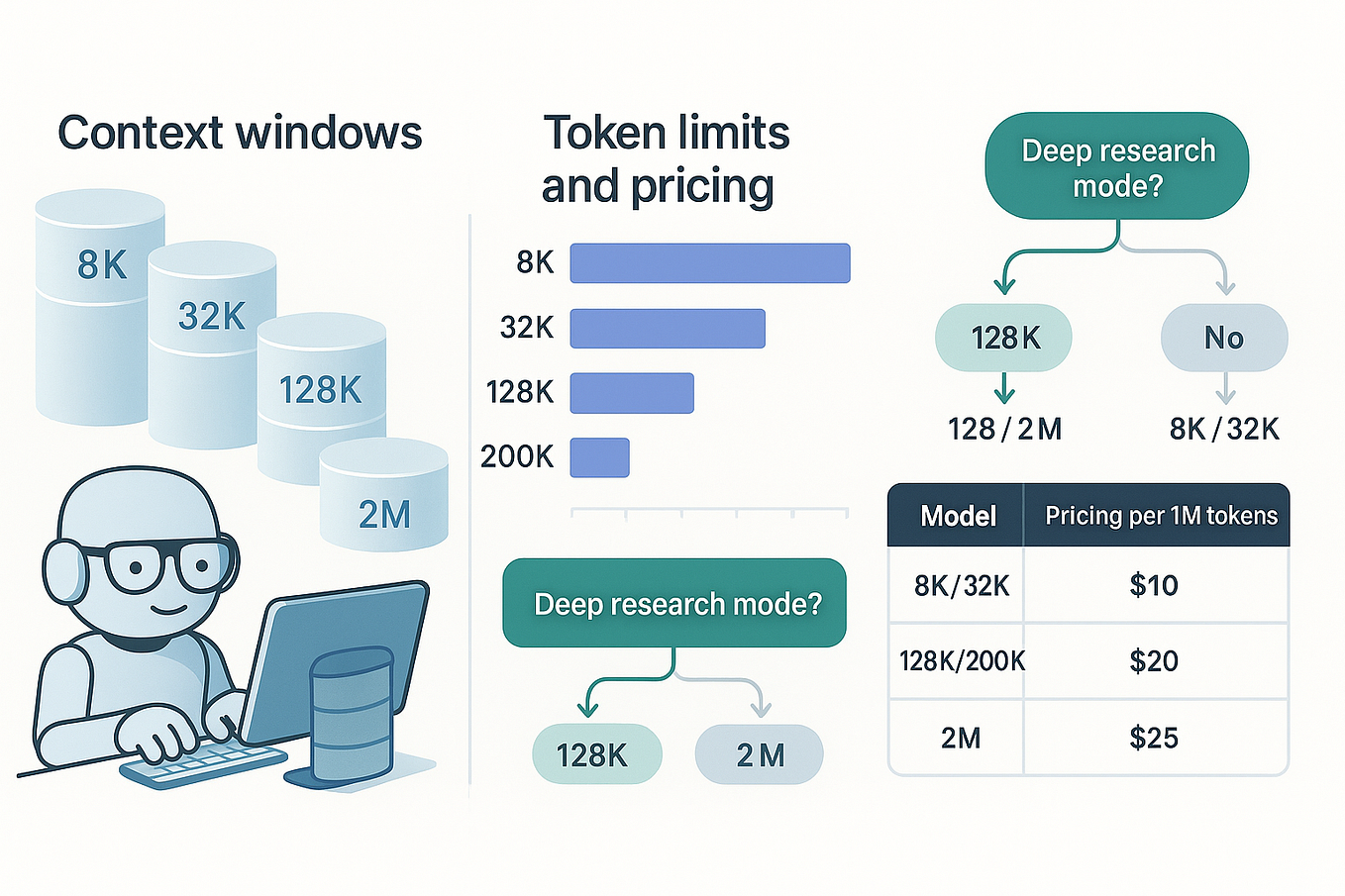
For a practical breakdown of these trade-offs, let's turn to a technical but highly informative article.
LLM context windows: what they are & how they work - Redis
This article from Redis compares large and small context windows across several business-critical dimensions. The table in this section is one of the most important takeaways of this lesson.
Read the section titled 'Large context windows vs small context windows' and pay close attention to the comparison table.
Putting it into practice:
- When to use a large context window: Analyzing a 100-page RFP to find all mentions of "security compliance." The task requires understanding the entire document. You can tolerate a slower response and higher cost for this high-value, offline task.
- When to use a small context window: Powering a real-time sales chatbot on your website to qualify leads. Here, low latency and low cost per interaction are paramount. It's better to use a faster, cheaper model and manage memory intelligently (e.g., by summarizing the conversation as it goes).
3. The Bottom Line: Understanding and Managing Inference Costs
Inference is the process of using a trained model to generate a response. The cost associated with this process is the inference cost. For any business operationalizing AI, this is the most significant ongoing expense.
This visual starkly illustrates the massive cost differences between different tiers of models.
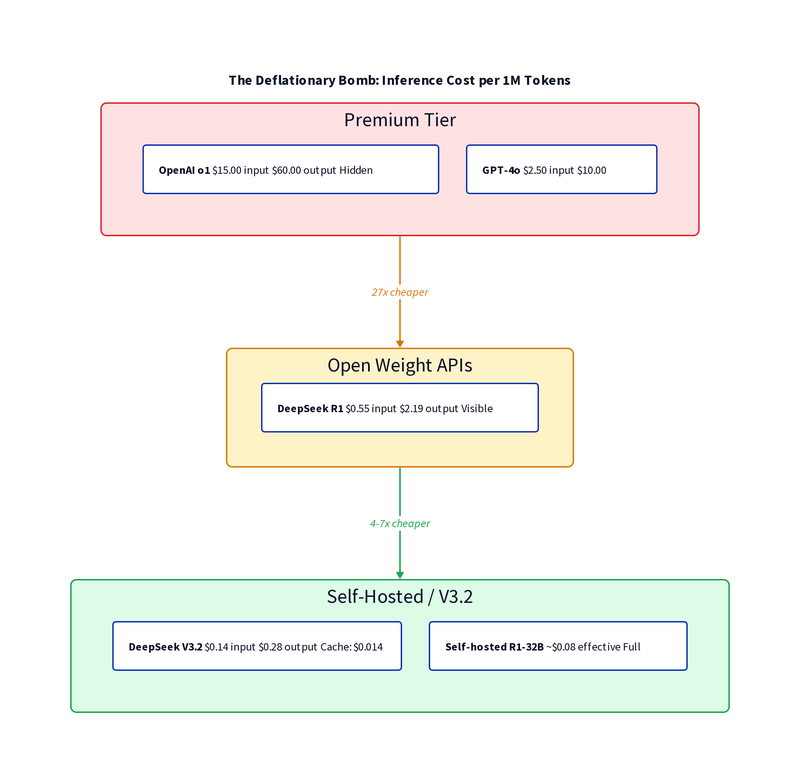
To understand how these costs are calculated in a real-world scenario, we'll return to the Silicon Data article. It uses a support ticket example, but we can easily adapt it to a sales workflow.
Understanding LLM Cost Per Token: A 2026 Practical Guide
This is the most critical part of our lesson. This article provides a clear, data-driven breakdown of how token costs translate into real-world application costs and, most importantly, how to manage them.
First, read the section 'Understanding Real-World Token Spend' to see a cost-per-ticket breakdown. Then, read 'Strategies for Reducing Token Costs' and 'Strategic Model Mixing' to learn how to control these costs.
A Sales Use Case: Automated Prospect Research
Let's apply the article's logic. Imagine an AI agent that researches 1,000 prospects. For each prospect, the workflow is:
- Input: System prompt (300 tokens) + LinkedIn Profile (1,500 tokens) + 2 recent news articles (1,200 tokens) = 3,000 input tokens.
- Output: A 150-word personalized email draft (200 output tokens).
Using the 2026 pricing from the article's table for GPT-4o Mini ($0.15/1M input, $0.60/1M output):
- Input cost:
(3000 / 1,000,000) * $0.15 = $0.00045 - Output cost:
(200 / 1,000,000) * $0.60 = $0.00012 - Total cost per prospect:
$0.00057 - Cost for 1,000 prospects: $0.57
Now, let's run the same workload on GPT-5.2 Pro ($21/1M input, $168/1M output):
- Input cost:
(3000 / 1,000,000) * $21 = $0.063 - Output cost:
(200 / 1,000,000) * $168 = $0.0336 - Total cost per prospect:
$0.0966 - Cost for 1,000 prospects: $96.60
The cost is over 160 times higher for the premium model. This is the economic reality of deploying AI.
The key takeaway, as highlighted in the article, is that you don't need the most expensive model for every task. Intelligent routing—using a cheap, fast model for 90% of tasks and escalating only the most complex 10% to an expensive model—is the secret to building cost-effective and scalable AI solutions.
Conclusion
In this lesson, we've unpacked the core economic drivers of large language models. You now have a framework for analyzing the business implications of any AI-powered text generation task.
Key Takeaways:
- Tokens are the currency of AI. Pricing is split between cheaper input tokens and more expensive output tokens, a crucial detail for budgeting.
- Context windows are a strategic trade-off. Larger windows enable powerful full-document analysis but come at the cost of higher latency, higher prices, and potential performance issues like "lost-in-the-middle."
- Inference cost is manageable. The dramatic price differences between models mean that choosing the right model for the job is the most important factor in building a cost-effective AI system. Techniques like intelligent routing are essential for scaling AI in an enterprise setting.
Preview of the Next Lesson:
Now that we understand the core technical and economic constraints, our next lesson will address a major strategic decision when building or buying AI solutions: Open-Source vs. Closed-Source Models. We will explore the trade-offs in terms of cost, performance, security, and customization, giving you the knowledge to advise clients and make informed decisions for your own sales workflows.