Welcome to your next lesson in our journey to become practical neuroscientists. In our last session, we explored the world of neurotransmitters, the chemical messengers that influence your mood, motivation, and focus. We saw that you can support this delicate chemical balance through lifestyle choices. Today, we're zooming out from the day-to-day chemical signals to look at the deeper blueprint that shapes your very tendencies and temperament: your genetics.
This lesson tackles the age-old question of "nature versus nurture." But instead of treating them as opposing forces, we'll see them as intimate collaborators. Our learning outcome is to reflect on how genes and environment interact to shape your own habits, temperament, and choices. We'll discover that your genes tell a story of potential, while your environment and experiences provide the edits, highlights, and annotations. The fascinating mechanism that makes this dialogue possible is called epigenetics, and understanding it gives you a powerful new lens through which to view your own development and potential for change.
1. The Genetic Blueprint: Dispositions, Not Destiny
It's undeniable that our genes play a significant role in who we are. They lay the groundwork for our physical traits, and as research increasingly shows, they also influence our psychological landscape—our personality, our preferences, and even the hobbies we're drawn to.
However, it's crucial to think of this genetic influence not as a rigid set of instructions, but as a collection of tendencies or dispositions. To explore this nuanced relationship between our DNA and our daily lives, let's turn to an insightful article from the BBC's Future series.
How genetics determine our life choices
This article provides an excellent, accessible overview of how modern genetics research is revealing the links between our genes and complex behaviors, while also highlighting the crucial role of the environment.
Please read from the beginning of the article through the end of the section just before "The genetics of love." As you read, focus on these key points: The introduction, which frames the central question. The idea that our DNA, plus our environment, shapes who we are. The examples of how genetics can influence preferences and hobbies. How genes contribute to broader personality traits like extroversion and impulsivity. The most important concept: the clear statement that DNA is not destiny and that our environment plays a massive role.
The key takeaway from this reading is that while your genes might give you a nudge toward being a risk-taker, or make you more sensitive to the bitterness of coffee, they don't force your hand. They load the gun, but the environment often pulls the trigger. This brings us to the central question: if genes aren't the whole story, how exactly does the environment exert its influence?
2. Epigenetics: How Experience Rewrites Your Genes
The bridge between our fixed genetic code (nature) and our dynamic life experiences (nurture) is a field called epigenetics. The prefix "epi-" means "above" or "on top of," and that's exactly what it is: a layer of control on top of your DNA.
Think of your DNA as a massive library of cookbooks (your genes), each with a recipe for a specific protein. Your cells don't need to use every recipe in every cookbook all at once. Epigenetics works like a librarian who walks through the library placing little sticky notes or bookmarks on certain recipes. A "read me!" note makes a gene more likely to be expressed, while a "do not use" note can effectively silence it.
Crucially, your experiences—what you eat, your stress levels, your social interactions, even what your mother experienced while you were in the womb—can influence where those sticky notes are placed. This is how your environment can change your gene expression without changing your genes themselves.
For a compelling and human story of how this works, let's watch a TEDx talk by one of the leading researchers in this field, Moshe Szyf.
Epigenetics - our bodies' way to change the destiny written in our DNA | Moshe Szyf | TEDxBratislava
In this talk, Dr. Szyf masterfully explains the core concepts of epigenetics through powerful stories, from mother rats to human natural disasters.
Please watch the following segments of the video: The Rat Mother Story: This famous experiment shows how a mother's behavior (nurture) physically changes the expression of genes related to the stress response in her pups (nature). Adapting to the World: Here, Dr. Szyf explains the evolutionary purpose of epigenetics—to allow our ancient DNA to adapt to modern environments. The Ice Storm Experiment: This is a powerful human example of how objective stress experienced by pregnant mothers left an epigenetic signature on their children years later. The Optimistic Conclusion: Dr. Szyf's summary reframes DNA not as a fixed script, but as a dynamic, interactive movie that we can influence.
Dr. Szyf's talk powerfully illustrates that our life experiences can leave a physical, chemical mark on our DNA. To solidify this concept with a classic example, let's turn to a more formal explanation.
Epigenetics in Psychology | Noba
This article from the Noba Project provides clear, scientific definitions and further illustrates the concept of gene-environment interaction.
Please read the following sections: The introduction, which provides a great summary definition. The section on gene-environment interactions, which explains how these interactions drive development and plasticity. The section on the dynamic epigenome. Pay close attention to the example of identical twins. This is a perfect illustration of how unique experiences create different epigenetic patterns on the same genetic foundation. The conclusion, which directly ties epigenetics to individual differences in resilience.
The identical twins example is perhaps the most intuitive proof of epigenetics. They start with the same DNA, but as they move through life having unique experiences, their epigenetic markers diverge, leading them to become distinct individuals in temperament, health, and even appearance.
3. Reflection: Your Personal Gene-Environment Story
We've seen that you are a product of an ongoing, dynamic conversation between your genes and your environment. Your genes may have given you a predisposition for patience, a quick temper, a love of routine, or a craving for novelty. But your upbringing, your relationships, your choices, and even random life events helped determine whether those predispositions were amplified, muted, or expressed in completely unexpected ways.
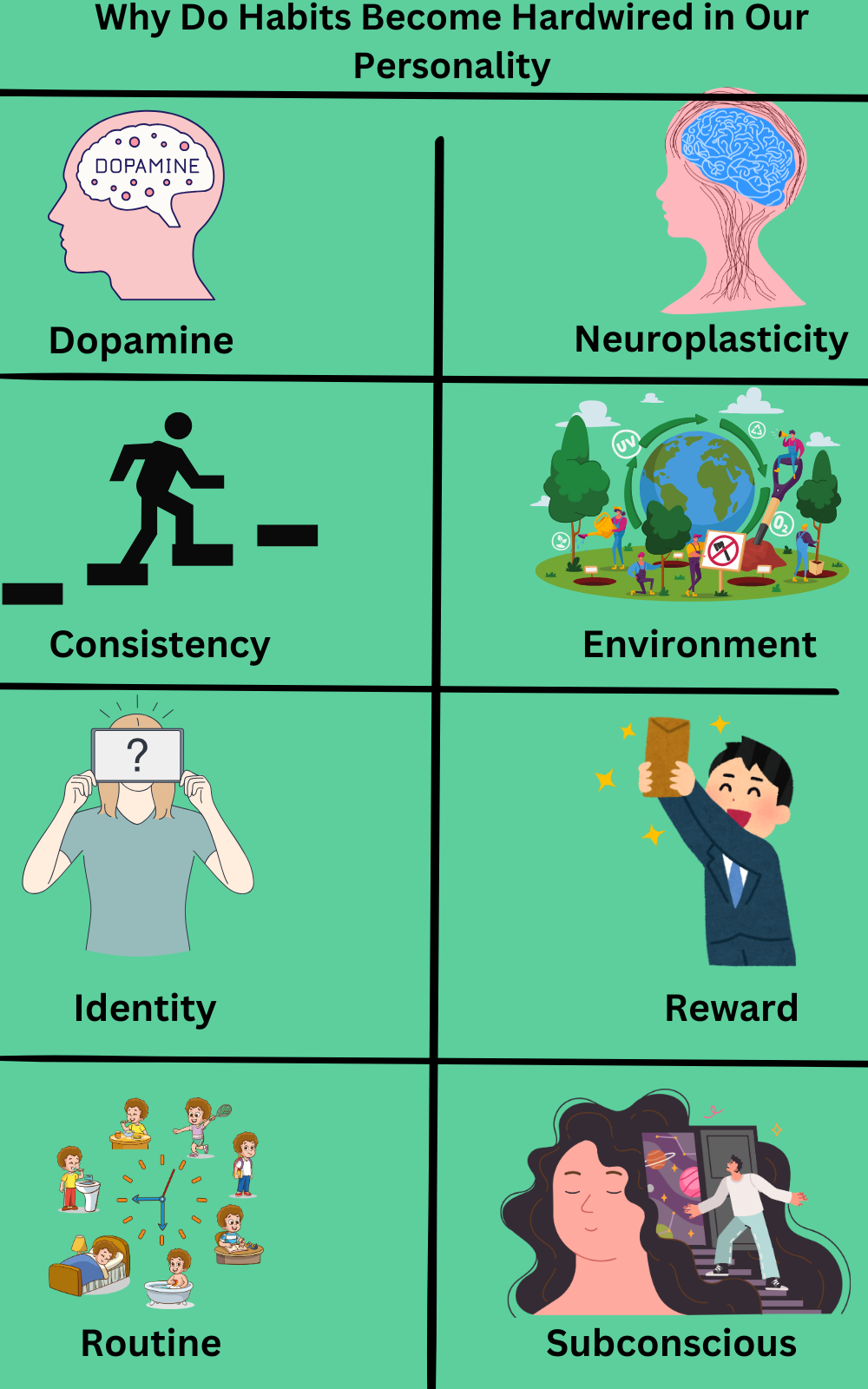
This constant interplay shapes your habits, your temperament, and the very choices you make. Look at the image below. It illustrates how various factors, including your environment and your sense of identity (which is shaped by your life story), contribute to making your habits and personality feel "hardwired." Epigenetics is the biological mechanism underlying much of this process.
For your final task in this lesson, take a few minutes for a structured reflection. Think about one strong aspect of your temperament (e.g., "I'm generally optimistic," "I'm prone to anxiety," "I'm very introverted") or a deeply ingrained habit.
Then, consider the following questions:
- Nature (Genetic Inclination): Can you see any hints of this trait in your family history? Does it feel like a deep, innate part of you that has been there for a long time? (You're speculating, of course, but it's a useful thought experiment).
- Nurture (Environmental Factors): What experiences in your life might have encouraged or strengthened this trait? Think about your childhood, your education, significant relationships, or major life events. Were you in an environment that rewarded this trait?
- The Interaction: How might these genetic nudges and environmental pushes have worked together? Can you imagine how a different environment might have led to a different expression of that same underlying tendency?
This kind of reflection isn't about finding definitive answers but about appreciating the complex and beautiful process that has made you who you are. It also opens the door to a powerful realization: since the environment is a key variable, you have agency to shape your future environment to encourage the traits and habits you value.
Conclusion
In this lesson, we've unraveled the elegant dance between nature and nurture. We've seen that our genetic inheritance is not a deterministic script, but a set of possibilities that are activated and shaped by our life experiences.
Key Takeaways:
- Genes influence our dispositions, preferences, and personality traits, but they do not dictate our destiny.
- The environment—from our mother's womb to our current social world—plays a critical role in determining which genetic potentials are expressed.
- Epigenetics is the molecular mechanism that explains how the environment leaves chemical marks on our DNA, changing gene expression without altering the DNA sequence itself.
- Reflecting on the gene-environment interplay in your own life can provide powerful insights into your habits, temperament, and choices, and empower you to create environments that support your goals.
This understanding of genetics as a dynamic system is crucial for a "practical neuroscientist." It helps us move beyond simplistic explanations for behavior. In our next and final lesson of this foundational module, we will apply this critical thinking to dismantle some common neuro-myths, like the idea that we only use 10% of our brain.