Welcome to the final lesson of our first module, "Your Malleable Brain." Throughout this module, we've laid the groundwork for becoming a "practical neuroscientist" by exploring neuroplasticity, key brain networks, and the chemical messengers that shape our experience. In our last lesson, we saw how genes and environment engage in a complex dance, reminding us that simple answers rarely capture the full picture of human behavior.
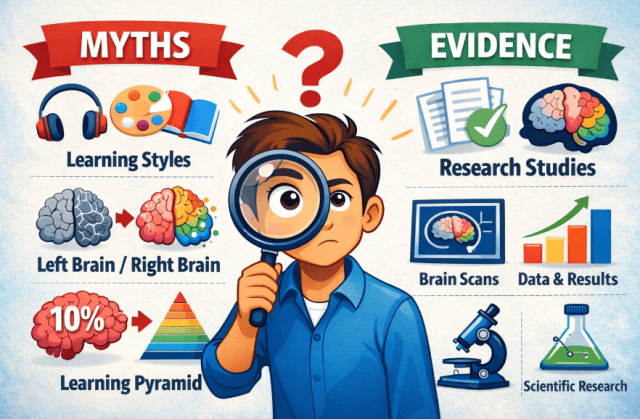
Today, we'll sharpen our critical thinking skills by turning our attention to common myths about the brain. You've likely encountered some of these ideas in movies, books, or online articles. Our goal is to evaluate common neuro-myths (e.g., 'we only use 10% of our brain') against current scientific evidence. Developing a "baloney detection kit" is one of the most practical skills you can have, ensuring that the neuroscience you apply to your daily life is grounded in fact, not fiction.
Let's begin by separating popular myths from scientific evidence.
1. What Are Neuromyths and Why Are They So Popular?
A neuromyth is a common misconception about how the brain works. These ideas are often based on misinterpretations or oversimplifications of genuine scientific findings. They stick around because they feel intuitive, offer simple explanations for complex behaviors, and make for great stories. Think of the film Lucy, which is built entirely on the premise that unlocking the "unused" 90% of our brain would give us superpowers.
While often harmless, these myths can sometimes lead to misguided efforts in education, self-help, and personal development. As someone interested in applying neuroscience for daily living, being able to spot these myths is a crucial first step. Let's examine a few of the most persistent ones.
2. Debunking the Classics: A Myth-by-Myth Takedown
We will now dissect four of the most widespread neuromyths, using the evidence-based lens we've been developing throughout this course.
Myth 1: We Only Use 10% of Our Brain
This is perhaps the most famous neuromyth of all. The idea that 90% of our brain lies dormant, a vast reservoir of untapped potential, is a tantalizing thought. However, the scientific evidence tells a very different story.
To understand why this is a myth, let's watch a clear explanation from Dr. Kevin Jubbal in his video, "7 Brain Myths You Thought Were True."
7 Brain Myths You Thought Were True
This video provides a concise and scientifically-grounded debunking of several key myths. We'll start with the most famous one.
Please watch the section covering the 10% brain myth. Pay close attention to the three main arguments against it: the historical origin of the myth, the brain's energy consumption, and the concept of sparse coding.
As the video explains, this myth falls apart under scrutiny for several reasons:
- Brain Imaging: Technologies like fMRI and PET scans show that there are no "silent" areas of the brain. Even when you are resting or sleeping, your brain is humming with activity. Different tasks activate different networks more intensely, but virtually all of your brain is utilized over the course of a day.
- Energy Consumption: The brain is an incredibly expensive organ. It accounts for only about 2% of your body weight but consumes roughly 20% of your daily energy. From an evolutionary perspective, it would be absurdly inefficient to develop and maintain an organ if 90% of it served no purpose.
- Sparse Coding: While it's true that only a small percentage of neurons are firing at any single moment (1-16%), this is a feature, not a bug. It's an energy-efficient strategy called sparse coding, which allows the brain to process a vast amount of information with minimal energy. The neurons that aren't firing are not useless; they are simply waiting for the right signal, and their silence is just as important for conveying information as the firing is.
To round out this point, the article "Brain Myths: 10 Neuromyths Set Straight" provides a succinct summary.
Brain Myths: 10 Neuromyths Set Straight - Edublox Online Tutor
This article gives a quick overview of why this persistent myth is untrue.
Please read the first section, "You only use 10 percent of your brain". Notice how it directly points to the evidence from brain mapping technology.
Myth 2: Are You "Left-Brained" or "Right-Brained"?
You've almost certainly heard this one: logical, analytical, methodical people are "left-brained," while creative, intuitive, and artistic people are "right-brained." This idea is deeply embedded in popular culture, from personality quizzes to career advice. While it is true that some functions are lateralized (meaning they are primarily processed in one hemisphere), the idea of a dominant hemisphere defining your personality is false.
Let's return to the "7 Brain Myths" video for an explanation.
7 Brain Myths You Thought Were True
The video does an excellent job of explaining the scientific origins of this myth and the reality of how the two hemispheres work together.
Please watch the segment on the left-brain/right-brain myth. Focus on the role of the corpus callosum and the key finding from the original split-brain experiments.
The key insight is that while functions like language production are often centered in the left hemisphere and spatial attention in the right, the two hemispheres are in constant communication via a massive bundle of nerve fibers called the corpus callosum.
Complex activities, especially creative ones, require a seamless integration of both hemispheres. For example, creating a piece of art involves not just the spatial and emotional processing associated with the right hemisphere, but also the fine motor planning and detailed execution often associated with the left. The idea of a logical person and a creative person using different sides of their brain is a gross oversimplification. In healthy individuals, the two halves work as a unified whole.
Myth 3: People Learn Best When Taught in Their "Learning Style"
This is a particularly influential myth, especially in education. The theory suggests that each person has a preferred learning style—most commonly categorized as Visual, Auditory, or Kinesthetic (VAK)—and that learning is most effective when information is presented in that preferred style. It sounds sensible, but there is virtually no scientific evidence to support it.
Brain Myths: 10 Neuromyths Set Straight - Edublox Online Tutor
This article provides a sharp critique of the learning styles myth, highlighting the lack of evidence and potential harm.
Please read section 8, on learning styles. Note the strong statement from neuroscientist Susan Greenfield and the argument that labeling can lead to negative mindsets.
The crucial distinction is between a preference and an effective learning strategy. You might prefer to learn by listening to a lecture, but that doesn't mean it's the most effective way for your brain to encode that information.
So, what does work? The evidence overwhelmingly points to multimodal learning. Engaging multiple senses and processing information in different ways (e.g., reading about a concept, watching a video of it, explaining it to someone else, and applying it in an exercise) creates richer, more robust neural pathways. This approach is effective for everyone, regardless of their stated preference.
Myth 4: The Adult Brain is Fixed and Can't Grow New Neurons
This used to be scientific dogma: you are born with all the brain cells you'll ever have, and it's all downhill from there. This belief can foster a sense of helplessness, suggesting that our cognitive abilities are set in stone. Fortunately, this is one of the most exciting myths to bust, as it directly connects to the central theme of this module: your brain is malleable.
As we discussed in our lesson on neuroplasticity, the brain is constantly changing. But this change isn't just about strengthening or weakening existing connections. The adult brain can, in fact, create new neurons in a process called neurogenesis.
7 Brain Myths You Thought Were True
This final clip from the video will reinforce what we've learned about the brain's capacity for change.
Watch the section that debunks the idea that you can't create new neurons. Pay attention to the factors mentioned that can boost neurogenesis, such as aerobic exercise.
This discovery is profoundly empowering. While neurogenesis is known to occur primarily in specific regions like the hippocampus (a key area for learning and memory), it confirms that the brain is not a static organ. Your lifestyle choices—such as engaging in regular exercise, managing stress, and continually learning new things—can actively support your brain's ability to grow and adapt throughout your life.
Conclusion
In this final lesson of our first module, we've equipped ourselves with a vital tool for any practical neuroscientist: a critical eye for misinformation. By examining the evidence, we've seen how some of the most popular ideas about the brain don't stand up to scrutiny.
Key Takeaways:
- You use your whole brain. The 10% myth is debunked by evidence from brain imaging and the brain's high energy demands.
- The brain is integrated, not divided. The "left-brain/right-brain" personality concept is a myth; complex tasks require constant communication between both hemispheres.
- Multimodal learning is best. The idea of tailoring teaching to fixed "learning styles" is not supported by evidence. Engaging multiple senses is more effective for everyone.
- Your brain is dynamic, not fixed. The adult brain retains the ability to change its structure (neuroplasticity) and even grow new neurons (neurogenesis).
Holding these truths in mind is essential as we move forward. You are now better equipped to distinguish between pop-psychology fads and genuine, applicable science.
This concludes our foundational module. You now have a solid understanding of the brain's core principles. In our next module, "Mastering Focus in a Distracted World," we will begin to apply this knowledge to one of the most critical challenges of modern life. We'll start by exploring how your brain doesn't just passively receive information from the world, but actively constructs your reality from the ground up.